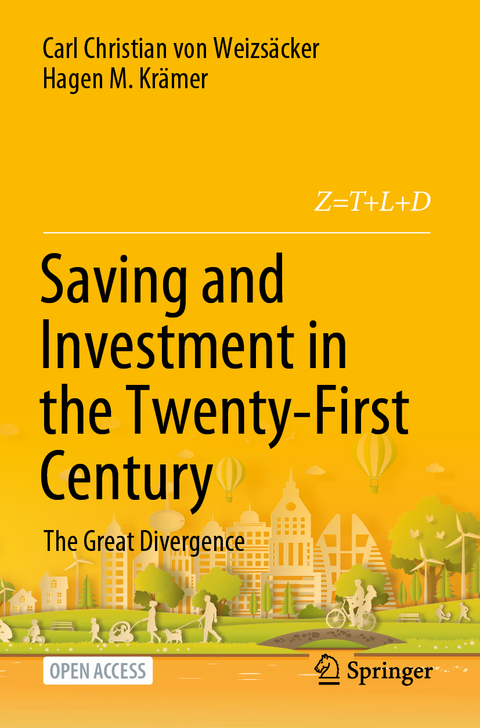
Saving and Investment in the Twenty-First Century
Springer International Publishing (Verlag)
978-3-030-75033-6 (ISBN)
The economy of the 21st century in the OECD countries and in China, is characterized by a new phenomenon: the structural surplus of private savings in relation to private investment. This is true even in a situation of prosperity and very low interest rates. On the one hand, this excess saving is due to people's increasing inclination to save in light of rising life expectancy, driven by the desire to have sufficient assets in old age. On the other hand, the demand for capital is not increasing to the same extent, so that investment is not keeping pace with the rising desire to save. The resulting gap between the private desire for wealth and private investment can only be closed by increasing public debt.
This open access book offers a new, capital-theoretical perspective on the macroeconomic relationship between desired wealth and investment, and it presents new empirical data on private wealth and its composition in the OECD plus China area. The authors arguethat a free economic and social order can only be stabilized if the wealth aspirations of individuals are met under conditions of price stability. This is not possible without substantial net public debt. A new way of thinking about the economy as a whole is required. By way of an in-depth theoretical and empirical analysis, the book demonstrates this new way of thinking and describes the current challenges facing economic policy. It will appeal to economists and students of economics who are interested in macroeconomic theory and its economic policy implications.
An impressive, and convincing theoretical dive into the fundamentals behind secular stagnation, with very strong implications for actual debt policy. Public debt may be needed to improve welfare.
- Olivier Blanchard, Senior Fellow at the Peterson Institute for International Economics and Professor of Economics Emeritus at Massachusetts Institute of Technology (MIT). Chief Economist at the International Monetary Fund from 2008 to 2015.
Saving and Investment in the Twenty-First Century gives a wholly new perspective on macroeconomics. (...) Weizsäcker and Krämer describe a simple, practical solution to the underemployment that has plagued Southern Europe for more than a decade.
- George Akerlof, Nobel Laureate in Economics, 2001. Professor at the McCourt School of Public Policy at Georgetown University and Professor of Economics Emeritus at the University of California, Berkeley.
This is a profound and original contribution that can help us to understand and act on the great issues of our times.
- Nicholas Stern, Grantham Research Institute on Climate Change and the Environment at the London School of Economics. Author of the Stern Review Report on the Economics of Climate Change. Chief Economist at the World Bank from 2000 to 2003.
lt;p> Carl Christian von Weizsäcker received his PhD in 1961 from the University of Basel for a dissertation in which he showed that the optimal rate of interest is equal to the growth rate. Edmund Phelps published the same result also in 1961 and called it the "Golden Rule of Accumulation." Following research visits at MIT and the University of Cambridge, he became full professor of economics in Heidelberg at the age of 27. From 1968 to 1970, he taught as a full professor at the Economics Department of MIT. His students included Robert Merton, Robert Shiller and Stanley Fischer. During these years, he co-authored papers with Paul Samuelson and Robert Solow in the field of capital theory and macroeconomics. Later, Carl Christian von Weizsäcker turned to microeconomic topics: in particular, topics in industrial economics, the economics of telecommunications and energy economics. He developed a theory of adaptive preferences that can serve as a basis for welfare economics beyond the homo economicus. He taught at the universities of Bielefeld, Bonn, Bern and Cologne. Since his retirement from teaching, he has been working at the Max Planck Institute for Research on Public Goods, Bonn (Germany).
Part I: Theory and Empirical Evidence.- Part II: Economic Policy.
| Erscheinungsdatum | 03.06.2022 |
|---|---|
| Zusatzinfo | XXI, 343 p. 26 illus., 22 illus. in color. |
| Verlagsort | Cham |
| Sprache | englisch |
| Maße | 155 x 235 mm |
| Gewicht | 563 g |
| Themenwelt | Wirtschaft ► Volkswirtschaftslehre ► Makroökonomie |
| Schlagworte | Capital supply, capital demand • Demography • Economic Policy • interest rates • Keynesian Economics • Macroeconomics • Neo-Austrian capital theory • open access • private investment • Private savings • Public Debt |
| ISBN-10 | 3-030-75033-7 / 3030750337 |
| ISBN-13 | 978-3-030-75033-6 / 9783030750336 |
| Zustand | Neuware |
| Informationen gemäß Produktsicherheitsverordnung (GPSR) | |
| Haben Sie eine Frage zum Produkt? |
aus dem Bereich