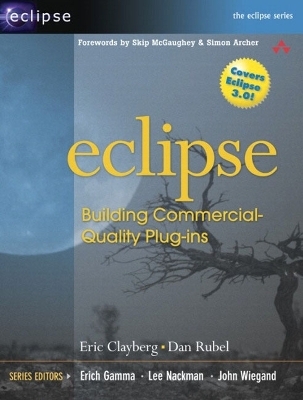
Eclipse
Addison-Wesley Educational Publishers Inc (Verlag)
978-0-321-22847-5 (ISBN)
- Titel erscheint in neuer Auflage
- Artikel merken
The book is focused on providing developers with the definitive resource to
which they can turn for in-depth knowledge and practical solutions to
challenges encountered when extending the Eclipse environment for
commercial use. The authors use a very practical approach to teaching Eclipse.
They begin by introducing the Eclipse development environment, and
outlining the process of building a simple plugin. The rest of the book is
focused on describing each of the various aspects of plugin development and
furnishes in-depth knowledge of how to solve the various challenges involved.
Sometimes a developer needs a quick solution, while at other times that same
developer needs to gain deeper knowledge of a particular aspect of Eclipse
development. The intent is to provide several different ways for the reader to
absorb and use the information so that both needs can be addressed.
About the Authors Eric Clayberg is Senior Vice President for Product Development for Instantiations, Inc. Eric is a seasoned software technologist, product developer, entrepreneur, and manager with more than 15 years of commercial software development experience, including seven years of experience with Java and four years with Eclipse. He is the primary author and architect of more than a dozen commercial Java and Smalltalk add-on products, including the popular WindowBuilder Pro, CodePro Studio, and the award-winning VA Assist Enterprise product lines. He has a Bachelor of Science degree from MIT, an MBA from Harvard, and has co-founded two successful software companies. Dan Rubel is Chief Technology Officer for Instantiations, Inc. He is an entrepreneur and an expert in the design and application of OO technologies with more than 15 years of commercial software development experience, including eight years of experience with Java and four years with Eclipse. He is the primary architect and product manager for several successful commercial products, including JFactor, jKit/GO, and jKit/Grid, and has played key design and leadership roles in other commercial products such as Window-Builder Pro, VA Assist, and CodePro Studio. He has a Bachelor of Science degree from Bucknell and has co-founded a successful company. Instantiations is an Advanced IBM Business Partner and developer of many commercial add-ons for Eclipse and IBM’s VisualAge and WebSphere product lines. Instantiations is a member of the Eclipse Foundation and a contributor to the Eclipse open source effort with responsibility for the Eclipse Collaboration Tools project known as Koi and joint responsibility for the Eclipse Visual Editor project.
Foreword by Skip McGaughey.
Foreword by Simon Archer.
Preface.
1. Using Eclipse Tools.
Getting Started.
The Eclipse Workbench.
Setting up Your Environment.
Creating a Project.
Navigating.
Searching.
Writing Code.
Team Development Using CVS.
Running Applications.
Introduction to Debugging.
Introduction to Testing.
Summary.
2. A Simple Plug-in Example.
The Favorites Plug-in.
Creating a Plug-in Project.
Reviewing the Generated Code.
Building a Product.
Installing and Running the Product.
Debugging the Product.
PDE Views.
Writing Plug-in Tests.
Summary.
3. Eclipse Infrastructure.
Overview.
Plug-in Directory.
Plug-in Manifest.
Plug-in Class.
Plug-in Model.
Logging.
Eclipse Plug-ins.
Summary.
4. The Standard Widget Toolkit.
SWT History and Goals.
SWT Widgets.
Layout Management.
Resource Management.
Summary.
5. JFace Viewers.
List-Oriented Viewers.
Text Viewers.
Summary.
6. Actions.
IAction versus IActionDelegate.
Workbench Window Actions.
Object Actions.
View Actions.
Editor Actions.
Key Bindings.
RFWS Considerations.
Summary.
7. Views.
View Declaration.
View Chapter.
View Actions.
Linking the View.
Saving View State .
Testing.
Image Caching.
Auto-sizing Table Columns.
RFWS Considerations.
Summary.
8. Editors.
Editor Declaration.
Editor Chapter.
Editing.
Editor Lifecycle.
Editor Actions.
Linking the Editor.
RFWS Considerations.
Summary.
9. Resource Change Tracking.
IResourceChangeListener.
Processing Change Events.
Batching Change Events.
Progress Monitor.
Delayed Changed Events.
RFWS Considerations.
Summary.
10. Perspectives.
Creating a Perspective.
Enhancing an Existing Perspective.
RFWS Considerations.
Summary.
11. Dialogs and Wizards.
Dialogs.
Wizards.
RFWS Considerations.
Summary.
12. Preference Pages.
Creating a Preference Page.
Preference Page APIs.
Preference APIs.
RFWS Considerations.
Summary.
13. Properties.
Creating Properties.
Displaying Properties in the Properties Dialog.
Displaying Properties in the Properties View.
Property Pages Reused as Preference Pages.
RFWS Considerations.
Summary.
14. Builders, Markers, and Natures.
Builders.
Markers.
Natures.
RFWS Considerations.
Summary.
15. Implementing Help.
Using Help.
Implementing Help.
Context-Sensitive “Infopop” Help (F1).
Accessing Help Programmatically.
RFWS Considerations.
Summary.
16. Internationalization.
Externalizing the Plug-in Manifest.
Externalizing Plug-in Strings.
Using Fragments.
Summary.
17. Creating New Extension Points.
The Extension Point Mechanism.
Defining an Extension Point.
Code Behind an Extension Point.
Extension Point Documentation.
Using the Extension Point.
RFWS Considerations.
Summary.
18. Features and Branding.
Feature Projects.
Branding.
Update Sites.
RFWS Considerations.
Summary.
19. Building a Product.
A Brief Introduction to Ant.
Building the Favorites Product.
Summary.
20. Advanced Topics.
Advanced Search–Reference Projects.
Accessing Internal Code.
Adapters.
Opening a Browser or Creating an Email.
Types Specified in an Extension Point.
Modifying Eclipse to Find Chapter Identifiers.
Label Decorators.
Background Tasks–Jobs API.
Plug-in ClassLoaders.
OSGi Bundles and the 3.0 Run-time.
Conclusion.
Appendix A.
Appendix B.
Index.
| Erscheint lt. Verlag | 8.7.2004 |
|---|---|
| Verlagsort | New Jersey |
| Sprache | englisch |
| Maße | 177 x 234 mm |
| Gewicht | 1164 g |
| Themenwelt | Wirtschaft ► Betriebswirtschaft / Management ► Allgemeines / Lexika |
| ISBN-10 | 0-321-22847-2 / 0321228472 |
| ISBN-13 | 978-0-321-22847-5 / 9780321228475 |
| Zustand | Neuware |
| Informationen gemäß Produktsicherheitsverordnung (GPSR) | |
| Haben Sie eine Frage zum Produkt? |
aus dem Bereich