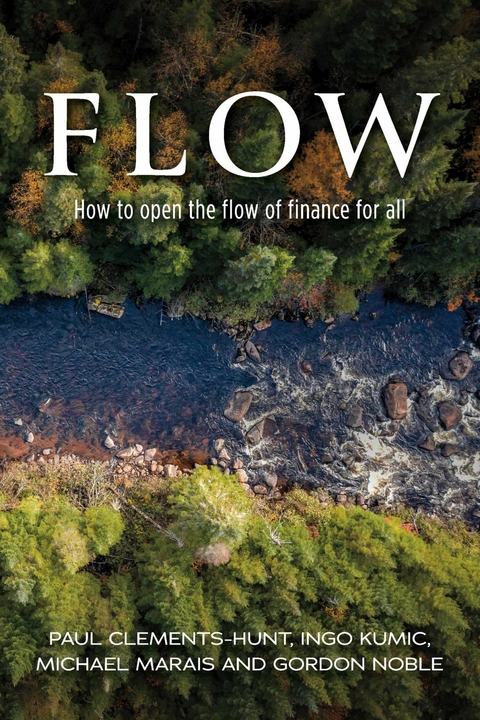
Flow (eBook)
168 Seiten
Bookbaby (Verlag)
978-1-6678-4061-1 (ISBN)
"e;Flow"e; is a book that examines the core question of: How can financial systems open flow of finance for all? An impediment to delivering sustainable development is that finance is not flowing to everywhere that it is needed. "e;Flow"e; unpacks why this is the case, and what we can do about it. This is a book about hope. In the end, the book comes down to a single proposition captured in a single word. Flow. It is the flow of finance to all that ultimately impacts societies and our environment. Flow is the measure by which we understand whether a financial system is serving society. A world where finance does not flow is a world of heightened systemic risks from mass migration of peoples through to unabated climate change. There is a tendency to think that finance is complicated. Books about finance must therefore only be for those that either understand, or want to understand, the intricacies of financial markets. This is not true. Finance at its heart is very simple. Two types of finance - debt and equity - make up the foundations of modern finance. What is complicated is the way that we commonly talk about finance. The approach with this book is to tell the story of the power of finance through narratives. The analogy used throughout the book is that finance is like water. Just as water will find a way to flow to its level, so too can finance-if we allow it to. The core thesis of the book is that just as human intervention created the canals that flowed water to where it was needed in ancient civilizations, there is a need for intervention to support the establishment of "e;finance canals"e; that will open a flow of finance for all. The book is focused on solutions. Finance can grow businesses that can improve the standard of living across the globe. Finance can support governments to address some of the most fundamental challenges facing humanity including climate change. Finance can unlock investments that protect, preserve, and regenerate our environment. The changes advocated to open a flow of finance to meet the needs of all are practical and achievable without the need for international treaties or changes to domestic legislation. Flow of finance for all is about creating and maintaining the channels that enable finance to reach every corner of the earth and fulfil every need.
Introduction
The term “cradle of civilization” is attributed to the poet Edmund Spenser, best known for his 1590 epic poem “The Faerie Queene”. The term has come to refer to locations in Mesopotamia, Egypt, India, and China where civilizations independently emerged. As soon as humans started to cultivate crops that heralded the start of the Agricultural Revolution, they needed a regular source of water. It is therefore not surprising that “cradles of civilization” are also associated with the first irrigation canals. The core thesis of this book is that just as human intervention created the canals that flowed water to where it was needed, there is a need for intervention to support the establishment of “finance canals” that will open a flow of finance for all. In the 1873 classic text on money, Lombard Street, Walter Bagehot2 famously wrote, “Thus capital runs as surely and instantly where it is most wanted, and where there is most to be made of it, as water runs to find its level.” Bagehot’s analogy comparing financial capital with water is still relevant today. Just as water is the key to life, finance is the key to economic life. Without finance businesses cannot grow, jobs are not created, there is no money for climate change adaptation and communities’ wither. It has become a cliché to state that there is a need to mobilize trillions of dollars to address systemic challenges such as climate change. One of the core challenges we face in achieving this objective is that in many parts of the world finance has not been flowing at all or has been flowing at such a low rate that it is not meeting the needs of communities. Many words have been dedicated to examining the problems we collectively face. This book does not aim to add to these words. The starting assumption is that you, the reader, have a broad familiarity with the risks of uncontrolled and rampant changes to the world’s climate, the current state of inequality and the raft of environmental, social and governance (ESG) issues that threaten economies and the fabric of society. An underlying theme of the book is that sustainability is a systemic issue. There is a tendency in aspects of our lives, whether it be work, or international forums, to structure issues into discrete silos. Whilst there is logic to focus in depth on an issue to solve a particular challenge, creating silos results in blind spots and a failure to see systemic issues that are right before our eyes. Nassim Nicholas Taleb coined the term Black Swan to refer to rare events with an extreme impact that have low predictability. None of the crises we have witnessed recently can be described as Black Swan events. As we shall discuss there were plenty of previous warnings on the dangers of pandemics. Perhaps the greatest surprise with COVID-19 is that a global pandemic had not occurred earlier with SARS and MERS early warnings. Russia’s invasion of Ukraine can also not be described as a Black Swan event. There were plenty of warnings that went unheeded. Even if the invasion was analysed solely from a climate change lens (understanding that there were many, many more factors at play), then there is an argument that the re-emergence of resource wars that long characterised empires is not a surprise – and has certainly been actively considered by security analysts. Climate changes impacting Russia include the 1,874,000 km2 Aral Sea Basin which has already been subject to significant warming. The largest freshwater lake in Asia, the 636km Lake Baikal, has already been the subject of tensions with China who faces its own water crises.
The book’s core proposition is that by recognising the systemic nature of crises, in response, financial systems need to be structured to flow capital to where it is needed. The question we examine is how can financial systems open flow of finance for all? The term financial system is used quite deliberately. This is not a book about the finance sector. Financial systems consist of a broader range of participants than the finance sector, which represent those financial institutions that serve the system. Financial systems include governments, regulators, banks, insurers, investors as well as households and business. An underlying theme of the book is that many participants do not appreciate that they are part of a financial system, and do not participate in shaping it. Examples include municipal authorities that have the power to not only borrow from financial markets but have the power to create financial markets themselves. The tendency to think of finance through the lens of the finance sector, rather than as a financial system, results in a bias where questions on solutions to sustainability challenges are seen through the prism of financial products. Financial products do have a fundamental role to play in flowing finance to all, however, they are not the only lever that can be pulled to achieve outcomes. The book argues that there is a need to establish mechanisms that encourage innovation. Financial systems need to become open systems that consider and facilitate different ways of doing things. An example of an open system is the early development of information technology, with owners of IBM computers in the 1950’s collaborating with each other to develop tools to improve the use of their computers. The open-source software movement can be credited with a score of innovations that have led to many of the applications that we take for granted today. An area where financial systems have been embracing the principles of the open-source software movement is responsible investment. Responsible investment has grown from a niche of the financial system to become mainstream within fifteen years. Language such as environmental, social and governance (ESG), which was first developed by responsible investors to succinctly communicate the need to consider all factors that influence the long-term value of an investment, not just the financial factors contained in financial statements, provides a common language around which financial system participants can debate issues. Through the leadership of institutions such as the United Nations Environment Program Finance Initiative (UNEPFI), thousands of individuals within financial institutions have been able to overcome the closed systems of their organizations and exchange ideas globally. One of the key challenges today is how the sustainable finance community can operate as an open system as concepts such as ESG become mainstream.
A range of critical opportunities to build sustainable financial markets, which can deliver for all 7.8 billion on the planet climbing to 9-10 billion by the Century’s close, are considered. To deliver the UN Sustainable Development Goals (SDGs),3 financial systems need to focus on the creation of local markets that deliver development outcomes at real scale. The book examines the ways that financial system participants, including governments and regulators, impede the flow of finance to sustainable development. The fundamental role of a financial system is to allocate capital. Scanning the horizon of the global financial system it is evident that there are major gaps where, due to factors including investor behaviour and regulatory practices, finance is simply not flowing. For instance, through an understanding of why institutional investors herd into large pools of what can be called ‘timid capital’,4 the strengths of the system can be used to design interventions that will flow capital to where it is needed. As financial systems grapple with the allocation of capital to areas including provision of infrastructure services, repair of natural systems, addressing inequality and investing in communities in developing countries and frontier economies, there is a need to understand how financial markets are created. To do that there is a need to go back into history. Historically, markets were always local. A key insight from the historic development of stock exchanges is that the key invention that created the first stock exchange was the establishment of a mechanism to transfer an asset from one person to another. It was not, as we may commonly think, to price an asset. This insight has implications in the development of new markets in areas including natural capital and impact investment. The establishment of market architecture that facilitates trading is critical to the scaling of new innovations in sustainable finance. Governments have always played a critical role in establishing and governing markets and have a key role to play in creating new financial markets that open finance for all.
The book presents a range of ideas on how to open flow of finance across a broad range of communities including refugees, remote and rural communities that lack access to infrastructure, and less developed countries. The disruption of infrastructure through technology is offering the opportunity to deliver core infrastructure services such as delivery of energy and water to all people, no matter where they live. The book outlines an ambition for Universal Infrastructure Coverage (UIC) that is possible today through three simple propositions: Firstly, recognize that the emergence of distributed infrastructure is a game changer that creates the possibility of universal infrastructure coverage. Secondly, establish infrastructure as a business that is co-owned by governments and institutional investors and that is listed on local stock exchanges. Thirdly, support the management of infrastructure businesses through the development and implementation of stewardship principles.
Addressing the poverty premium—the extra cost that households on low incomes incur when...
| Erscheint lt. Verlag | 15.5.2022 |
|---|---|
| Sprache | englisch |
| Themenwelt | Wirtschaft |
| ISBN-10 | 1-6678-4061-4 / 1667840614 |
| ISBN-13 | 978-1-6678-4061-1 / 9781667840611 |
| Informationen gemäß Produktsicherheitsverordnung (GPSR) | |
| Haben Sie eine Frage zum Produkt? |
 EPUB (Ohne DRM)
Größe: 1,1 MB
Digital Rights Management: ohne DRM
Dieses eBook enthält kein DRM oder Kopierschutz. Eine Weitergabe an Dritte ist jedoch rechtlich nicht zulässig, weil Sie beim Kauf nur die Rechte an der persönlichen Nutzung erwerben.
Dateiformat: EPUB (Electronic Publication)
EPUB ist ein offener Standard für eBooks und eignet sich besonders zur Darstellung von Belletristik und Sachbüchern. Der Fließtext wird dynamisch an die Display- und Schriftgröße angepasst. Auch für mobile Lesegeräte ist EPUB daher gut geeignet.
Systemvoraussetzungen:
PC/Mac: Mit einem PC oder Mac können Sie dieses eBook lesen. Sie benötigen dafür die kostenlose Software Adobe Digital Editions.
eReader: Dieses eBook kann mit (fast) allen eBook-Readern gelesen werden. Mit dem amazon-Kindle ist es aber nicht kompatibel.
Smartphone/Tablet: Egal ob Apple oder Android, dieses eBook können Sie lesen. Sie benötigen dafür eine kostenlose App.
Geräteliste und zusätzliche Hinweise
Buying eBooks from abroad
For tax law reasons we can sell eBooks just within Germany and Switzerland. Regrettably we cannot fulfill eBook-orders from other countries.
aus dem Bereich