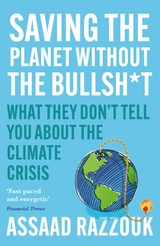
Saving the Planet Without the Bullsh*t (eBook)
304 Seiten
Atlantic Books (Verlag)
978-1-83895-464-2 (ISBN)
Assaad Razzouk is a Lebanese-British clean energy entrepreneur, author, podcaster and commentator. He co-founded and runs a clean energy company headquartered in Singapore, financing, building and operating renewable energy projects in Asia; as well as a not-for-profit Singapore start-up, digitising and democratising renewable energy. With his hands-on experience in renewable energy combined with his other roles, Assaad is a high-profile thought leader on climate change, clean energy and the UN climate talks with several hundred thousand followers on Twitter, Facebook and LinkedIn and widely read occasional newspaper columns.
'Fast paced and energetic' Financial Times'Punchy, provocative and wonderfully readable' - David Shukman'Eye-popping and essential' - Rowan Hooper'A must-read' - Peter StottHave you heard that you should plant trees to save the planet? Or buy carbon offsets when you fly? Or recycle plastic? Go vegan? Or not have children? What if all these actions were a distraction, no matter how well-intentioned?In this provocative manifesto, Assaad Razzouk shows that for too long our ideas about what's best for the environment have been unfocused and distracted, trying to go in too many directions and concentrating on individual behaviour. While some of these things can be useful, they are dwarfed by one big thing that simply has to happen very soon if we're to avoid major environmental breakdown: curtailing the activities of the fossil fuel industry. Full of counter-intuitive statistics and positive suggestions for individual and collective action, this ingenious book will change how you view the climate crisis.
Assaad Razzouk is a Lebanese-British clean energy entrepreneur, author, podcaster and commentator. He co-founded and runs a clean energy company headquartered in Singapore, financing, building and operating renewable energy projects in Asia; as well as a not-for-profit Singapore start-up, digitising and democratising renewable energy. With his hands-on experience in renewable energy combined with his other roles, Assaad is a high-profile thought leader on climate change, clean energy and the UN climate talks with several hundred thousand followers on Twitter, Facebook and LinkedIn and widely read occasional newspaper columns.
Introduction
It was the blackened teeth and poisoned skin of coal miners in China’s coal capital, the city of Taiyuan, that gave me my first brush with sustainability. I had never seen anything like it before. The sight of those embarrassed smiles (instinctively covered with one hand) and awful complexions stopped me in my tracks and forced me to pause, think and question everything that I had until that point believed was important.
I first landed in Taiyuan in the spring of 2006. Flights there were unreliable and often cancelled. During the winter, chimney smoke enveloped the city. In the warmer seasons, the population was spared the smoke but it still had to contend with other scourges: pollution caused by coal-dependent industries, sand and dust from the surrounding countryside, slow-moving traffic and endless construction works as the city’s unrelenting tentacles spread wider and wider. The air tasted gritty and the mountains on three sides helped trap air that looked yellow and felt like it was asphyxiating all those breathing it.
The coal mine and associated buildings lay to the east of the city. As I approached, the roads crackled, the heavy traffic became increasingly demonic and the air thicker. A sulphureous odour permeated the dusty atmosphere, generated by the poor-quality coal burned and breathed by the miners. The route to the mine itself was tortuous and hazardous. A narrow dirt track rose steeply up the side of a rubble-strewn valley and into the scrub-covered mountains. The buildings were dilapidated, and pavements were covered in dirt and debris thrown up by passing heavy trucks that also gouged ruts in the road. Groups of coal miners occasionally appeared as dark silhouettes in the dusty distance, as if rising from the land where their makeshift homes were buried.
I’d spent my formative school years in Lebanon, in the midst of a civil war where neither safety nor school schedules, roads, electricity or clean water were a given. After managing to get into a US university, I had no choice but to excel academically to land a job and therefore a work permit: the alternative was to return to a bitterly divided and burning Beirut. After university, it was all about competition and survival, first in the United States, then the United Kingdom and finally Singapore. I had little time to be aware of the environmental issues around me.
I was in China in 2006 on a business trip. At the time, I was trying to build a company that reduced quantifiable amounts of pollution from certain industries. We would then obtain proof that pollution had been reduced, in the form of certificates that we would sell into a market created especially for this purpose under a United Nations agreement called the Kyoto Protocol, a gallant effort focused on achieving net reductions in worldwide pollution. We also had to prove that we wouldn’t have intervened to invest the necessary money and technology to decrease the pollution if it weren’t for the Kyoto Protocol. The goal was to drive a sustained reduction in emissions from greenhouse gases everywhere.
Pollution is agnostic when it comes to its global impact. Climate change in particular is caused by emissions that are man-made: greenhouse gases, and pollution generated when we burn oil, gas or coal or anything made with them (like plastics). It doesn’t matter where that pollution is generated; it all ends up in the same place: our planet’s atmosphere.
In Taiyuan, we saw an opportunity to stop methane, a potent greenhouse gas around 85 times worse for the environment than carbon dioxide over 20 years, from leaking from Chinese coal mines in vast quantities. Our engineers helped build drainage pipes that captured the methane, prevented it from escaping into the atmosphere and redirected it instead to generate electricity.
However, what started as an abstract commercial opportunity became very real at the sight of the coal miners in Taiyuan, who had been visibly and permanently scarred by one of the unhealthiest activities in the world. It didn’t take long to figure out that irrespective of how many vegetables they might eat, their health wasn’t going to recover from mining and burning industrial quantities of hydrocarbons.
Over the next few years, I developed my business focusing on greenhouse gas mitigation in multiple countries, including the United States, China, India and South East Asia; then a business deploying renewable energy (solar and wind power projects as well as biogas to energy and biomass to energy projects) across Asia. Over the course of 16 years (and counting) in carbon tech, clean tech and developing greenhouse gas mitigation and renewable energy projects from the ground up, I was at the front line of climate change-fuelled destruction. I witnessed the incredible vulnerability of Thailand, the Philippines, Indonesia, China, India and Pakistan to floods; the discernible warming trends in Asian cities; the plastic pandemic; the destruction of our oceans; the insect apocalypse going on in our midst; and the deforestation of the remaining rainforests in Indonesia.
I was also at the table at multiple United Nations climate meetings, sometimes as a government negotiator and other times as an observer or independent participant, as well as at a vast number of conferences convened by the United Nations, other governments and the private sector.
Every one of these meetings and every visit to vulnerable communities helped develop my awareness of the climate catastrophe in our midst. Over time, I started shouting more stridently from the rooftops about the climate change crisis, using social media, my podcast and occasionally newspaper articles and blogs. Throughout, I also tried to showcase solutions and actions we can all take to make a real impact.
The world has hosted 26 annual climate talks since 1995, at which practically every country has been represented. These talks were convened because human activities (principally burning fossil fuels) have dumped an enormous amount of greenhouse gases in the earth’s atmosphere. This has had the effect of warming the planet to levels that increasingly threaten our survival, by shifting the frequency and violence of climate extremes such as droughts and typhoons, as well as causing the ice sheets to melt, the seas to rise and temperatures in some areas to become intolerable to humans.
During each of these annual climate talks, thousands at first, then tens of thousands of representatives from government, industry and civil society have held countless meetings, none of which bent the curve. Greenhouse gases continue to increase inexorably, and as they do, promises of decarbonization recede further and further into the future. What is, however, sometimes less appreciated is that a very slow decarbonization path is a set-up for much more absolute harm than a very fast one. We can think about this the way we think about a mortgage loan: if you reduce the capital of the mortgage quickly (in the case of climate change, the capital would be total greenhouse gas emissions), you would save a lot in interest (i.e., climate effects), and as a result, the overall amount you pay out is greatly reduced. Every fraction of a degree of warming matters. The 2015 Paris Agreement agreed by 192 countries is aimed at limiting the average increase in global temperatures to well below 2° Celsius above pre-industrial levels, and preferably to 1.5°. The warming implications of 1.5° versus 2° Celsius are very different. For example, if rapid decarbonization limits warming to 1.5°, then coral reefs around the world would be projected to decline by 70 per cent, whereas at a 2° increase, they would decline by more than 99 per cent. In a 1.5° warming scenario, heatwaves will affect 14 per cent of the world’s population every five years, whereas 37 per cent (that’s close to three billion people) would be affected in a 2° world.
Yet we must not just talk about failures, as we seem to do – overwhelmingly – in the climate change space. Yes, we have failed to control emissions or to even bend their upward-sloping curve. Yes, extreme weather and climate disasters are now a fact of daily life for many. But every moment spent dwelling on these setbacks is a moment lost to effecting change. What’s required is a focus on strategies in our daily lives that deliver outcomes.
While informed individual efforts to be eco-friendly are important in galvanizing others, this book argues that they largely miss the mark. I’ll show that individual action, while good and important from a moral standpoint, makes little actual difference and may even be counterproductive in some cases. We are in critical need of major systemic changes: 89 per cent of emissions come from burning oil, gas and coal, and just stopping subsidies for fossil fuels would cut global emissions by a third. Yet cash subsidies for fossil fuel consumption alone amounted to $440 billion globally in 2021. Once we include all assistance to the industry, we paid out $11 million every minute, according to no lesser authority than the International Monetary Fund. All this to burn up our planet faster.
How do we make these systemic changes happen? And what is the most effective role for individuals as we switch to clean energy to fuel global lifestyles?
All over the world, people are confronted with complex daily choices in the name of saving the planet: can I avoid using this plastic bag? Should I fly less? Should I get an electric bike? Am I buying too many clothes? Are electric cars really good news? Should I bother to recycle? Is it ethical to eat my favourite burger or must I go...
| Erscheint lt. Verlag | 1.9.2022 |
|---|---|
| Verlagsort | London |
| Sprache | englisch |
| Themenwelt | Sachbuch/Ratgeber ► Natur / Technik ► Natur / Ökologie |
| Naturwissenschaften ► Biologie ► Ökologie / Naturschutz | |
| Technik | |
| Wirtschaft ► Volkswirtschaftslehre | |
| Schlagworte | Bill Gates • Christiana Figueres • Clean Energy • climate change • Fossil Fuels • future we choose • Greenhouse Gas • how Bad Are Bananas • How to Avoid a Climate Disaster • Hydrocarbon • Jen Gale • mike berners-lee • Oil • Petrochemical • Plastic • pollution • sustainability • The Sustainable(ish) Living Guide |
| ISBN-10 | 1-83895-464-3 / 1838954643 |
| ISBN-13 | 978-1-83895-464-2 / 9781838954642 |
| Informationen gemäß Produktsicherheitsverordnung (GPSR) | |
| Haben Sie eine Frage zum Produkt? |
 EPUB (Wasserzeichen)
DRM: Digitales Wasserzeichen
Dieses eBook enthält ein digitales Wasserzeichen und ist damit für Sie personalisiert. Bei einer missbräuchlichen Weitergabe des eBooks an Dritte ist eine Rückverfolgung an die Quelle möglich.
Dateiformat: EPUB (Electronic Publication)
EPUB ist ein offener Standard für eBooks und eignet sich besonders zur Darstellung von Belletristik und Sachbüchern. Der Fließtext wird dynamisch an die Display- und Schriftgröße angepasst. Auch für mobile Lesegeräte ist EPUB daher gut geeignet.
Systemvoraussetzungen:
PC/Mac: Mit einem PC oder Mac können Sie dieses eBook lesen. Sie benötigen dafür die kostenlose Software Adobe Digital Editions.
eReader: Dieses eBook kann mit (fast) allen eBook-Readern gelesen werden. Mit dem amazon-Kindle ist es aber nicht kompatibel.
Smartphone/Tablet: Egal ob Apple oder Android, dieses eBook können Sie lesen. Sie benötigen dafür eine kostenlose App.
Geräteliste und zusätzliche Hinweise
Buying eBooks from abroad
For tax law reasons we can sell eBooks just within Germany and Switzerland. Regrettably we cannot fulfill eBook-orders from other countries.
aus dem Bereich