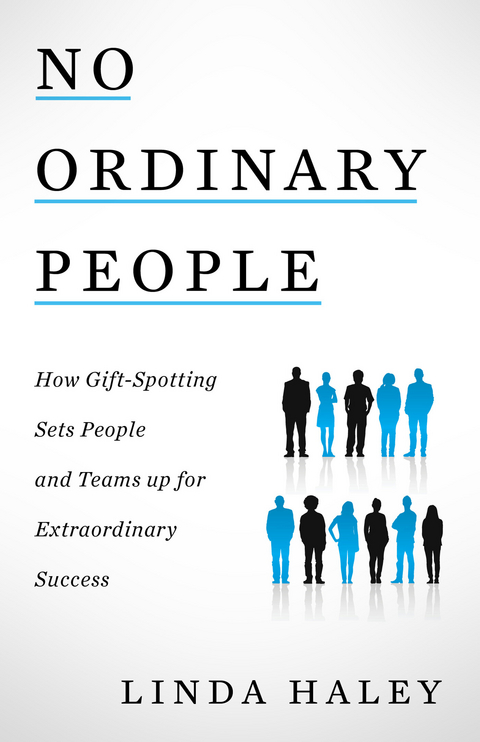
No Ordinary People (eBook)
192 Seiten
Houndstooth Press (Verlag)
9781544528038 (ISBN)
Discover your best traits and find extraordinary success What are your unique gifts and strengths? What makes a good leader? The answers to these questions are exactly the same. No Ordinary People provides a funny, straightforward look at twenty-three "e;ordinary"e; people across three decades who got the job done right, each in their own way. Spanning careers in business, military, and law enforcement, these extraordinary leaders prove that you don't need any special training to bring out the best in people. And that you don't need to do things in any way but your own. Through one success story after another, each one vastly different from the next, you'll walk away from No Ordinary People with a new plan to make the most of your team's unique gifts, and with a new role model for the very best person to lead them-YOU.
Chapter 1.
Core Values, aka the Golden Rule
“It’s not hard to make decisions, once you know what your values are.”
—Roy E. Disney
Ethics are everything, but how do you teach them? Isn’t that what parents, grandparents, or guardians are for? Standards, practices, and behaviors in the workplace can be taught and insisted upon. Ethics, however, develop further back. I know a man who was raised by his grandmother and turned out great. Me? I never knew either of my grandfathers. I trace my ethics back to my parents, who were both raised by strong single mothers.
My mother’s father died of a heart attack when she was two years old, leaving her mother, Maggie, to work full time to support my mother, Kay, and her sister, Maryann. Maggie worked, of course, for a fraction of the salary her male counterparts earned. She outperformed them and won awards, but when she asked about the pay discrepancy, Maggie was told, “The men have families to support.” What did they think Kay and Maryann were? Household pets? Yep, those were the good old days. Though much has improved since then, gender income disparity still exists in our society. What Maggie lacked in income, she made up for in four strong, Irish-Catholic sisters. Mom always said she was raised by five mothers.
My father’s father also died when my father was young (more on him in Chapter 5), and his mother, Nellie, raised six children on a nurse’s salary during the Great Depression. She came from a long line of overcomers; Nellie’s mother almost starved to death when she came to America from Ireland because of the “No Irish Need Apply” signs and the unwelcome atmosphere of the times. That was after she nearly starved to death in Ireland during the potato famine. Before Nellie weathered the Great Depression, she lived quite the life. She was a suffragette and found other ways to embarrass the family. She cropped her hair short, wore spaghetti-strapped dresses that revealed her arms and shoulders, and rode the family cow as if it was a horse (the horror!)—all things frowned upon in her conservative community. Now let’s meet the parents, the products of these two colorful women.
My parents, Kay and Bill.
Kay (aka Mom)
The biggest influence in my childhood. She was a straight-up, no-nonsense, loving, Irish Catholic, stay-at-home mom of three girls.
Positive
No matter how crummy the day, Mom reminded me tomorrow would be a fresh start—make it count. She didn’t indulge self-pity but always offered hugs and encouragement.
In eighth grade, my friends dumped me because I wasn’t popular. Mom assured me that when I got to high school, I would make new, better friends. She was right; she usually was right about most things. Mom was also over-the-top fun—she loved the Michigan State Fair, face painting, top hats, sharing a glass of wine or two, and was always a good sport.
Mom and me.
Selfless
Mom rarely spent any money on herself. Even when Grandma sent her birthday money, Mom found ways to spend it on us. A birthday was the only day one sister got singled out over another; Mom always made sure she provided for all three of us equally. Mom was selfless to a fault; her worst nightmare (while raising us) was her kids waking up on Christmas morning to an empty tree.
Encouraging
All my life Mom told me I was beautiful, and in middle school, I needed to hear it. I grew a naturally curly blonde afro when long, straight hair was the fashion. Being dumped by my friends didn’t help. Mom never wavered. The next year in high school, she encouraged me to get involved in extracurricular activities and be a good friend to anyone who needed one. I joined the choir, theatre arts, the First Aid Squad, field hockey, and the Varsity Club. I excelled and brought home trophies: All Conference, All State, All North Jersey, and Most Valuable Player.
By the end of sophomore year, I had new, less shallow, genuinely nice friends. And an unpredictable perk? They were the popular teens, and I had found the popularity that eluded my previous friends. Popularity is a mixed bag. It can be handed out for superficial attributes like clothes, beauty, wealth, or connections, or it can be the just reward of talent and acknowledgment of good character. No doubt Mom wanted her daughters to find it for praiseworthy reasons.
Standards
Mom cared more about my treatment of others than my academic grades. When we were little, Mom lectured us about defending those who could not defend themselves. We were not allowed to physically fight, but we were allowed to defend anyone being bullied. Would wonders never cease—permission to fight after all. That made my little sister eager to defend one particular girl at school who had learning disabilities. She went to school the next day, and “defend” she did.
On another day, Mom caught that same little sister throwing rocks at cars driving by. Mom lined us all up and delivered an impassioned Irish lecture that she did not raise her children to be “white trash” (her words). It lasted for what seemed like hours. We didn’t know what white trash was, but my rock-throwing sister was getting dangerously close to it.
In middle school, Mom made me stop seeing one friend because she heard the girl vandalized a neighbor’s car. Mom did not tolerate mischief that caused grief to others. Because Mom cared more about good conduct than good grades, cheating in school was out of the question, and cause for great humiliation. She just expected us to do our best. That brings up the next point.
Personal Responsibility
Mom raised us to feel a sense of responsibility to our community, and both parents taught us to do the right thing in any given situation. At one time, Dad was being transferred overseas, and we needed a battery of shots before traveling. We objected, and Mom entered lecture mode. She explained in detail how we could pass a debilitating disease to a pregnant woman’s baby, landing her child in a wheelchair for life! All because we didn’t want a momentary needle prick? (Not HER daughters!) Yes, plenty of Irish guilt to be had. She also didn’t tolerate littering. Why should somebody else (groundskeepers, janitors, city workers . . .) pick up our garbage because we’re too lazy to carry it to a trash can? These were the lectures that wore us down into responsible citizenship.
Work Ethic
When I was eight years old, I told my mom I was bored. Maybe I thought she’d recommend some form of entertainment. Mom saw it as an opportunity. “ There’s nothing like an honest day’s work,” she said. She gathered me up (and my sisters), and took us to scrub floors in a nursing home run by the Little Sisters of the Poor in Istanbul, Turkey. My sisters were not happy with me because they weren’t bored. The nuns had us cleaning floors for what seemed an eternity, and I never complained of being bored again.
During that time in Istanbul, we had a housekeeper. One day Mom told me to go pick up my room. I said, “Why? We have a maid.” She said, “Yes—to clean the rooms, not to pick up after you.” To this day, I can’t leave a hotel room without straightening it and putting all the towels on the counter.
At age thirteen, I criticized the way Mom did my laundry (you’d think I’d have learned by then). Again, Mom saw it as an opportunity to introduce me to the washing machine. From then on, I washed my own laundry. I never saw that one coming.
Growing up—with the exception of a two-year tour overseas—we lived in houses we could barely afford so our parents could put us in better schools. Unfortunately, the houses were usually fixer-uppers. One house sat on a dead-end road opposite a diesel factory’s chain-link fence. Another house flooded twice a year like clockwork and had to be purged of the river silt left behind (good times). But by God, we attended great schools! We were a family of five on one income, so money was tight.
When I came of driving age, many of my friends were being given cars. I went home and announced, “Mom, I want a car.” Without skipping a beat, she replied, “So do I. Have you seen what’s in the driveway? (She pointed to our aging VW hatchback.) Get a job.” So, I did. I got two jobs and have been working hard ever since. As I progressed in the workplace, I was expected to go into business, compete with men, and not make excuses. Mom taught us to be ten minutes early, work hard, and be the best employee on shift.
She raised no victims; she said having three babies in the first three years of her marriage meant she couldn’t afford to have whiny babies on her hands. If you got hurt, you walked it off. But one thing I will say, she never made us feel poor. Mom was an excellent cook and made holidays and birthdays special. She’d set the table with Grandma’s purple china, candles, and glorious homemade cakes.
Compassion
When we stayed home sick from school, Mom spoiled us (in the best way) with soups, Popsicles, comic books, and one-on-one time. Once in a while, I’d feign illness just to stay home with her for a day. She knew it but didn’t let on and took it as an opportunity for mother/daughter time. Mom learned that lesson from her mother years earlier.
At five years of age, I started misbehaving. Grandma took Mom aside and told her she wasn’t spending enough time with me. I had an older sister who was her helper and a younger sister who was the baby. As the middle child,...
| Erscheint lt. Verlag | 1.3.2022 |
|---|---|
| Sprache | englisch |
| Themenwelt | Wirtschaft ► Betriebswirtschaft / Management ► Unternehmensführung / Management |
| ISBN-13 | 9781544528038 / 9781544528038 |
| Informationen gemäß Produktsicherheitsverordnung (GPSR) | |
| Haben Sie eine Frage zum Produkt? |
 EPUB (Ohne DRM)
Größe: 14,8 MB
Digital Rights Management: ohne DRM
Dieses eBook enthält kein DRM oder Kopierschutz. Eine Weitergabe an Dritte ist jedoch rechtlich nicht zulässig, weil Sie beim Kauf nur die Rechte an der persönlichen Nutzung erwerben.
Dateiformat: EPUB (Electronic Publication)
EPUB ist ein offener Standard für eBooks und eignet sich besonders zur Darstellung von Belletristik und Sachbüchern. Der Fließtext wird dynamisch an die Display- und Schriftgröße angepasst. Auch für mobile Lesegeräte ist EPUB daher gut geeignet.
Systemvoraussetzungen:
PC/Mac: Mit einem PC oder Mac können Sie dieses eBook lesen. Sie benötigen dafür die kostenlose Software Adobe Digital Editions.
eReader: Dieses eBook kann mit (fast) allen eBook-Readern gelesen werden. Mit dem amazon-Kindle ist es aber nicht kompatibel.
Smartphone/Tablet: Egal ob Apple oder Android, dieses eBook können Sie lesen. Sie benötigen dafür eine kostenlose App.
Geräteliste und zusätzliche Hinweise
Buying eBooks from abroad
For tax law reasons we can sell eBooks just within Germany and Switzerland. Regrettably we cannot fulfill eBook-orders from other countries.
aus dem Bereich