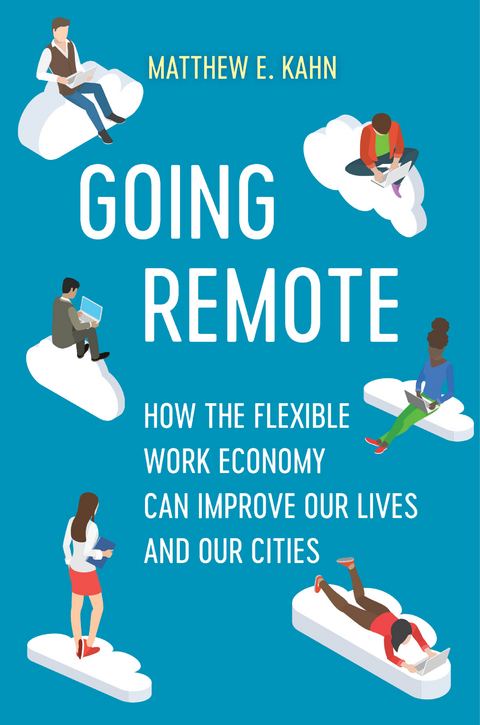
Going Remote (eBook)
264 Seiten
University of California Press (Verlag)
978-0-520-38432-3 (ISBN)
As COVID-19 descended upon the country in 2020, millions of American office workers transitioned to working from home to reduce risk of infection and prevent spread of the virus. In the aftermath of this shift, a significant number of workers remain at least partially remote. It is clear that this massive experiment we were forced to run will have long-term consequences, changing the shape of our personal and work lives, as well as the urban landscape around us. How will the rise of telecommuting affect workers' quality of life, the profitability of firms, and the economic geography of our cities and suburbs? Going Remote addresses the uncertainties and possibilities of this moment.
In Going Remote, urban economist Matthew E. Kahn takes readers on a journey through the new remote-work economy, revealing how people will configure their lives when they have more freedom to choose where they work and how they live. Melding ideas from labor economics, family economics, the theory of the firm, and urban economics, Kahn paints a realistic picture of the future for workers, firms, and urban areas, big and small. As Kahn shows, the rise of remote work presents especially valuable opportunities for flexibility and equity in the lives of women, minorities, and young people, and even for those whose jobs do not allow them to work from home. Uncovering key implications for our quality of life, Going Remote demonstrates how the rise of remote work can significantly improve the standard of living for millions of people by expanding personal freedom, changing the arc of how we live, work, and play.
Introduction: No Going Back
I · Workers
1 Short-Run Gains for Workers
2 Medium-Term Gains for Workers
II · Firms
3 How Will Firms Adapt?
III · Locations
4 The Rise of Remote Work and Superstar Cities
5 New Opportunities for Other Areas
Conclusion: The New Geography of Jobs
Acknowledgments
Notes
Recommended Reading
Index
| Erscheint lt. Verlag | 26.4.2022 |
|---|---|
| Sprache | englisch |
| Themenwelt | Wirtschaft ► Betriebswirtschaft / Management |
| Wirtschaft ► Volkswirtschaftslehre ► Makroökonomie | |
| Schlagworte | Built Environment • Cities • commercial real estate prices • communting • commuters • corporate campus • Economic Geography • housing costs • Inequality • Infrastructure • job flexibility • Labor • Living Standards • quality of life • suburbs • telecommute • urban work life • Workers • work from home |
| ISBN-10 | 0-520-38432-6 / 0520384326 |
| ISBN-13 | 978-0-520-38432-3 / 9780520384323 |
| Informationen gemäß Produktsicherheitsverordnung (GPSR) | |
| Haben Sie eine Frage zum Produkt? |
 EPUB (Adobe DRM)
Kopierschutz: Adobe-DRM
Adobe-DRM ist ein Kopierschutz, der das eBook vor Mißbrauch schützen soll. Dabei wird das eBook bereits beim Download auf Ihre persönliche Adobe-ID autorisiert. Lesen können Sie das eBook dann nur auf den Geräten, welche ebenfalls auf Ihre Adobe-ID registriert sind.
Details zum Adobe-DRM
Dateiformat: EPUB (Electronic Publication)
EPUB ist ein offener Standard für eBooks und eignet sich besonders zur Darstellung von Belletristik und Sachbüchern. Der Fließtext wird dynamisch an die Display- und Schriftgröße angepasst. Auch für mobile Lesegeräte ist EPUB daher gut geeignet.
Systemvoraussetzungen:
PC/Mac: Mit einem PC oder Mac können Sie dieses eBook lesen. Sie benötigen eine
eReader: Dieses eBook kann mit (fast) allen eBook-Readern gelesen werden. Mit dem amazon-Kindle ist es aber nicht kompatibel.
Smartphone/Tablet: Egal ob Apple oder Android, dieses eBook können Sie lesen. Sie benötigen eine
Geräteliste und zusätzliche Hinweise
Buying eBooks from abroad
For tax law reasons we can sell eBooks just within Germany and Switzerland. Regrettably we cannot fulfill eBook-orders from other countries.
aus dem Bereich