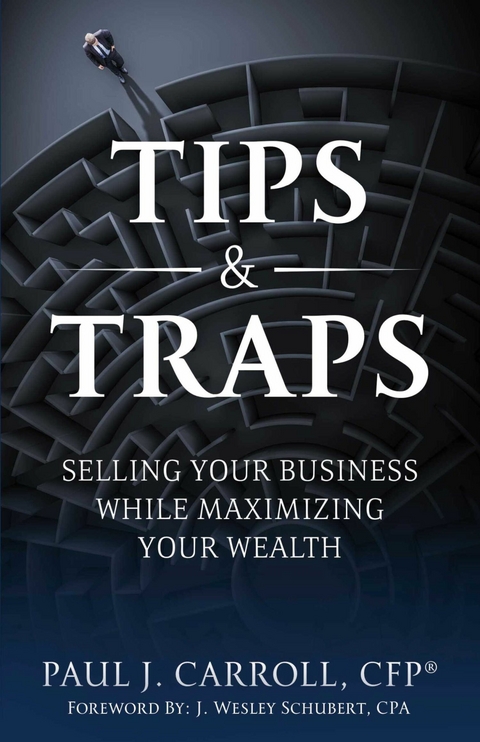
Tips & Traps (eBook)
190 Seiten
Bookbaby (Verlag)
978-1-6678-1813-9 (ISBN)
Paul Carroll provides insightful tips into, and traps that may occur selling your business. He encourages entrepreneurs to "e;start with the end in mind"e; as they begin their venture and explains the importance of knowing your true enterprise value throughout the selling process. He also advises on how to benefit from identifying and engaging your "e;dream"e; team. Most business owners are not expert in selling a business. With Tips and Traps, successful business owners will be ready for both anticipated and unexpected offers, with input on the entire process as well as negotiating terms that will maximize your wealth.
Chapter One:
The Human Element
When I conducted the interviews that are the source information of this book, one thing came through time and time again: the human element is significantly underestimated. Entrepreneurs, the heroes of the 21st century, are accustomed to being masters of their universe. They’re command-oriented individuals; they’re used to being in charge. They’re comfortable with making decisions. It never enters their mind that the human element in the sale of the business is what’s most likely to derail their success – which I define as maximizing the net present value (NPV), after taxes, of cash flows received. Here are some of the very human traps you might encounter when selling your business.
In order for Luke to succeed where many others before him have failed, he will need to mitigate against the natural risks posed by working with real people whose minds could change at any time. He must be aware that every decision he makes has an impact on all involved, buyers and sellers. His future buyer, for example, might need careful guidance and encouragement as he sees the deal through. Or what if his team starts to lose faith in the deal, and he has to reassure and motivate them without causing friction? The human element should be central to his planning because businesses are their people.
Unknown Unknowns
It is important that you, the owner, recognize that you don’t know what you don’t know. Using the term made famous by Donald Rumsfeld, these “unknown unknowns” may be lying in wait whether you’re aware or not.
Successfully running a business typically results in confidence. Confidence can be important for continued success, but sometimes we allow repeated success in one field of life to make us overconfident when we’re handling situations that do not lie within our day-to-day expertise. In an example of this halo effect, we believe that because we perform well in one certain area, we will automatically perform well in any area. A commonly cited example: Doctors that become pilots who, with an overconfident assessment of their skills, steer their aircraft expertly into the ground. In short, this overconfidence prevents highly qualified people from getting the advice or the information they need to optimize their outcome in an unfamiliar endeavor.
Unfortunately, when it comes to selling your business, there’s no mulligan, no redo. It’s going to be hard to unravel mistakes once the Letter of Intent (LOI) is signed. (We’ll describe LOI’s and Term Sheets in greater detail in chapter four.) This book attempts to address any gaps in your knowledge that may cause you to suffer regret later.
Underestimating the Human Element
The human element is very much about the interplay between your head, your heart, and your gut. We call the head the rational mind, the heart the feeling mind, and the gut the instinctual mind. Entrepreneurs are primarily working with their heads. They tend to think rationally, occasionally taking guidance from their gut, “thinking” instinctually. But all three elements need to be given their due during this process: you’re going to need to include the feeling mind.
Too Personally Involved
Your business is your baby: you raised and nurtured it. There is nothing wrong with feeling personally involved in the process or the outcome, just be careful not to let that feeling threaten your chance of success. A buyer is going to look for warts and defects throughout the process, not only to minimize the possibility of failure but also to gain leverage in the ongoing dance of negotiations. In other words, the buyer’s objective is to maximize their wealth which, in this deal, means not maximizing yours. This dynamic can, without the right combination of confidence and experience, lead to an overreaction from the seller, so it is important not just to understand but to constantly remember that none of this is personal. Yes, this is your business, but from a buyer’s perspective, it is only business, and they will be eager to exploit any weakness you reveal throughout the negotiations.
During the sale of Luke’s Ventures, Luke’s trusted advisor is his first line of defense, who can protect his targets and keep the process rational. Like any great football team, he needs to trust his players to do the job: it’s fine for Luke, as coach, to call the plays, but without his Tom Brady anchoring the sale and keeping a level head when the pressure is on, he can’t win the Superbowl. A long relationship with a trusted wealth manager, Certified Public Accountant (CPA), or attorney, as long as they are experienced with the ups and downs of selling a business, is priceless.
In the mergers & acquisitions (M&A) universe, dealmakers (the sellers of midsize businesses) are afraid of not only novice buyers and sellers but also – and to a greater degree –phony advisors who are inexperienced in these transactions. Why? Because M&A Professionals spend a great deal of time and money putting these deals together. Emotional owners, at crunch time, unable to let go of their baby, might unconsciously sabotage the deal by picking away at the terms of sale while the wrong advisor lets them. Likewise, skilled advisors will know when to hold the line versus when to let something immaterial go with a view to ceding some battles in order to win the war. They want to ensure that the deal can be done if reasonable terms can be agreed to.
Here are some examples of common mistakes that can be flagged by a good anchor advisor:
Being too generous with earn-out provisions versus cash now. I call this the earn-out trap and will discuss it in greater detail in chapter eighteen.
Failure to determine whether a buyer is a financial buyer (like a private equity firm that may value your business based on a multiple of Earnings Before Interest, Taxes, Depreciation, and Amortization) or a strategic buyer (that may pay a higher price because of synergies). Once this has been made clear you can shape the deal you want.
Providing an emotional or exaggerated report of your company’s historical financial performance.
Unrealistic Expectations
Unrealistic expectations can also dismantle a deal. Greed, for example, can kill it: in the stock market, they say, “Bulls make money, bears make money, pigs get slaughtered.” Don’t be a pig and let greed kill the deal. Work to identify and avoid unrealistic expectations.
In addition to unrealistic financial expectations, there is a significant commitment in time and resources involved in maximizing the wealth you extract from the sale of a business. Ideally, selling the business will be a gratifying experience. But it can be grueling. Be ready to set aside time and, preferably, assign a trusted leader within your company to keep on top of the process. As the firm’s visionary, you need to keep your eye on the ball (the business day-to-day operations) despite the obvious distractions of the business sale.
A lot of owners also don’t realize just how much they make from a business. Many, when they sell, are going to lose not just their salary and profits but their personal piggy bank, tied up with expenditures like car leases, generous travel expenses or renting to or from a sister company at barely market rates. You need a mechanism to replace the combined resource stream to avoid future financial challenges.
Finally, our research and experience has shown us how common it is for misunderstandings to birth fantastical thinking. In many cases, for example, owners thought that their offspring and/or their employees wanted the business when they did not. Not everyone’s an entrepreneur, and you can’t just produce one when you haven’t got the right ingredients. This is a cookbook, remember, not a fantasy. Try to keep your feet on the ground and your expectations based on figures not faith.
All parents believe that their baby is not only perfect but that it is the most perfect (well, most parents). But when that baby is your business, it is important to valuate it objectively. Entrepreneurs frequently struggle with reconciling their inflated value of their business with true economic value: we know you’re the hero, that you built this, that you created value, wealth and jobs, that you took the risk, that you put in the sweat equity. The issue arises when there’s a difference between your valuation and the true economic value; like getting off a subway in London, you have to mind the gap.
The challenge here is that you can’t quantify, let alone monetize, the unpaid labor that employees or owners put into a business, also known as sweat equity. Your emotional investment and commitment cost a lot in sacrifice and passion but are not relevant to your deal. This commonly manifests itself in inappropriate comparisons with much larger competitors, or even with completely different industries. Luke’s aerial transport business may sell for a multiple of two times revenue while his jealous friend’s accounting firm only sells for one. Every business is unique: Luke’s friend shouldn’t expect his business to get that 2x multiple just because his buddy’s does. Stubborn commitment to a valuation not based on objective, reasonable measurements is always problematic.
Many business owners not only overestimate the value of their business but also underestimate the risk. Concentrated risk hurts value, not just in financial instruments, but also in a business itself. It could be that the concentrated risk...
| Erscheint lt. Verlag | 14.2.2022 |
|---|---|
| Sprache | englisch |
| Themenwelt | Wirtschaft |
| ISBN-10 | 1-6678-1813-9 / 1667818139 |
| ISBN-13 | 978-1-6678-1813-9 / 9781667818139 |
| Informationen gemäß Produktsicherheitsverordnung (GPSR) | |
| Haben Sie eine Frage zum Produkt? |
 EPUB (Ohne DRM)
Größe: 2,0 MB
Digital Rights Management: ohne DRM
Dieses eBook enthält kein DRM oder Kopierschutz. Eine Weitergabe an Dritte ist jedoch rechtlich nicht zulässig, weil Sie beim Kauf nur die Rechte an der persönlichen Nutzung erwerben.
Dateiformat: EPUB (Electronic Publication)
EPUB ist ein offener Standard für eBooks und eignet sich besonders zur Darstellung von Belletristik und Sachbüchern. Der Fließtext wird dynamisch an die Display- und Schriftgröße angepasst. Auch für mobile Lesegeräte ist EPUB daher gut geeignet.
Systemvoraussetzungen:
PC/Mac: Mit einem PC oder Mac können Sie dieses eBook lesen. Sie benötigen dafür die kostenlose Software Adobe Digital Editions.
eReader: Dieses eBook kann mit (fast) allen eBook-Readern gelesen werden. Mit dem amazon-Kindle ist es aber nicht kompatibel.
Smartphone/Tablet: Egal ob Apple oder Android, dieses eBook können Sie lesen. Sie benötigen dafür eine kostenlose App.
Geräteliste und zusätzliche Hinweise
Buying eBooks from abroad
For tax law reasons we can sell eBooks just within Germany and Switzerland. Regrettably we cannot fulfill eBook-orders from other countries.
aus dem Bereich