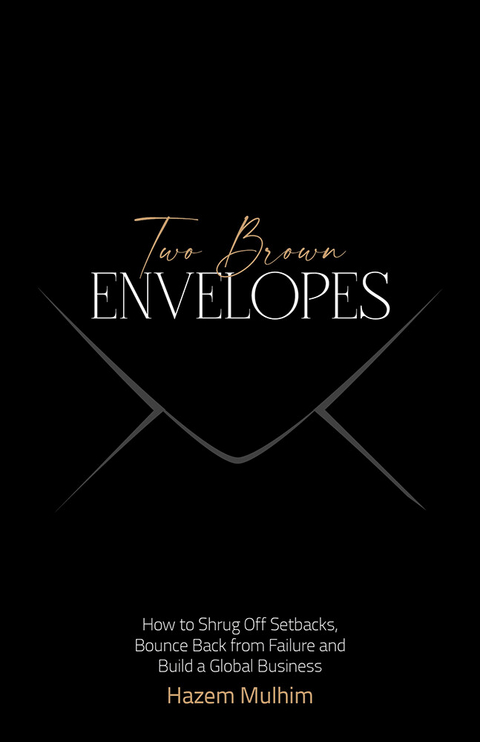
Two Brown Envelopes (eBook)
218 Seiten
Houndstooth Press (Verlag)
978-1-5445-2482-5 (ISBN)
When Hazem Mulhim was starting out in life, his father presented him with two brown envelopes: one bulging with money, the other flat with some dollar bills. Only one-and its contents-would be his. After a brief but memorable discussion, his father made the decision that would influence the rest of Hazem's life. Two Brown Envelopes offers a refreshingly candid account of the ups and the downs of building a business in the age of globalization. Hazem started out as a shop owner, opening the first computer store in Jordan in the 1980s. Since then, he has built a global business that provides anti-money-laundering and other technology solutions for almost 10 percent of the world's banks. Unlike most business memoirs that only recount achievements, Two Brown Envelopes takes you on a roller-coaster journey-revealing the humbling lows of defeat and the highs of winning-proving that what defines your future is how well you shrug off setbacks and bounce back from failure.
Chapter 2
Two Brown Envelopes
I grew up with my father telling me all about his formative years in England in the late 1940s. It was a time of scarcity: there were no luxuries, rationing still existed, and austerity was the prevailing economic orthodoxy. And yet my father was filled with hope as he watched a nation try to rebuild itself anew in the aftermath of the Second World War. He was energized by the Labour leader, Clement Atlee, excited by the creation of the National Health Service, and enthused by ideas about workers’ rights and the cooperative movement. He was animated by the new mood of freedom that followed the defeat of Nazism, and he applauded the efforts of anti-colonial leaders—notably Mahatma Gandhi and Nehru in India—who fought for independence from the British Empire.
He enjoyed his four years as a law student in Leeds, and he knew that the experience had set him up for success in life. Everywhere he went, he carried his business card, stamped with the words: “Barrister-at-Law, Gray’s Inn.” He was justly proud of his achievement. Step inside Gray’s Inn’s ancient hall, with its ornate oak screen, which is said to have been carved from wood salvaged from a defeated galleon of the Spanish Armada and given to the lawyers by Queen Elizabeth I, and you can see how far my father traveled in those postwar years.10 And so it was inevitable that, when it came to my own postschool education, England would loom large as an option.
It is important to note here that Palestinians regard education as a critical asset. As a people, we are defined not by our faith—since there are Palestinian Muslims, Palestinian Christians and Palestinian Jews—but by the place we called home until we were brutally forced to leave in 1948. Since then, there has been nowhere that we can truly call home—where we rule ourselves. That loss continues to haunt us. How could it not? If you’re an American, can you imagine being banished from entering the United States? If you’re British, can you imagine having to apply for a visa in order to see the White Cliffs of Dover?
Without a home, we are, by definition, homeless. But with an education, at least, we can go anywhere, we can do anything, and we can succeed. As Yasser Arafat, the late Chairman of the Palestinian Liberation Organization (PLO), once put it, after 1948, “we had to struggle for sheer existence,” and so “even in exile we educated our children.” Why? “This was all a part of trying to survive.”11
So Palestinian parents prioritize education, and they are prepared to set aside considerable resources to fund their children’s schooling. That they do so is well known across the region. When Saudi Arabia’s founder, King Ibn Sa’ud, ordered Aramco to hire Palestinians, he did so primarily because he wanted to show “a sign of solidarity” with displaced fellow Arabs. But he also knew that he would be able to tap what Aramco’s official history recognized as “among the best-educated Arab populations in the Middle East.”12
As I prepared to leave my Kuwaiti high school, I had several possible options. One was to go to university in the United States, which was the route taken by some of my friends. Another option was to go to either the American University in Beirut or the American University in Cairo—two institutions founded by American missionaries and which enjoyed fine reputations. But after much debate, it was decided that I would be sent to an English boarding school to study A-levels and prepare for entry to a British university.
***
So in 1973, when I was eighteen years old, I flew from Kuwait to London, landing in Heathrow on a cold September day. It was my first visit to Europe. Until then, the most distant place I had visited was Istanbul. After a couple of days in London, where I stayed with my mother’s uncle, who was then working for an American investment company on Regent’s Street, I took the train to a little town in Leicestershire called Market Harborough. Take a look at a map, as I did before I set off from Kuwait, and you’ll see that it is slap bang in the middle of the country.
If you have never been to Market Harborough, think of a classic English town, with half-timbered Tudor buildings, and you’ll know what I mean. Every time I think back to my first visit, I am reminded of the Hollywood movie Straw Dogs, in which the Dustin Hoffman character moves to an out-of-the-way English village in the middle of nowhere.
When I got to Market Harborough, after two hours on the train from London, it was 5 p.m. and already getting dark. The place was dead. Not long before, I had been weaving my way through the crowd as I looked for my carriage at Kings Cross station. Now, there was no one around except the stationmaster, who greeted me with a grunt, clipped my ticket and pointed me in the direction of the taxi stand. There, I waited for what seemed like an age.
Eventually, a taxi arrived, I lifted my suitcase into the boot, and we sped toward my new school. A few minutes later, we drove through the entrance to Brooke House College, a grand, ivy-covered Georgian mansion where the headmaster, Mr. Donald Williams, and his wife, Joan, were there to welcome me. At the turn of the twentieth century, this building had served as a winter hunting lodge for a distinguished old English family—the de Capell Brookes—and all those years later, it still retained its warm, high-spirited, collegial atmosphere.13
But for all its old-world charms, the school was relatively new, and it focused on helping international students switch to the British education system. My father liked the school when he had visited the previous year, and he liked the fact that it took boarders: he thought that this would keep me in check and help me focus on my studies.
As things turned out, he could not have been more wrong.
***
On that first exciting day, I was shown to my boarding house, where I shared a room with a young white Rhodesian—Zimbabwe would not win independence from Britain for another seven years. I was then taken to the hall, where we were treated to a sumptuous meal. It was a propitious beginning. But ultimately, my time in England was marred by underachievement, although it was no less formative for that. I studied four A-levels: mathematics, chemistry, physics and biology. I had graduated with distinction in Kuwait, and so my ambition was to win a place to study medicine at university.
But once in England, far from home, living on my own, I had my head turned: by girls, by smoking and drinking and by the extraordinary events happening back home. A few weeks after my arrival, the third Arab-Israeli war, sometimes known as the Yom Kippur War, erupted: Egypt’s leader, Anwar Sadat, promised that the PLO would be handed control of the West Bank and Gaza, if Israel were defeated.
Israel won the war and retained control of the Palestinian territories, including Halhul and the rest of the West Bank. But the Arab world retaliated, imposing an oil embargo on countries that supported Israel, including Britain. By January 1974, the British government had imposed a three-day work week, as it tried to conserve dwindling energy resources by reducing the consumption of electricity produced by coal-burning power stations.
At Brooke House, we had to get used to routine power cuts, when we occasionally had to resort to using candles to see anything. And I remember once walking round Piccadilly Circus—London’s answer to New York’s Times Square—and noticing how all the buildings no longer had their iconic, flashing neon lights.
Eventually, the oil embargo was lifted, and the spirits of every Palestinian were lifted by some thrilling news from the United Nations in New York. In November 1974, as I began the second year of my A-levels, the young, dashing leader of the PLO, Yasser Arafat, delivered a now-famous speech at the UN assembly. Wearing his trademark black-and-white keffiyeh, and donning dark shades, which he took off as he ramped up the rhetoric, Mr. Arafat said, “Today I have come bearing an olive branch and a freedom-fighter’s gun. Do not let the olive branch fall from my hand. I repeat: do not let the olive branch fall from my hand.”14 Nine days later, the UN reaffirmed the inalienable rights of the Palestinian people to self-determination, national independence and sovereignty, and the right of the Palestinians to return to their homes and property.15
This was a hugely exciting time, and strangely ironic: my father had been studying in England as Palestine was being erased from the map, and now I was studying in England as Palestine seemed to be on the cusp of independence. Throughout this period, I became heavily engaged in lively political debates, and I was an active member of the General Union of Palestinian Students, which was affiliated to the PLO. During the school holidays, I often traveled down to London to spend time with my Palestinian friends, and we would dream of returning to our lost homeland.
It was while I was on one of these trips that I realized that I was the only one among my friends who went to a private boarding school. So, for my second year, I moved to another school: Kettering Technical College. Although it was only about twenty miles from Brooke House College, it was a world away in terms of academics and atmosphere. It was a state-run institution, housed in a perfunctory, redbrick...
| Erscheint lt. Verlag | 24.1.2022 |
|---|---|
| Sprache | englisch |
| Themenwelt | Wirtschaft |
| ISBN-10 | 1-5445-2482-X / 154452482X |
| ISBN-13 | 978-1-5445-2482-5 / 9781544524825 |
| Informationen gemäß Produktsicherheitsverordnung (GPSR) | |
| Haben Sie eine Frage zum Produkt? |
 EPUB (Ohne DRM)
Größe: 385 KB
Digital Rights Management: ohne DRM
Dieses eBook enthält kein DRM oder Kopierschutz. Eine Weitergabe an Dritte ist jedoch rechtlich nicht zulässig, weil Sie beim Kauf nur die Rechte an der persönlichen Nutzung erwerben.
Dateiformat: EPUB (Electronic Publication)
EPUB ist ein offener Standard für eBooks und eignet sich besonders zur Darstellung von Belletristik und Sachbüchern. Der Fließtext wird dynamisch an die Display- und Schriftgröße angepasst. Auch für mobile Lesegeräte ist EPUB daher gut geeignet.
Systemvoraussetzungen:
PC/Mac: Mit einem PC oder Mac können Sie dieses eBook lesen. Sie benötigen dafür die kostenlose Software Adobe Digital Editions.
eReader: Dieses eBook kann mit (fast) allen eBook-Readern gelesen werden. Mit dem amazon-Kindle ist es aber nicht kompatibel.
Smartphone/Tablet: Egal ob Apple oder Android, dieses eBook können Sie lesen. Sie benötigen dafür eine kostenlose App.
Geräteliste und zusätzliche Hinweise
Buying eBooks from abroad
For tax law reasons we can sell eBooks just within Germany and Switzerland. Regrettably we cannot fulfill eBook-orders from other countries.
aus dem Bereich