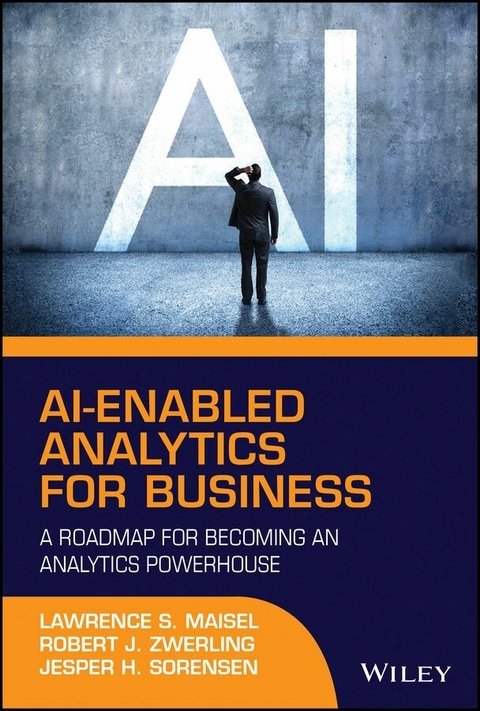
AI-Enabled Analytics for Business (eBook)
John Wiley & Sons (Verlag)
978-1-119-73609-7 (ISBN)
We are entering the era of digital transformation where human and artificial intelligence (AI) work hand in hand to achieve data driven performance.
Today, more than ever, businesses are expected to possess the talent, tools, processes, and capabilities to enable their organizations to implement and utilize continuous analysis of past business performance and events to gain forward-looking insight to drive business decisions and actions. AI-Enabled Analytics in Business is your Roadmap to meet this essential business capability. To ensure we can plan for the future vs react to the future when it arrives, we need to develop and deploy a toolbox of tools, techniques, and effective processes to reveal forward-looking unbiased insights that help us understand significant patterns, relationships, and trends. This book promotes clarity to enable you to make better decisions from insights about the future.
- Learn how advanced analytics ensures that your people have the right information at the right time to gain critical insights and performance opportunities
- Empower better, smarter decision making by implementing AI-enabled analytics decision support tools
- Uncover patterns and insights in data, and discover facts about your business that will unlock greater performance
- Gain inspiration from practical examples and use cases showing how to move your business toward AI-Enabled decision making
AI-Enabled Analytics in Business is a must-have practical resource for directors, officers, and executives across various functional disciplines who seek increased business performance and valuation.
LAWRENCE S. MAISEL is President of DecisionVu, a management consultancy specializing in Performance Management, Data Analytics, and Operations Improvements. He is an experienced executive with proven leadership to drive efficiency and control through planning and analysis, AI-enabled analytics, and operating process redesign. Maisel is a CPA, MBA, and CGMA and received AICPA's Thought Leader award for creating its Center for Excellence in Financial Management. He authored Predictive Business Analytics, co-created with Drs. Kaplan and Norton, the Balanced Scorecard Approach, and co-authored with Drs. Kaplan and Cooper Implementing Activity-Based Cost Management. He is a former Senior KPMG Partner and an Adjunct Professor, Columbia University's Graduate School of Business.
ROBERT J. ZWERLING is a high-tech entrepreneur founding and growing software companies across telecom, manufacturing, distribution, high data availability, analytics, and AI. He is a noted speaker, thought leader, and author on AI and analytics, and has co-authored with Jesper H. Sorensen dozens of papers and the groundbreaking book, Implementing an Analytics Culture for Data Driven Decisions. Zwerling holds two degrees in engineering and is a registered Professional Engineer. He is Managing Director at Aurora Predictions, providing AI-enabled analytics with an intuitive/no-code interface to automatically reveal insights that moves the business's needle. He is co-founder of the Finance Analytics Institute, which teaches how to implement analytics through papers, surveys, benchmarks, and the Analytics Academy.
JESPER H. SORENSEN is a Finance Executive with a proven track record of advancing the analytics agenda. He is currently a Vice President of Finance at Oracle, leading a large global finance team for a multi-billion-dollar business. Prior to Oracle he held leading positions with DuPont and IBM. He holds several advisory positions including advisory board member for Aurora Predictions. He co-authored with Robert J. Zwerling many articles and papers on analytics and the book Implementing an Analytics Culture for Data Driven Decisions. Sorensen is also the co-founder of the Finance Analytics Institute. He holds a Master in Economics and Management from the University of Aarhus, Denmark, and is certified in Risk Management and Strategic Decision Making from Stanford University
We are entering the era of digital transformation where human and artificial intelligence (AI) work hand in hand to achieve data driven performance. Today, more than ever, businesses are expected to possess the talent, tools, processes, and capabilities to enable their organizations to implement and utilize continuous analysis of past business performance and events to gain forward-looking insight to drive business decisions and actions. AI-Enabled Analytics in Business is your Roadmap to meet this essential business capability. To ensure we can plan for the future vs react to the future when it arrives, we need to develop and deploy a toolbox of tools, techniques, and effective processes to reveal forward-looking unbiased insights that help us understand significant patterns, relationships, and trends. This book promotes clarity to enable you to make better decisions from insights about the future. Learn how advanced analytics ensures that your people have the right information at the right time to gain critical insights and performance opportunities Empower better, smarter decision making by implementing AI-enabled analytics decision support tools Uncover patterns and insights in data, and discover facts about your business that will unlock greater performance Gain inspiration from practical examples and use cases showing how to move your business toward AI-Enabled decision making AI-Enabled Analytics in Business is a must-have practical resource for directors, officers, and executives across various functional disciplines who seek increased business performance and valuation.
LAWRENCE S. MAISEL is President of DecisionVu, a management consultancy specializing in Performance Management, Data Analytics, and Operations Improvements. He is an experienced executive with proven leadership to drive efficiency and control through planning and analysis, AI-enabled analytics, and operating process redesign. Maisel is a CPA, MBA, and CGMA and received AICPA's Thought Leader award for creating its Center for Excellence in Financial Management. He authored Predictive Business Analytics, co-created with Drs. Kaplan and Norton, the Balanced Scorecard Approach, and co-authored with Drs. Kaplan and Cooper Implementing Activity-Based Cost Management. He is a former Senior KPMG Partner and an Adjunct Professor, Columbia University's Graduate School of Business. ROBERT J. ZWERLING is a high-tech entrepreneur founding and growing software companies across telecom, manufacturing, distribution, high data availability, analytics, and AI. He is a noted speaker, thought leader, and author on AI and analytics, and has co-authored with Jesper H. Sorensen dozens of papers and the groundbreaking book, Implementing an Analytics Culture for Data Driven Decisions. Zwerling holds two degrees in engineering and is a registered Professional Engineer. He is Managing Director at Aurora Predictions, providing AI-enabled analytics with an intuitive/no-code interface to automatically reveal insights that moves the business's needle. He is co-founder of the Finance Analytics Institute, which teaches how to implement analytics through papers, surveys, benchmarks, and the Analytics Academy. JESPER H. SORENSEN is a Finance Executive with a proven track record of advancing the analytics agenda. He is currently a Vice President of Finance at Oracle, leading a large global finance team for a multi-billion-dollar business. Prior to Oracle he held leading positions with DuPont and IBM. He holds several advisory positions including advisory board member for Aurora Predictions. He co-authored with Robert J. Zwerling many articles and papers on analytics and the book Implementing an Analytics Culture for Data Driven Decisions. Sorensen is also the co-founder of the Finance Analytics Institute. He holds a Master in Economics and Management from the University of Aarhus, Denmark, and is certified in Risk Management and Strategic Decision Making from Stanford University
Acknowledgments ix
Introduction XI
Part I Fundamentals 1
Chapter 1 A Primer on AI-Enabled Analytics for Business 3
Chapter 2 Why AI-Enabled Analytics Is Essential for Business 17
Chapter 3 Myths and Misconceptions About Analytics 27
Chapter 4 Applications of AI-Enabled Analytics 39
Part II Roadmap 57
Chapter 5 Roadmap for How to Implement AI-Enabled Analytics in Business 59
Chapter 6 Executive Responsibilities to Implement Analytics 87
Chapter 7 Implementing Analytics 97
Chapter 8 The Role of Analytics in Strategic Decisions 109
Part III Use Cases 121
Chapter 9 Cases of Analytics Failures from Deviation to the Roadmap 123
Chapter 10 Use Case: Grabbing Defeat from the Jaws of Victory 133
Chapter 11 Use Case: Incremental Improvements to Gain Insights 143
Chapter 12 Use Case: Analytics Are for Everyone 151
Epilogue 157
Appendix - Analytics Champion Framework 159
About the Authors 209
About the Website 215
Index 217
CHAPTER 1
A Primer on AI-Enabled Analytics for Business
Knowledge will forever govern ignorance; and a people who mean to be their own governors must arm themselves with the power which knowledge gives.
—James Madison1
Artificial intelligence (AI) dates back over 75 years. Alan Turing, a mathematician, explored the mathematical possibility of AI, suggesting that “humans use available information as well as reason in order to solve problems and make decisions,” and if this premise is true, then machines can do so too. This was the basis of his 1950 paper “Computing Machinery and Intelligence,” in which he discussed “how to build intelligent machines and how to test their intelligence.”2
So, what is artificial intelligence? Very broadly speaking, it is the ability of a machine to make decisions that are done by humans. But what does that mean, what does AI look like, and how will it change our lives and society?
We all know that AI, sooner or later, will be part of all businesses. But when it is part of the business is entirely dependent on what each executive knows and understands about AI and analytics. And here lies the chasm between the early adopters and the rest of the pack.
According to Grant Thornton's 21 May 2019 report “The Vital Role of the CFO in Digital Transformation,” the 2019 CFO Survey of Tech Adoption covered several technologies, including advanced analytics and machine learning. 38% of respondents indicated that they currently implemented advanced analytics, and 29% are planning implementations in the next 12 months. For machine learning technology, the survey results said that 29% had implemented it and 24% were planning to implement in the next 12 months. Impressive returns from the survey's sample set, and indicative of the priority of and accelerating trend in the adoption of analytics and AI throughout business. However, while conveying progress in its best light, this survey is a poor showing of a glass that is not even half full.
Implementations of AI are just scratching the surface, as projects have been highly targeted to only certain areas of the business and for certain tasks. So, while the movement to incorporate advanced analytics is in the right direction, there are many more failures than successes. This is disturbingly bad news, which we shall learn largely rests with executives. The good news is that AI and analytics failures are eminently avoidable.
Many executives lack clarity of vision and voice to how they will navigate their business, division, group, or department through the adoption of analytics and AI. Other executives think they know what AI enablement means but are often working from poorly defined terms or misconceptions about analytics. Their knee-jerk response is to hire consultants and buy AI-enabled analytics software without fully understanding how analytics will be used to drive decisions.
Cries of “We need better forecasting” and “What factors are driving our business?” and “We must get smarter about what we do” echo in boardrooms and executive conference rooms. But how exactly is this done? Not what, but how? The “what,” many an executive has read from a mountain of consulting reports; but the “how” is unclear and is why too many businesses are lagging in their adoption of AI and analytics.
In this chapter, we lay the foundation for this book by untangling terms and terminology with definitions and giving a ground-level introduction in select technologies (for the purpose of understanding, not to become experts). We will pursue a high-level discussion of AI, machine learning (ML), and analysis vs. analytics, followed by an explanation of business intelligence and data visualization and how these are different from analytics. We will introduce the application of AI-enabled analytics in the context of insights and the contrast between biased vs. unbiased predictions. Finally, we will position the importance of AI by discussing its ROI.
AI AND ML—SIMILAR BUT DIFFERENT
We see the widely used phrase “AI and ML” and conjure these as linked at the hip; but while related, they are not one and the same. First, AI is a superset, covering all that is considered artificial intelligence. The overarching concept of AI is simply a machine that can make a human decision. Any mode of achieving this human decision by a machine is thus AI, and machine learning is one such mode or subset of AI. Therefore, all ML is AI, but not all AI is ML.
Accordingly, ML is one form of AI. ML is a widely used method for implementing AI, and there are many tools, languages, and techniques available. ML engages algorithms (mathematical models) that computers use to perform a specific task without explicit instructions, often relying on patterns and inference, instead.
Another popular form of AI is neural networks that are highly advanced and based on mirroring the synapse structure of the brain. So, ML and neural networks are both subsets of AI, as depicted in Figure 1.1, as well as other forms of AI (that is, any other technology/technique that enables a machine to make a human decision).3
Figure 1.1 Superset and subsets of AI.
MACHINE LEARNING PRIMER
This section offers a brief orientation to ML. ML is a technique and technology that today requires specialized skills to use and deploy. ML is an AI engine often used with other tools to render the ML output useful for decisions. For example, suppose a bank wants to expand the number of loans without increasing the risk profile of its loan portfolio. ML can be used to make predictions regarding risk, and then the results are imported to spreadsheets to report those new additional loan applicants that can now be approved.
Large ML projects often involve the collaboration of data scientists, programmers, database administrators, and application developers (to render a deliverable outcome). Further, ML needs large volumes of high-quality data to “train” the ML model, and it is this data requirement that causes 8 of 10 ML and AI projects to stall.4 While ML is popular and powerful, it is not easy. Many new software applications are making ML use easier, but it is still mostly for data scientists.
Before an ML project can begin, its “object” must be defined: that is, what is to be solved. For example, suppose we want to predict which customers on our ecommerce website will proceed to check out (vs. those who exit before checking out). As presented in Figure 1.2, the process to go from the object to deployed solution has many steps, including collection of data, preparation of data, selecting the algorithm and its programming, model training, model testing, and deployment. Any failure at any point will require a reset and/or restart back to any previous point in the process.3
Figure 1.2 ML process.
ML has a limitation in that the solution of the object is highly specific to the data used to train the ML model. Most often, the model is not transportable, even to a similar business or a similar department within the same business. Also, as mentioned, the use of ML often requires other tools to render its results useful for consumption by business managers. However, while complex, ML can offer high business value with a wide range of applications: for example, predicting customer churn, sales deals that will close in the next 60 days, drugs that are likely to proceed to the next phase in trials, customers who are more likely to buy with a 5% discount, demand forecasting, and so on.
ANALYTICS VS. ANALYSIS
Another set of terms to get our arms around is analysis and analytics. Analysis, in business reporting, involves calculations of arithmetic (add, subtract, multiply, and divide), whereas analytics for business encompasses mathematics (algebra, trigonometry, geometry, calculus, etc.) and statistics (about the study of outcomes).
In a profit and loss statement, there is a variance analysis of current year actual performance against budget. The analysis is expressed as the difference in dollars and as a percent. The variance analysis uses arithmetic to make a measurement of the existing condition of the company compared to what it planned for the year. This analysis is comparative information from arithmetic on data and descriptive of a current situation, but it is not an insight that is additive to a decision.
Insight, as defined with respect to the value from data, is that not known about the business and when known should affect decisions, and insights are derived from analytics that applies mathematics to data.
For example, say sales are down 15% for the past three months, but sales are predicted to increase this month. This prediction is based on a correlation of unemployment as a three-month inverse leading indicator to sales, meaning as unemployment goes down, sales will go up. In this example, unemployment has been dropping for the past three months, so the prediction is for sales to increase in the current month.
The use of correlations to make a prediction is analytics that reveals an insight, which was not known from the data or information from the analysis of the data, and which when known will affect decisions. In this case, without knowing the prediction of the lead indicator, the business would run deep...
| Erscheint lt. Verlag | 10.1.2022 |
|---|---|
| Sprache | englisch |
| Themenwelt | Wirtschaft ► Betriebswirtschaft / Management |
| Schlagworte | AI • AI-enabled business decisions • Artificial Intelligence • Automated Decision Making • business AI • Business & Management • Business & Management Special Topics • Business Analytics • Business Automation • business performance improvement • data analytics • Datenanalyse • decision support • Entscheidungsunterstützung • KI • Künstliche Intelligenz • predictive analytics • Spezialthemen Wirtschaft u. Management • Wirtschaft u. Management |
| ISBN-10 | 1-119-73609-9 / 1119736099 |
| ISBN-13 | 978-1-119-73609-7 / 9781119736097 |
| Informationen gemäß Produktsicherheitsverordnung (GPSR) | |
| Haben Sie eine Frage zum Produkt? |
 EPUB (Adobe DRM)
Kopierschutz: Adobe-DRM
Adobe-DRM ist ein Kopierschutz, der das eBook vor Mißbrauch schützen soll. Dabei wird das eBook bereits beim Download auf Ihre persönliche Adobe-ID autorisiert. Lesen können Sie das eBook dann nur auf den Geräten, welche ebenfalls auf Ihre Adobe-ID registriert sind.
Details zum Adobe-DRM
Dateiformat: EPUB (Electronic Publication)
EPUB ist ein offener Standard für eBooks und eignet sich besonders zur Darstellung von Belletristik und Sachbüchern. Der Fließtext wird dynamisch an die Display- und Schriftgröße angepasst. Auch für mobile Lesegeräte ist EPUB daher gut geeignet.
Systemvoraussetzungen:
PC/Mac: Mit einem PC oder Mac können Sie dieses eBook lesen. Sie benötigen eine
eReader: Dieses eBook kann mit (fast) allen eBook-Readern gelesen werden. Mit dem amazon-Kindle ist es aber nicht kompatibel.
Smartphone/Tablet: Egal ob Apple oder Android, dieses eBook können Sie lesen. Sie benötigen eine
Geräteliste und zusätzliche Hinweise
Buying eBooks from abroad
For tax law reasons we can sell eBooks just within Germany and Switzerland. Regrettably we cannot fulfill eBook-orders from other countries.
aus dem Bereich