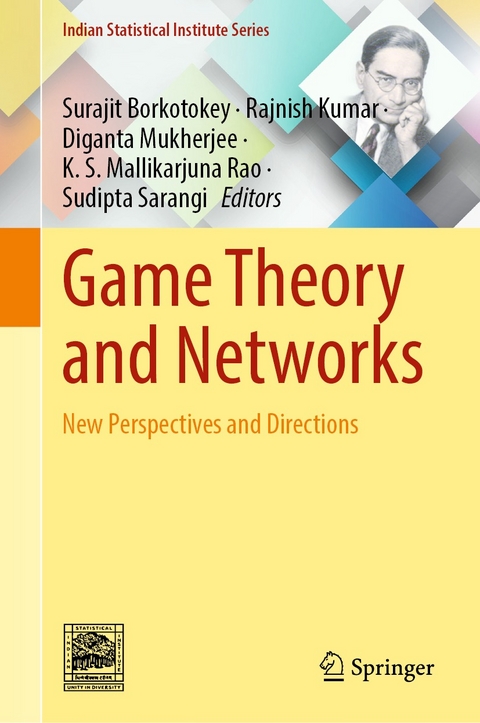
Game Theory and Networks (eBook)
362 Seiten
Springer Singapore (Verlag)
978-981-16-4737-6 (ISBN)
This book is a collection of selected papers presented at the consecutively held international conferences on “Game Theory and Networks”, organized by the Department of Mathematics, Dibrugarh University, India, in collaboration with the Economics Department of Queen’s University, Belfast, UK, during September 6–9, 2019 and September, 13–15 2018. The book includes chapters on network measures and network formation, application of network theory to contagion, biological data and finance and macroeconomics as expository articles. The book also contains chapters on fair allocation in the context of queuing, rationing and cooperative games with transferable utilities for engaged researchers. A few survey chapters on non-cooperative game theory, evolutionary game theory, mechanism design and social choice theory are also incorporated to cater to the needs of the beginners in the field.
This book discusses the use of game theoretic tools and network models across disciplines: mathematics, statistics, economics, computer science, political science, sociology and psychology. It aims at providing a suitable learning experience to beginners on the basics of cooperative games, networks and mechanism design, as well as recent developments to research scholars having the basic knowledge of these topics.
This book is a collection of selected papers presented at the consecutively held international conferences on "e;Game Theory and Networks"e;, organized by the Department of Mathematics, Dibrugarh University, India, in collaboration with the Economics Department of Queen's University, Belfast, UK, during September 6-9, 2019 and September, 13-15 2018. The book includes chapters on network measures and network formation, application of network theory to contagion, biological data and finance and macroeconomics as expository articles. The book also contains chapters on fair allocation in the context of queuing, rationing and cooperative games with transferable utilities for engaged researchers. A few survey chapters on non-cooperative game theory, evolutionary game theory, mechanism design and social choice theory are also incorporated to cater to the needs of the beginners in the field.This book discusses the use of game theoretic tools and network models across disciplines: mathematics, statistics, economics, computer science, political science, sociology and psychology. It aims at providing a suitable learning experience to beginners on the basics of cooperative games, networks and mechanism design, as well as recent developments to research scholars having the basic knowledge of these topics.
| Erscheint lt. Verlag | 1.1.2022 |
|---|---|
| Reihe/Serie | Indian Statistical Institute Series | Indian Statistical Institute Series |
| Zusatzinfo | XIX, 362 p. 37 illus., 25 illus. in color. |
| Sprache | englisch |
| Themenwelt | Mathematik / Informatik ► Mathematik ► Angewandte Mathematik |
| Mathematik / Informatik ► Mathematik ► Finanz- / Wirtschaftsmathematik | |
| Mathematik / Informatik ► Mathematik ► Graphentheorie | |
| Mathematik / Informatik ► Mathematik ► Statistik | |
| Mathematik / Informatik ► Mathematik ► Wahrscheinlichkeit / Kombinatorik | |
| Wirtschaft ► Betriebswirtschaft / Management ► Planung / Organisation | |
| Wirtschaft ► Betriebswirtschaft / Management ► Unternehmensführung / Management | |
| Wirtschaft ► Volkswirtschaftslehre | |
| Schlagworte | Bayesian analysis • Game Theory • Influence • information flow • International Relations • Mechanism Design • Network Models • Rational choice • Social Networks • transferable utility |
| ISBN-10 | 981-16-4737-2 / 9811647372 |
| ISBN-13 | 978-981-16-4737-6 / 9789811647376 |
| Informationen gemäß Produktsicherheitsverordnung (GPSR) | |
| Haben Sie eine Frage zum Produkt? |
 PDF (Wasserzeichen)
DRM: Digitales Wasserzeichen
Dieses eBook enthält ein digitales Wasserzeichen und ist damit für Sie personalisiert. Bei einer missbräuchlichen Weitergabe des eBooks an Dritte ist eine Rückverfolgung an die Quelle möglich.
Dateiformat: PDF (Portable Document Format)
Mit einem festen Seitenlayout eignet sich die PDF besonders für Fachbücher mit Spalten, Tabellen und Abbildungen. Eine PDF kann auf fast allen Geräten angezeigt werden, ist aber für kleine Displays (Smartphone, eReader) nur eingeschränkt geeignet.
Systemvoraussetzungen:
PC/Mac: Mit einem PC oder Mac können Sie dieses eBook lesen. Sie benötigen dafür einen PDF-Viewer - z.B. den Adobe Reader oder Adobe Digital Editions.
eReader: Dieses eBook kann mit (fast) allen eBook-Readern gelesen werden. Mit dem amazon-Kindle ist es aber nicht kompatibel.
Smartphone/Tablet: Egal ob Apple oder Android, dieses eBook können Sie lesen. Sie benötigen dafür einen PDF-Viewer - z.B. die kostenlose Adobe Digital Editions-App.
Buying eBooks from abroad
For tax law reasons we can sell eBooks just within Germany and Switzerland. Regrettably we cannot fulfill eBook-orders from other countries.
aus dem Bereich