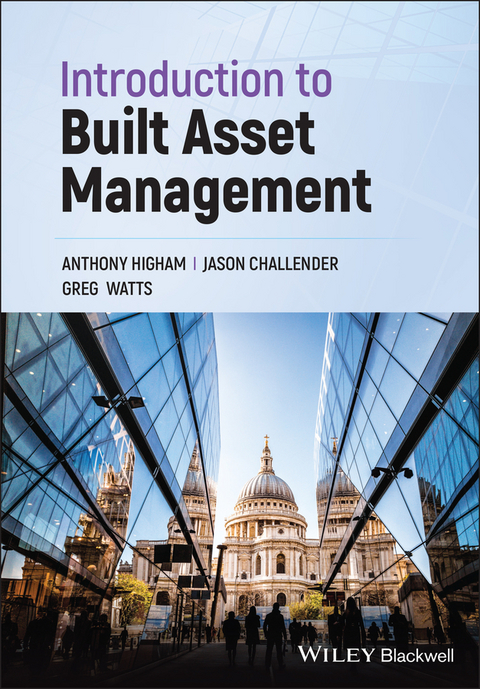
Introduction to Built Asset Management (eBook)
John Wiley & Sons (Verlag)
978-1-119-10656-2 (ISBN)
Provides a multidisciplinary introduction to building maintenance management and execution, covering a wide range of current technical and management issues
The maintenance and upgrading of existing buildings is no longer viewed as separate from the operational phase of the completed building. Maintenance and management are now regarded as fundamental parts of a building's life cycle, forming a significant percentage of the construction industry's total output. As higher education programmes in the UK and elsewhere continue to place greater emphasis on the longer-term view of construction projects, students and instructors require a thorough and up-to-date textbook that emphasises the comprehensive nature of building maintenance.
Introduction to Built Asset Management is a systematic introduction to both the technology and management issues central to building maintenance and refurbishment. Covering the entire life cycle of built assets, the textbook reviews the role of framework agreements, describes key performance indicators, discusses recent advancements in the procurement of maintenance activities and more. Detailed yet accessible chapters include illustrative examples, seminar questions and self-assessment tasks that enable students to measure their progress as they work through the material. Designed to meet the needs of today's learners, this much-needed textbook:
- Addresses a variety of both environmental and commercial concerns
- Evaluates important concepts of sustainability, sustainable maintenance and carbon resilience
- Discusses the growing retrofit market in the wider context of asset management and maintenance
- Describes information management tools such as building information modelling (BIM) and geographic information systems (GIS)
Introduction to Built Asset Management is ideally suited for courses in construction, construction management, building surveying and facilities management with modules in built asset management and maintenance.
Anthony Higham is a Senior Lecturer at the University of Salford, where he has delivered a range of quantity surveying modules. A Chartered Building Engineer and Chartered Construction Manager, Anthony was heavily involved in the financial and project management of major planned maintenance schemes for a range of corporate clients before moving into academia in 2006.
Jason Challender is Director of Estates and Facilities at the University of Salford, UK, a member of its Senior Leadership Team, and responsible for overseeing a large department of approximately 350 estates and construction related staff. He is a Fellow and Board Director of the Royal Institution of Chartered Surveyors.
Greg Watts is a Chartered Quantity Surveyor and Director of the Quantity Surveying Programme at the University of Salford. Before becoming a lecturer, Greg worked in the construction industry up to the level of Senior Quantity Surveyor, for various companies, on a range of multi-million pound projects.
Introduction to Built Asset Management Provides a multidisciplinary introduction to building maintenance management and execution, covering a wide range of current technical and management issues The maintenance and upgrading of existing buildings is no longer viewed as separate from the operational phase of the completed building. Maintenance and management are now regarded as fundamental parts of a building s life cycle, forming a significant percentage of the construction industry s total output. As higher education programmes in the UK and elsewhere continue to place greater emphasis on the longer-term view of construction projects, students and instructors require a thorough and up-to-date textbook that emphasises the comprehensive nature of building maintenance. Introduction to Built Asset Management is a systematic introduction to both the technology and management issues central to building maintenance and refurbishment. Covering the entire life cycle of built assets, the textbook reviews the role of framework agreements, describes key performance indicators, discusses recent advancements in the procurement of maintenance activities and more. Detailed yet accessible chapters include illustrative examples, seminar questions and self-assessment tasks that enable students to measure their progress as they work through the material. Designed to meet the needs of today s learners, this much-needed textbook: Addresses a variety of both environmental and commercial concerns Evaluates important concepts of sustainability, sustainable maintenance and carbon resilience Discusses the growing retrofit market in the wider context of asset management and maintenance Describes information management tools such as building information modelling (BIM) and geographic information systems (GIS) Introduction to Built Asset Management is ideally suited for courses in construction, construction management, building surveying and facilities management with modules in built asset management and maintenance.
Anthony Higham is a Senior Lecturer at the University of Salford, where he has delivered a range of quantity surveying modules. A Chartered Building Engineer and Chartered Construction Manager, Anthony was heavily involved in the financial and project management of major planned maintenance schemes for a range of corporate clients before moving into academia in 2006. Jason Challender is Director of Estates and Facilities at the University of Salford, UK, a member of its Senior Leadership Team, and responsible for overseeing a large department of approximately 350 estates and construction related staff. He is a Fellow and Board Director of the Royal Institution of Chartered Surveyors. Greg Watts is a Chartered Quantity Surveyor and Director of the Quantity Surveying Programme at the University of Salford. Before becoming a lecturer, Greg worked in the construction industry up to the level of Senior Quantity Surveyor, for various companies, on a range of multi-million pound projects.
1
Introduction
1.1 Introduction to the Book
Undertaking responsible and practical repairs and maintenance policies and strategies are becoming an ever-important factor in life cycle management of property assets from owner occupiers to large property portfolios. In this sense, building maintenance practices are needed in every development and is therein a very crucial part in every life of every building. This may be predicated on buildings requiring to be well maintained in order to retain the value of the property itself. Furthermore, the buildings will also continue to fulfil their functions if properly maintained and will give the convenience to the tenant and occupants in the buildings.
With the technological advancement in buildings over many years and the advent of more complex building elements and services, the area of building management is becoming a ‘hot topic’ and one that is worthy of a more profound and professional approach and address. There has become a need for more prescriptive and perhaps regimented maintenance programmes and procedures to ensure statutory compliance is maintained as legislation becomes more convoluted, and to ensure buildings do not develop defects and deteriorate.
Some earlier publications have successfully considered aspects of maintenance, including its dimensions, planning, organisation, procurement and post-contract management and finally the role of knowledge management within maintenance organisations. Despite the comprehensive coverage of the fundamental issues, most of these previous works have not considered the increasingly important areas of carbon resilience and information management, which the present book will address. This is an important and topical aspect, as it is now essential that clients need to consider the viability of retrofitting microgeneration and renewable technologies to existing structures during major maintenance activities. This book will seek to readdress the balance and will provide readers with a depth of knowledge around such areas in an attempt to improve best practice in maintenance management.
1.2 The Main Areas and Themes Covered in the Book
As an introduction to the book and to provide context for readers, an overview is provided below of all the main areas and themes covered alongside related discussion points.
1.2.1 Chapter 2 Surveying Existing Buildings
This chapter will outline the background to conducting building surveys and identify the skills, steps and requirements for them to be completed successfully. It will describe the methodology by which defects are correctly diagnosed through collection of evidence and observing telltale signs. Notwithstanding this premise, it will provide instances when this can sometimes be challenging, and misdiagnosis may remain a real factor. To assist readers, it will describe circumstances and practical examples where there may be more than one force of nature at play and how these can lead to different forms of building deterioration. Furthermore, it will provide examples where certain defects have been misdiagnosed for others and where symptoms are similar, e.g., alternative forms of structural cracking and dampness.
The chapter will also highlight the importance of client engagement both before and after building surveys and will describe the type and form of background information that may be useful to them. In this regard the usefulness of desktop studies and reviewing previous technical reports will be discussed. Following on from this, the importance of understanding the clients’ requirements in the type and nature of information to be captured in the survey will be articulated and explained.
The different types of building survey, ranging from full structural surveys to valuation surveys, will be outlined in the chapter together with the respective benefits and possible limitations of each. In addition, the range of different surveying equipment and tools will be identified. The use and application of each piece of equipment to assist surveyors in their inspections will be covered, especially where access and visibility difficulties are experienced. Photographs of different building surveying equipment and apparatus will be provided.
The modus operandi by which surveyors will conduct their inspections will be discussed, alongside factors such as health and safety and limitations which will need to be considered. In addition, the challenges and obstacles which sometimes confront building surveyors in the course of their inspection will be identified, especially where disruption to normal building operations remains an important factor. Examples of such factors will be given and an understanding of the difficulties that these constraints can impose on the building surveying process.
Following on from this, the importance of further investigation work will be outlined in circumstances that require opening up works or more specialist input. Finally, the various stages of managing the remedial work process will be described, alongside the importance of client consultation of the different options and preferred solutions. Examples of different scenarios leading up to the agreement of the agreed remedial works will be provided.
1.2.2 Chapter 3 Common Maintenance Issues and Managing Defects
This chapter of the book is focused on the pathology of buildings with particular emphasis on building degradation and will describe the ways and means of identifying and addressing potential defective elements and defects within buildings. In this pursuit, it will examine the different methodologies for diagnosis of defects and their root cause (rather than just the symptoms of defects) to assist in identifying the most appropriate type of repair.
An analysis of the underlying conditions and mechanisms that lead to defects and building failures resulting from poor design and quality of build during the construction stage or refurbishment will be covered, from dampness to structural movement, corrosion and timber decay. Furthermore, the role of maintenance across the life cycles of buildings will then be discussed and the influence that this has on their preservation and deterioration. The debate around this important area will then extend into the examination of planned and reactive policies for maintenance management of buildings estates.
The challenges associated with identifying the underlying causes of building failures will be presented where one or more possible different diagnoses may be initially debated. In this context the requirements for further investigation will be examined in correctly determining the underlying root cause of problems more accurately and confidently. The different categories of building failures which lead to the emergence of defects will then be discussed and the mitigation measures that should be undertaken to reduce the risk of such failures. In addition, the individual forces at work leading to different types of defects and how these can vary depending on climate and the geographical locations around the world will be articulated. Furthermore, the difficulties and challenges of correctly identifying faults and defects to building services such as heating, lighting, fire alarms, cooling and other forms of gas and electrical installation will be explained, and practical examples provided.
The importance of understanding the nature and effect of agents that can lead to building defects will be examined in detail, including human misuse of buildings and deliberate vandalism, coupled with electromagnetic, mechanical, chemical, building user, thermal and biological related forces and effects at work. The wrong use of materials and components and design defects will be discussed and how these can develop into latent construction defects in the future, therein introducing maintenance liabilities for building owners. Thereafter, the magnitude of managing remedial works and the associated disruption that this can bring for building users will then be investigated with reference to different examples in practice. Dilemmas associated with repair or renewal decisions will be introduced and debated in detail and the overall effects that decision making can have on future maintenance and lifecycle costings analysis. This will entail a discussion around capital cost (CAPEX) versus operational cost (OPEX) perspectives. Following on from this, the various influences of different factors on the repair or renewal decision making will be covered, including capital funding, building longevity and potential disruption from proposed remedial works.
Managing the remedial works processes to address maintenance issues and defects will be examined, with a focus on best practice and achieving the correct level of supervision and quality control throughout the contract period. This will introduce quality control and best practices in selecting the right design, a team and contractors from the perspective of attaining the necessary skills, experience and competency levels required to undertake projects successfully. Finally, measures to mitigate and prevent defects will be covered and the importance of allowing access provisions in building to enable and carry out regular maintenance inspections as part of planned preventative maintenance programmes.
1.2.3 Chapter 4 Maintenance Management and Performance Measurement as Part of Private Financing Initiative (PFI) Schemes
The chapter will start with a background to the discussion on performance measurement (PM) of maintenance and other facilities management services in the healthcare...
| Erscheint lt. Verlag | 29.12.2021 |
|---|---|
| Sprache | englisch |
| Themenwelt | Recht / Steuern ► Wirtschaftsrecht |
| Technik ► Bauwesen | |
| Wirtschaft ► Betriebswirtschaft / Management ► Rechnungswesen / Bilanzen | |
| Betriebswirtschaft / Management ► Spezielle Betriebswirtschaftslehre ► Immobilienwirtschaft | |
| Schlagworte | Asset Management • Baubetrieb • Bauingenieur- u. Bauwesen • BIM • Building Maintenance • Building Maintenance & Services • Building Surveying • built assets • carbon resilience • Civil Engineering & Construction • Construction • Construction Management • Gebäudeunterhaltung, Dienstleistungen • Gebäudevermessung • GIS</p> <p> </p> • <p>Built Asset Management • Refurbishment • retrofit market • sustainable maintenance |
| ISBN-10 | 1-119-10656-7 / 1119106567 |
| ISBN-13 | 978-1-119-10656-2 / 9781119106562 |
| Informationen gemäß Produktsicherheitsverordnung (GPSR) | |
| Haben Sie eine Frage zum Produkt? |
 EPUB (Adobe DRM)
Kopierschutz: Adobe-DRM
Adobe-DRM ist ein Kopierschutz, der das eBook vor Mißbrauch schützen soll. Dabei wird das eBook bereits beim Download auf Ihre persönliche Adobe-ID autorisiert. Lesen können Sie das eBook dann nur auf den Geräten, welche ebenfalls auf Ihre Adobe-ID registriert sind.
Details zum Adobe-DRM
Dateiformat: EPUB (Electronic Publication)
EPUB ist ein offener Standard für eBooks und eignet sich besonders zur Darstellung von Belletristik und Sachbüchern. Der Fließtext wird dynamisch an die Display- und Schriftgröße angepasst. Auch für mobile Lesegeräte ist EPUB daher gut geeignet.
Systemvoraussetzungen:
PC/Mac: Mit einem PC oder Mac können Sie dieses eBook lesen. Sie benötigen eine
eReader: Dieses eBook kann mit (fast) allen eBook-Readern gelesen werden. Mit dem amazon-Kindle ist es aber nicht kompatibel.
Smartphone/Tablet: Egal ob Apple oder Android, dieses eBook können Sie lesen. Sie benötigen eine
Geräteliste und zusätzliche Hinweise
Buying eBooks from abroad
For tax law reasons we can sell eBooks just within Germany and Switzerland. Regrettably we cannot fulfill eBook-orders from other countries.
aus dem Bereich