


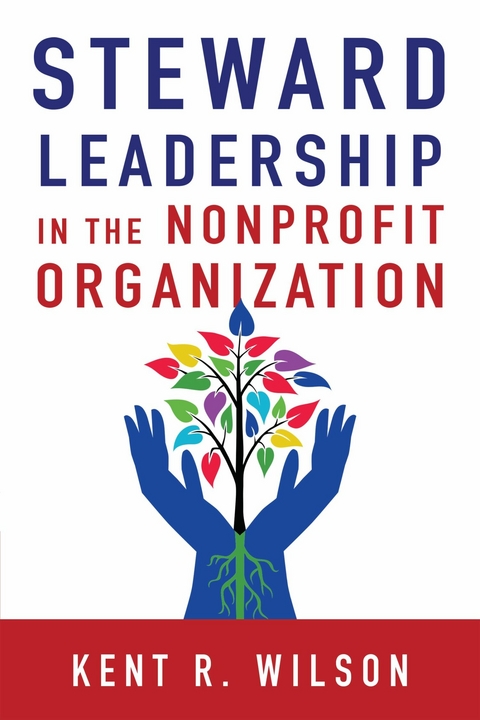
Steward Leadership in the Nonprofit Organization (eBook)
221 Seiten
IVP (Verlag)
978-0-8308-9340-9 (ISBN)
Kent R. Wilson (d. 2017) was a business practitioner and leadership specialist. He was the cofounder of Steward Leadership Initiative and served as the national program director for Christian Leadership Alliance's Leader2Leader program. After running for-profit and nonprofit companies for thirty years, Wilson mentored and coached CEOs as an executive coach with Vistage International and the Nonprofit Leadership Exchange in Colorado Springs. He is a contributor to the NIV Stewardship Study Bible and taught entrepreneurial business skills internationally as a volunteer trainer for three international business-as-mission organizations.
Kent R. Wilson (d. 2017) was a business practitioner and leadership specialist. He was the cofounder of Steward Leadership Initiative and served as the national program director for Christian Leadership Alliance's Leader2Leader program. After running for-profit and nonprofit companies for thirty years, Wilson mentored and coached CEOs as an executive coach with Vistage International and the Nonprofit Leadership Exchange in Colorado Springs. He is a contributor to the NIV Stewardship Study Bible and taught entrepreneurial business skills internationally as a volunteer trainer for three international business-as-mission organizations.
Introduction
I have never enjoyed reading long introductions and tend to skip them if they go on and on, so I’ll be brief. In fact, all I really want to share with you is the vision that drove me to devote decades to researching and writing on steward leadership, especially to writing this book.
I began my professional working life as an electrical engineer but spent the last thirty years of my working life in the nonprofit world. I’ve worked for a children’s camp, a church, a foundation and a nonprofit Christian publishing company, almost all eventually in the capacity of executive director. I also serve on the board of directors of numerous nonprofit organizations (NPOs), mostly in the role of chairman.
My first exposure to the nonprofit world came through my local Bible church. There a young elder, Alex Strauch, encouraged me to embrace my leadership gifts, and under his mentorship I began preaching occasionally starting at age sixteen. I taught Bible studies almost weekly in high school and started serving as deacon while in college. Working in the church taught me how church leadership is unique compared with other nonprofit organizations and how even the young can be given chances to lead, influence and learn.
In my college years I worked every summer at a children’s camp as program director. There I was mentored by the director, Paul Sapp (now deceased), who pointedly taught me about servanthood, accountability, delegation and influence over power.
When I was in my mid-twenties my grandfather approached me one day and asked if I would be willing to take over leadership of the Wilson Family Foundation, an organization he had started in the 1950s to support publishing of Christian books in third-world countries. I was shocked by his offer at my young age, but he too said he recognized leadership in me. We engaged in many conversations about vision, mission, impact for Christ and the spread of the gospel worldwide. In some ways he was a negative example for me; his approach to leadership was as a business owner who emphasized power and authority over influence. But his early vision and obedience to Christ in creating the foundation continues to have its influence to this day, some sixty-five years later.
After college I worked as an electrical engineer for a number of years. I never viewed engineering as a diversion from what some mistakenly call “full-time ministry” (we are all called as believers to full-time ministry wherever we are). As an engineer I saw many examples of leadership, both good and bad, and was given opportunities of my own to lead ethically and to learn how to lead through influence when one does not have formal authority.
Since my youth I felt that God would someday lead me into professional ministry, and so I went to seminary in the evenings for several years. After graduation God made it clear that now was the time to join the pastoral staff of my church, so I left engineering behind and became an associate pastor and teaching elder. Church leadership was a refining process of learning about team leadership and spiritual leadership. But it was also when I experienced the dark side of leadership, when I allowed my passion for the church to overshadow my growing family and marriage, causing me to become a one-sided leader who excelled at ministry and failed at life. I will never forget the day one of the elders confronted me over breakfast (thank you, Doyle Roth) and said, “Kent, you can either have the work of the church or you can have your family, but the way you are living your life right now, you can’t have both. You have to choose.” I chose my family and resigned, feeling as though I had failed as a leader after all those years of learning.
After floundering for months not knowing what to do, God was gracious and opened an opportunity to join the staff at NavPress Publishing, the publishing arm of the Navigators. I was hired to do a job in which I had zero experience (direct marketing), but the publisher saw transferable skills and potential in this young thirty-year-old. I ended up working at NavPress for twenty-one years and performed almost every job, finally being asked to lead the organization as executive publisher for the last ten years. At NavPress I was a part of a rich mentoring and leader-development environment. NavPress is what we call a “commercial nonprofit” in that it is expected to achieve a spiritual mission as a ministry but at the same time operate like a business with all of the attendant financial and performance disciplines. At NavPress I was able to hone and refine steward leadership when there wasn’t a term, literature or defined model for it yet.
Today I work as an executive coach and consultant to business owners and nonprofit executives. I am now the mentor, coach, facilitator and encourager of other leaders, a leader of leaders. It is the fulfillment of my personal mission to mentor developing leaders to be all God intended them to be.
In spite of such an immersive background in the world of nonprofit organizations and nonprofit leadership, my primary exposure to professional leadership development was through reading general business and leadership books, attending occasional leadership seminars and studying the few nonprofit management books available. Like most Christian nonprofit leaders, I found leadership models and resources in the for-profit world, but for the most part those models lacked any biblical basis. I wasn’t looking for “the biblical model” of leadership (since I believe the Bible focuses on principles and a leader’s character, not on models), but I wanted to learn an approach to leadership that was founded on (instead of supplemented by) biblical principles.
The for-profit leadership models I read did provide a wealth of knowledge about organizational leadership and management, but I became increasingly aware of significant differences in the for-profit and nonprofit worlds. My own experience persuaded me that the nonprofit leader’s motivation to produce excellent results had a different basis than that of my for-profit counterparts. The most significant distinction I experienced was an awareness of leading the organization, its people and resources, as a trustee or steward—never as an owner. I also led employees and volunteers who viewed themselves as stewards. I realized that a foundational understanding of one’s role as a steward and not an owner was prevalent throughout Scripture but largely absent in the leadership literature of the day.
Through most of my thirty years of nonprofit leadership, I struggled to develop an approach to leadership that conformed to this steward leader image. There were almost no books or seminars that highlighted the stewardship role nonprofit leaders performed. In fact, most of the Christian books on stewardship ignored the application of the steward as leader.
As a result I talked with peers and tried to develop principles of steward leadership on my own. I read dozens of books on general stewardship (discovering that most were written by Christian authors) but found only one at the time that applied stewardship to leadership, and that just barely. Being a Christian and a trained Bible exegete, I sensed that we could find a basis for understanding who the steward was and how stewards led through studying the Old Testament and the parables of Jesus.
I also was influenced both positively and negatively by other nonprofit leaders. Those who led effectively and articulated stewardship concepts in their leadership encouraged me to emulate their style and approach. Those who led as though they owned the organization and ignored the interests of the board and stakeholders increasingly gave me concern that they were violating fundamental principles of nonprofit leadership. At NavPress, an eighteen-million-dollar nonprofit publishing organization at the time, I found fertile ground both for testing my developing concepts of steward leadership and encouraging stewardship behaviors in other employees. The majority of this research and my concepts of steward leadership were developed while serving as executive director of that organization.
The final impetus to formally launch my research came when I read a copy of Peter Block’s 1993 milestone book on stewardship and leadership, Stewardship: Choosing Service Over Self-Interest. That book thrust the issue of steward leadership to the forefront, but I saw it primarily as a missed opportunity. Block’s book never addresses leadership in the nonprofit sector, and it equates steward leadership with the redistribution of power, purpose and wealth. His book does provide useful emphases on servanthood, rethinking the structure of the workplace and democratizing empowerment. But in my view Block misses the essence of stewardship, which is to manage the resources of others to accomplish the desires and goals of the owner of the resources, not their own objectives. That experience set in motion my commitment to contribute to the dialogue through doctoral research, the development of the Steward Leader Institute, and the writing of this book.
I was torn concerning the type of book I wanted to write. On one hand I wanted to write about the steward as leader in every sphere of life, but I know the nonprofit sphere best and hence chose to focus there. I wanted...
| Erscheint lt. Verlag | 8.8.2016 |
|---|---|
| Verlagsort | Lisle |
| Sprache | englisch |
| Themenwelt | Religion / Theologie ► Christentum ► Moraltheologie / Sozialethik |
| Wirtschaft ► Betriebswirtschaft / Management ► Planung / Organisation | |
| Wirtschaft ► Betriebswirtschaft / Management ► Unternehmensführung / Management | |
| Schlagworte | biblical leadership • board members • CEO • Christian leader • Christian leadership • Leader • Leadership • Management • Manager • Nonprofit • nonprofit leadership • Nonprofit Management • Nonprofit Organization • not for profit • Organizational leadership • Resource Management • servant leader • Servant Leadership • Stakeholders • Steward • steward leader • Stewardship • Trust • Trustee • Trustworthy |
| ISBN-10 | 0-8308-9340-7 / 0830893407 |
| ISBN-13 | 978-0-8308-9340-9 / 9780830893409 |
| Informationen gemäß Produktsicherheitsverordnung (GPSR) | |
| Haben Sie eine Frage zum Produkt? |
 EPUB (Wasserzeichen)
DRM: Digitales Wasserzeichen
Dieses eBook enthält ein digitales Wasserzeichen und ist damit für Sie personalisiert. Bei einer missbräuchlichen Weitergabe des eBooks an Dritte ist eine Rückverfolgung an die Quelle möglich.
Dateiformat: EPUB (Electronic Publication)
EPUB ist ein offener Standard für eBooks und eignet sich besonders zur Darstellung von Belletristik und Sachbüchern. Der Fließtext wird dynamisch an die Display- und Schriftgröße angepasst. Auch für mobile Lesegeräte ist EPUB daher gut geeignet.
Systemvoraussetzungen:
PC/Mac: Mit einem PC oder Mac können Sie dieses eBook lesen. Sie benötigen dafür die kostenlose Software Adobe Digital Editions.
eReader: Dieses eBook kann mit (fast) allen eBook-Readern gelesen werden. Mit dem amazon-Kindle ist es aber nicht kompatibel.
Smartphone/Tablet: Egal ob Apple oder Android, dieses eBook können Sie lesen. Sie benötigen dafür eine kostenlose App.
Geräteliste und zusätzliche Hinweise
Buying eBooks from abroad
For tax law reasons we can sell eBooks just within Germany and Switzerland. Regrettably we cannot fulfill eBook-orders from other countries.
aus dem Bereich


