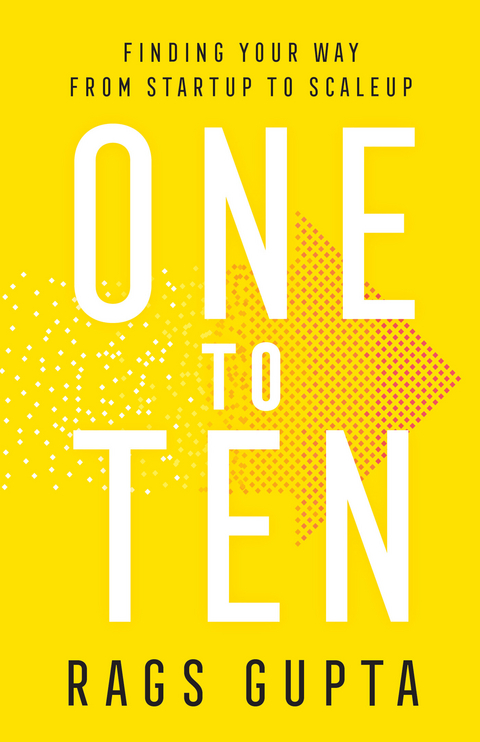
One to Ten (eBook)
250 Seiten
Lioncrest Publishing (Verlag)
9781544522838 (ISBN)
Here's a little secret: Most tech startups get to One. They build a product, land some customers, and close funding. The harder part? Getting from One to Ten. Tech founders struggle to progress past early adopter customers and founder-led sales-to grow from a scrappy group in which everyone just pitches in to building out an executive team and a well-functioning organization. They struggle to go from One to Ten, from Startup to Scaleup. To be able to scale, tech startups must achieve Product Readiness, build a Repeatable Sales Machine, and scale their Human Capital. In One to Ten: Finding Your Way from Startup to Scaleup, B2B tech entrepreneurs will discover the tools, frameworks, and principles they need to overcome the inevitable growing pains and plot their own path to Ten and beyond.
Introduction
“The first $10 million is the hardest.”
—Jason Calacanis
Here’s what they don’t tell you about going from Zero to One: that’s the easy part.
Most startup tech founders create something out of nothing, raise their first institutional rounds, convince some early adopters to pay for their product. They grow the kernel of what could become a real business.
Then they hit a wall.
They struggle to progress past customer pilots. To transcend founder-led sales. To go from a scrappy group pitching in to build out an executive team and a well-functioning organization. To find the right role for each founder. To execute their first reorganization. And, especially, to get to $10 million in revenue.
The going gets messy during the One-to-Ten phase, that awkward adolescence when a startup scales beyond its first customers, its early team, its first million in revenue.
The result? Bridge rounds. Employee attrition. Scathing Glassdoor reviews. Revenue misses. Executive team shake-ups. Founder breakups. Dilution. “Landing the plane” via an acqui-hire. Or worse, perishing in the startup valley of death.
Any of this sound familiar to you?
I, for one, have seen this movie play out many times during my twenty-odd years in tech. And yet, it’s a phase rarely discussed in the startup world. Plenty is written about finding product–market fit or navigating “blitz-scaled hypergrowth,” but the transition phase is rarely talked about.1 I’m here to change that. This book will help you through each step of the One-to-Ten phase.
What do I mean by One to Ten? Let’s first abstract the startup journey into three phases. Take a look at the following chart for a basic understanding of each phase.
Zero to One: Innovation
In the beginning, you leverage your entrepreneurial insight to create something that other people want. This phase, all about finding product–market fit, involves lab work, prototypes and alpha products, maybe your initial 1.0 product. You and your co-founders are landing your first customers, whether they’re called pilots, beta users, or design partners. This stage is all about innovation, about doing things that don’t scale.
One to Ten: Transition
Going from One to Ten requires different muscle than what got you from Zero to One. It requires transitions that you’ve likely never encountered before, much less imagined the right strategy for. You’ll see changes from shipping alpha and beta versions to general availability, from doing things that don’t scale to putting in processes and protocols to reliably service multiple customers, from founder selling to productive reps who can sell without you. You’ll build out your management team and key functions during this stage, which itself will be a major transition for you and your early employees.
Ten to X: Acceleration
Once you’ve proven repeatability of sales and product, this phase is about accelerating growth and finding new S curves of growth, building on the foundation you have in place. This may involve new products, new ways of selling, new markets, and new teams.
Where are you on your journey? This book is to help founders find their way during the One-to-Ten transition phase, when startups grow into scaleups. Take a few recent examples of founders currently finding their way.
Jonathan Tushman and Sonci Honnoll are founders of Quala.io, a next-gen customer success platform based in Boston. Having founded Quala in 2018, Jonathan and Sonci have successfully navigated the Zero-to-One phase with the first version of their platform, their first couple dozen customers, and a top-notch team comprising product, sales, growth, and engineering. But they know that, to get to the next level, they’ll need to deliver the table-stakes features expected by their target market, while proving that their new revenue team can sell without them.
“I’ve helped land every pharma and biotech deal that we’ve done so far. We need to figure out how to scale beyond just me selling.” That’s Abhishek Jha (a.k.a. AJ), founder/CEO of Elucidata, a venture capital (VC)-backed bioinformatics data platform. AJ faces the classic scaling problem of going beyond founder selling. Elucidata needs to build a repeatable sales machine to get to Ten.
“We need to hire a VP of ops. Right now, my co-founder Brent is waking up at five a.m. every day to deal with our site deployments…but the people we’re considering would be the most senior in our company and it makes us nervous!” Damon Henry, co-founder and CEO of Asylon, a drone platform startup providing aerial security to customers such as FedEx and Ford, told me this in a recent conversation. Their drone-in-a-box systems are flying hundreds of missions each month across a number of sites. Damon needs to scale his organization to take Asylon to the next level.
To get to Ten, every business-to-business (B2B) startup needs to nail product readiness, to build a repeatable sales machine, and to scale their human capital. These form a three-legged stool with each leg needing to be in harmony with the other two. For example, you may achieve product readiness and have a great team built out but you’ll flounder without repeatable sales. Another common failure mode is to prematurely scale your org way ahead of product maturity. This book covers the common mistakes to avoid, mental models, and best practices to lay the foundation for growth.
Once you do get to Ten, the sky’s the limit. As Jason Lemkin, founder of Echosign and SaaS guru investor, put it, “If you can get to $10 million in revenue, you can get to a thousand million.”
Having spent twenty-plus years operating and investing in VC-backed startups and scaleups, I’ve seen a lot. The outcomes range from bankruptcy (Rollup Media) to a zombie (Live365) to an acquisition (Videoplaza) to an IPO (Brightcove). And those are just the companies I’ve operated.2 I’ve also invested in, advised, or mentored countless other startups over the years.3
Unsuccessful startups are all alike; every successful startup is successful in its own way.4
And now, a word from my lawyer:5 startup advice is highly context-specific. The advice you get during the Zero-to-One phase may be terrible advice for the One-to-Ten phase. And vice versa. Every founder and company has their unique context, and you are no different. That said, while the settings and characters differ, the plotlines often follow similar arcs. So, this book articulates principles and frameworks to navigate growing pains common to startups. It’s geared toward first-time technical or product-centric entrepreneurs operating B2B startups with an emphasis on top-down sales since there’s so much written about bottom-up, product-led models.
It’s organized around the three legs of the stool.
Part 1 on Product Readiness provides mental models and case studies to determine if your product is ready for scale. I’ll also offer tips for avoiding scaling prematurely, especially relevant for deep tech ventures but applicable to software startups too.
Part 2 on Repeatable Sales offers best practices in getting your sales machine humming. We’ll start with honing your sales motion and cover everything from running great meetings to negotiating and closing deals to building out your go-to-market team.
Part 3 on Scaling Human Capital focuses on the people at your startup. It gives you tools to operate and scale your company, from putting a strategic plan together to developing an operating cadence to building out the organization, concluding with advice on how to scale yourself.
Each part is written to stand alone, so feel free to skip to the parts that are most relevant to you. But the book works as a complete experience if you’re on the cusp of the One-to-Ten journey.
Most startups fail to scale due to internal factors that were under their control. That’s why I wrote this book. If this book helps you close just one more deal or avoid a costly hiring mistake, or even just gives you more confidence in handling your...
| Erscheint lt. Verlag | 28.9.2021 |
|---|---|
| Sprache | englisch |
| Themenwelt | Wirtschaft ► Betriebswirtschaft / Management |
| ISBN-13 | 9781544522838 / 9781544522838 |
| Informationen gemäß Produktsicherheitsverordnung (GPSR) | |
| Haben Sie eine Frage zum Produkt? |
 EPUB (Ohne DRM)
Größe: 2,2 MB
Digital Rights Management: ohne DRM
Dieses eBook enthält kein DRM oder Kopierschutz. Eine Weitergabe an Dritte ist jedoch rechtlich nicht zulässig, weil Sie beim Kauf nur die Rechte an der persönlichen Nutzung erwerben.
Dateiformat: EPUB (Electronic Publication)
EPUB ist ein offener Standard für eBooks und eignet sich besonders zur Darstellung von Belletristik und Sachbüchern. Der Fließtext wird dynamisch an die Display- und Schriftgröße angepasst. Auch für mobile Lesegeräte ist EPUB daher gut geeignet.
Systemvoraussetzungen:
PC/Mac: Mit einem PC oder Mac können Sie dieses eBook lesen. Sie benötigen dafür die kostenlose Software Adobe Digital Editions.
eReader: Dieses eBook kann mit (fast) allen eBook-Readern gelesen werden. Mit dem amazon-Kindle ist es aber nicht kompatibel.
Smartphone/Tablet: Egal ob Apple oder Android, dieses eBook können Sie lesen. Sie benötigen dafür eine kostenlose App.
Geräteliste und zusätzliche Hinweise
Buying eBooks from abroad
For tax law reasons we can sell eBooks just within Germany and Switzerland. Regrettably we cannot fulfill eBook-orders from other countries.
aus dem Bereich