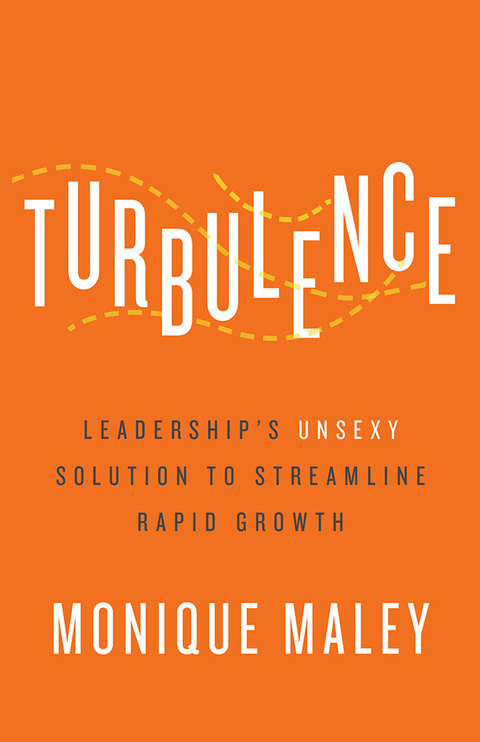
Turbulence (eBook)
262 Seiten
Lioncrest Publishing (Verlag)
978-1-5445-2344-6 (ISBN)
When change intimidates others, you embrace it. Metrics inspire you, and a bold vision drives you. You're an entrepreneurial leader-you thrive with rapid growth. But what happens when growth slows, plateaus, or even declines? What if your structure becomes unstable? Turbulence is the culprit, and it's capable of impacting everything from outlook and productivity to retention and sales. What happens when the cause of that Turbulence is you? In Turbulence, Monique Maley shares the insight she's gained from years of working with entrepreneurial leaders to help you identify the most common ways that turbulence disrupts your organization. She provides you with the tools and strategies you need to create an iterative cycle of leadership that begins with you. Whether you're struggling to build a cohesive culture, experiencing conflict with your board of directors, or failing to see blind spots holding you back, this book shows you how to overcome resistance that stands in your way. You'll learn how to slow down so you can speed up, assess and address turmoil and instability, and unlock the most effective, articulate, and persuasive leader you can be.
Chapter 1
1. Conversations
Dialogue, Not Monologue
“A conversation is a dialogue, not a monologue. That’s why there are so few good conversations.”
—Truman Capote
Communication is like Ping-Pong: neither works if you’re the only person playing.
In Ping-Pong, if you serve the ball over the net and no one is standing on the other side to hit it back, the game ends. If no one hits back, there is no game. Likewise, there is no conversation without at least two sides fully engaged and playing. It takes a ping and a pong.
As leaders, we go through our day thinking about things we need to do: the email we need to write, the press release that needs to go out, the staff meeting we need to hold. We might see each task as a kind of communication, but we often don’t see them as dialogue.
The truth is, if you email a potential customer about a product, that’s a dialogue about sales. If you have a meeting with your board of directors, that’s a dialogue involving influence and persuasion. If you need to make a big decision on goals for next quarter, that’s a dialogue with key players on your team, including yourself. Every conversation, every form of communication, is ultimately a dialogue.
In Ping-Pong, it’s easy to imagine the back-and-forth interaction. Both players have a paddle and each hits the ball during the course of the game. In work-related conversations—whether it’s a Slack message, a pitch, or a one-on-one discussion—there may not be words coming back from the other side of the net, so to speak, but communication is happening through body language, micro-expressions, energy, tone of voice, word choice, and more. Dialogue is taking place.
For those of you who prefer the theater to Ping-Pong: when a show is running for weeks or months at a time, an actor will do the same play night after night, communing with the audience as they perform. Although the play itself is the same, the actual conversation that takes place between actor and audience differs from night to night. The Friday and Saturday night audiences are usually experienced theatergoers. They may laugh, but it’s controlled laughter. The Wednesday matinee is usually full of kids. Their engagement—when they laugh or don’t laugh, how much noise they make—communicates to the actor as well but in a very different way than the Friday and Saturday night crowd. In both cases, the audience’s responses inform the actor how to return the volley. It’s a conversation. It’s a dialogue, even if only one person is doing the talking.
When we view any conversation as a monologue instead of a dialogue, we intentionally or unintentionally make it about us. We limit ourselves to one source of information—ourselves—whether it’s one tape in our head or our own perspective during a performance review. We don’t really listen and thus miss out on the multitude of messages that can inform our understanding, decisions, and interactions, which ultimately leads to turbulence.
Conversations are an integral part of leading. In the course of a day, they happen hundreds of times across the organization. Some are often labeled “tough” or “crucial” conversations, but many are motivating and informative. If even half of those conversations, whether difficult or positive, are ineffective, happen too late, or don’t happen at all, they become a potential source of turbulence in every facet of your company.
To master the skill of effective conversations, we have to begin with the one many leaders find the hardest or often think about the least—conversations with ourselves. I mentioned that leadership can be lonely. This makes effective conversation with yourself essential.
We’ll start this chapter by discussing the ways your internal dialogue might be causing challenges for you and your team, along with strategies for stopping those unproductive conversations. Mastering the conversations in your head is the first step to engaging in effective dialogue with people both inside and outside your organization.
Conversations with Ourselves
Internal dialogue is sometimes associated with mindset, but it’s more. Mindset is the outcome of our thoughts; the internal dialogue is the process that leads to that mindset.
We often talk about mindset when we discuss elite athletes. I am a big fan of professional road racing. In a grand tour, these cyclists race nearly every day for three weeks. Each day lasts four, five, or even six hours without stopping. They race in heat, wind, and freezing rain. They ride fifty miles per hour downhill and up insanely steep mountains—not hills.
How do these cyclists ride up a mountainside after five hours in the rain? Why do they choose to get up and keep going after a brutal fall? Where do they find the power to push to the finish line when they know they can’t win the day? How do they lose ground one day and manage to gain the next? Yes, training and skill play a part, but their mindset is the powerful contributor that makes the difference.
Here is where internal dialogue comes into play. They may think, “My legs are burning,” or “I’m already past my limit,” and then follow those thoughts with, “I’ve gotten through this before,” or “I’m going to win this stage.” Jens Voigt, the well-known German cyclist, would famously yell, “Shut up, legs!” as he struggled up a steep climb. The difference between first and tenth place is often mindset. Those who master the art of internal dialogue come out ahead.
Turbulence Alert
Craig was a very successful client of mine who had somewhat plateaued in his own business leadership. For nearly twenty years prior to our working together, he had been a CEO in organizations with limited resources. His internal conversations had revolved around the theme “How do I make the most of what I have?” implying constant scarcity. Craig had never dreamed big because the resources hadn’t existed to do so: if he’d made a big request, he would have butted heads with the board of directors or disappointed employees because he promised things he couldn’t make happen. Because it had never been a possibility, he had never asked himself, “If I had all the resources I could want at my disposal, what would I do with them?”
Now Craig was CEO of a much bigger company with much deeper resources, both human and financial. He was in a position to think on a grand scale with an almost infinite vision—and that was an unfamiliar place that made him question his judgment. As a result, Craig allowed himself to be informed by other people’s ideas as he worked on the strategic plan. After a conversation with one board member, he would come away thinking that was the direction he wanted to go. Then he would talk to someone else—a longtime mentor—and suddenly his vision shifted.
The problem was that Craig never sat down and had a conversation with himself about his vision. That wasn’t a conversation he was used to having or that he was confident in having.
The goal for Craig was to sit in what felt like discomfort and sort out which perspectives and data points deserved the greatest weight. Out of that came a vision for his organization that was much more exciting, not only for him but also for his employees. Morale skyrocketed.
The goal wasn’t to outright dismiss those other ideas but to understand who was contributing to the conversation and to make sure his own voice was the strongest one.
The Tapes in Your Head
Having an effective conversation with yourself is not necessarily about eliminating unproductive or even negative thoughts. It’s about having a dialogue, not a monologue, with yourself in which you give all thoughts their due and then choose which perspective deserves more weight. If you think about your mind as a conference room, that means giving every perspective at the table the space to speak, not just the loudest or the most negative.
One-sided conversations with yourself are as unproductive and occasionally as damaging as one-sided conversations with others. They are influenced by your beliefs, your experiences, your mood, as well as the tapes you have running through your head. Some tapes may come from a mentor, a dominating board member, or even someone you worked with years ago. Although you need to be aware of the valid points those tapes bring to the dialogue, you also need to recognize when they have no place in the conversation or in what you’re trying to achieve. More often than not, in allowing other voices to dominate, you become the biggest obstacle to your own successful leadership.
Whether positive or negative, the tapes from our past are now part of our internal dialogue and affect nearly every aspect of our leadership: our mindset, our confidence, our credibility, and for entrepreneurial leaders, our risk tolerance. The skill to master is knowing which tapes deserve to be heard and which tapes are just noise. One of my clients has the voice of an...
| Erscheint lt. Verlag | 14.9.2021 |
|---|---|
| Sprache | englisch |
| Themenwelt | Wirtschaft ► Betriebswirtschaft / Management ► Unternehmensführung / Management |
| ISBN-10 | 1-5445-2344-0 / 1544523440 |
| ISBN-13 | 978-1-5445-2344-6 / 9781544523446 |
| Informationen gemäß Produktsicherheitsverordnung (GPSR) | |
| Haben Sie eine Frage zum Produkt? |
 EPUB (Ohne DRM)
Größe: 3,8 MB
Digital Rights Management: ohne DRM
Dieses eBook enthält kein DRM oder Kopierschutz. Eine Weitergabe an Dritte ist jedoch rechtlich nicht zulässig, weil Sie beim Kauf nur die Rechte an der persönlichen Nutzung erwerben.
Dateiformat: EPUB (Electronic Publication)
EPUB ist ein offener Standard für eBooks und eignet sich besonders zur Darstellung von Belletristik und Sachbüchern. Der Fließtext wird dynamisch an die Display- und Schriftgröße angepasst. Auch für mobile Lesegeräte ist EPUB daher gut geeignet.
Systemvoraussetzungen:
PC/Mac: Mit einem PC oder Mac können Sie dieses eBook lesen. Sie benötigen dafür die kostenlose Software Adobe Digital Editions.
eReader: Dieses eBook kann mit (fast) allen eBook-Readern gelesen werden. Mit dem amazon-Kindle ist es aber nicht kompatibel.
Smartphone/Tablet: Egal ob Apple oder Android, dieses eBook können Sie lesen. Sie benötigen dafür eine kostenlose App.
Geräteliste und zusätzliche Hinweise
Buying eBooks from abroad
For tax law reasons we can sell eBooks just within Germany and Switzerland. Regrettably we cannot fulfill eBook-orders from other countries.
aus dem Bereich