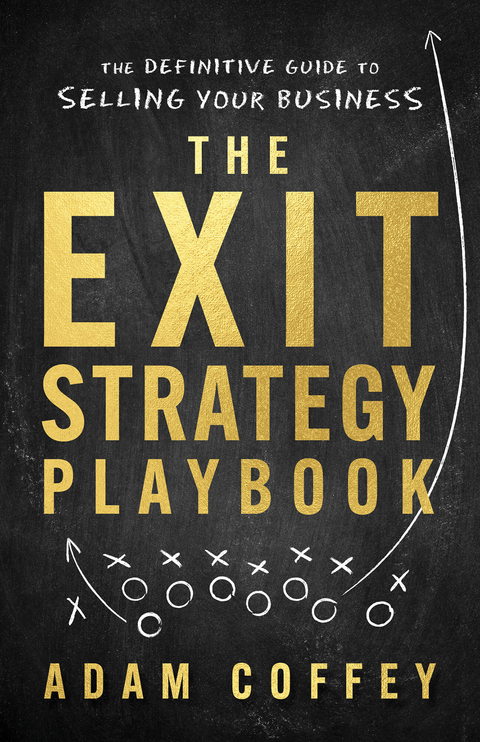
Exit-Strategy Playbook (eBook)
198 Seiten
Lioncrest Publishing (Verlag)
9781544523026 (ISBN)
From the bestselling author of The Private Equity Playbook comes Adam Coffey's second offering, The Exit-Strategy Playbook. Explore the universe of potential buyers. Learn how to assemble a team of expert advisors to prepare your business for sale. Walk step by step through a typical investment-banker-led midmarket sale process from start to finish. Adam Coffey has spent the last twenty years as CEO of three private-equity-backed national service companies. Through his experience executing a buy-and-build strategy, he has bought and sold more than 100 companies ranging in size from $1 million to $1 billion. Selling your business is an art. Learn from an experienced artist how to successfully navigate the sale process. This book isn't about selling fast-it's about selling smart and achieving maximum value for the time and effort you've put into your company. Pick up The Exit-Strategy Playbook today and get an instant PhD in the art of the business sale.
Chapter One
1. Strategic Buyers
We’re going to start with strategic buyers because they are one of the two most common type of buyers you’ll encounter. A strategic buyer is a company that seeks to grow by purchasing another company. The strategic company might be a public company, a private company owned by an individual, or a private company owned by private equity. The acquiring company’s backing and structure are irrelevant. How the acquiring company pays for the purchase is also irrelevant—it may be some combination of cash, leveraged debt, seller note, or stock. The key thing to note is that the buyer type remains strategic when a financial entity or institution does not make the purchase—rather, one company purchases another.
When Morgan Stanley bought E*Trade, Morgan Stanley was a strategic buyer. When Facebook bought WhatsApp, Facebook was a strategic buyer. When Amazon bought Whole Foods, Amazon was a strategic buyer. Get the picture?
Strategic buyers purchase for a multitude of reasons, including:
- Expanding into a new geographical market or customer vertical.
- Building density to create saturation in existing markets.
- Buying expertise, knowledge, or new technology.
Strategic buyers are typically larger in size than the companies they seek to acquire but not always. Sometimes little guys buy big guys too! In general, though, the reason big guys buy smaller guys is that along with size comes the ability to generate enough internal cash or raise enough debt to successfully make the purchase.
In the end, the strategic buyer makes the purchase in order to gain customers, market share, geography, and expertise. There is generally a specific strategy that drives them to acquire, and thus the term strategic buyer was originally coined eons ago by someone my research was unable to uncover!
Types of Strategic Buyers
I like to say there are two types of strategic buyers: those that want to turn the lights off and those that invite you to join the team.
Turn the Lights Off
This type of buyer is not necessarily interested in your expertise. They want your customers and are buying density.
Let’s say one plumbing company services Phoenix, Arizona. They are looking to build density by adding customers in their existing geographic market and customer vertical, so they purchase another local plumbing company. They already have a president, finance department, service staff, parts, and everything they need. They are only looking to increase the size of their existing business and don’t need another CEO or HR department. For that matter, they are not even expanding into new geographies, so they most likely won’t even need the other company’s offices or warehouses.
Although my example above is small in nature, you often see this playing out in larger corporate mergers with many markets that overlap across broad geographies. After the acquisition or merger closes, there’s a period of integration. They make a number of cost reductions and increase profits, and the benefits of the strategic acquirer become fully realized. This concerted effort is known as harvesting the synergies. They may offer the second business owner a consulting agreement to stay on for a period of time. They may offer bonuses to keep key individuals on during the transition. They may keep some of the staff—drivers, service technicians, or other types of worker bees—but the rest are dismissed. One company more or less displaces the other. They literally turn the lights off in all the offices of the acquired company at some point post acquisition.
When I was the CEO of WASH, our normal mode of operation was to acquire companies, work with the founders under a consulting arrangement, and then jettison the majority of the overhead cost of the business. If the geography overlapped, everything would go in the back office and warehouses. Only the people working in the field were kept on. We did this approximately thirty times in my thirteen-year tenure. The only exceptions were when we entered new geography or countries. In those cases, more people retained their jobs, but in virtually all cases, relationships with former owners and founders lasted for only brief periods of time. This company was mostly buying density and access to new markets and the existing long-term contracts and relationships. The primary strategy of the company fit into the category of turn the lights off.
Join the Team
As the CEO of CoolSys, I have bought eighteen companies over the last four years, and sixteen of eighteen owners—and the overwhelming vast majority of all acquired employees—are still active in the business. So what happened to the other two owners? They retired, which was their original goal in selling. This is the opposite of a company that wants to turn the lights off. This strategy is known as join the team or keep the lights on.
The primary key drivers of my using a different strategy at CoolSys are as follows. First, the industry that CoolSys plays in has contracts that, regardless of length, can be canceled with thirty days’ notice by either party. At WASH, we acquired contracts that weren’t cancelable and lasted, on average, five to seven years. Although relationships were important to WASH, the fact that customers couldn’t leave meant that we had time to build new relationships before contract renewal. We only needed the entrepreneurs long enough to help us facilitate that transition.
The second reason was that I had a scalable platform at WASH, and the industry had very predictable ways of conducting business. I could fully and easily integrate companies we acquired. At CoolSys, we are still investing in our technology platforms, and customer interactions are very different depending on the geographic market and specific vertical. The end result is that we need and want entrepreneurs to stay and become a part of CoolSys for a much longer time period or even permanently.
As seen above, an acquiring company may choose to turn the lights off or join the team based on their own individual strengths and weaknesses. At CoolSys, I am purchasing a relationship, so the goal is to retain the owners who created the relationship. I want them to be a part of the company, help us retain their employees, and in essence, keep the lights on.
Determine Your Ideal Buyer
As you begin to entertain possible buyers of your company, it’s important to understand what type of company you’ll be dealing with. You can catch the potential buyer’s deal team off guard and get honest answers by asking overtly.
Start by asking, “How many companies have you acquired in the last five years?”
If they’ve purchased fifteen companies in the last five years, you can ask, “How many of those former entrepreneurs are still active within the business today?”
In my case, I would respond, “Sixteen out of eighteen owners; two have retired.” That is a very good indication that I’m a person who is not turning the lights off and who will invite you to join the team.
If they tell you that you are the first company they are acquiring, you can then ask more directly, “What are your post-close plans for my company?” or “What is the strategic rationale behind your desire to purchase the company? Is this a buy and build? Are you turning the lights off on my business or am I joining the team?”
These questions will show you are a savvy and knowledgeable seller who is capable of an elevated and more meaningful conversation. Buyers will be less apt to attempt to lowball you or play games.
When Do You Consider a Strategic Buyer?
If your company is too small to serve as a platform company with a financial buyer (discussed in Chapter Two), you should consider selling to a strategic buyer. The universe of financial buyers will be limited due to your size. This could mean selling to a small private equity firm buyer, or it could mean selling as an add-on company to a strategic buyer. You may decide that it’s safer or easier to be part of a larger company or that you want to learn from the structure of a larger organization.
My brother Mike and I ultimately sold our insurance agency in January 2020 to Acrisure, a multibillion-dollar company. We chose this strategic buyer because my brother was getting close to retiring and wanted to diversify his holdings, but he wasn’t quite ready to retire yet, so he also wanted someone who would keep the lights on. There were some minor synergies harvested, but my brother continued in his role. He was able to roll over some of his stock and is now an investor in Acrisure (more on rollovers in Chapters Two and Twelve). He’s also running the same company with the same employees—just now under the umbrella of a much larger organization.
Sometimes a strategic purchase can be very positive for the seller because they now have a greater sense of security...
| Erscheint lt. Verlag | 14.9.2021 |
|---|---|
| Sprache | englisch |
| Themenwelt | Wirtschaft |
| ISBN-13 | 9781544523026 / 9781544523026 |
| Informationen gemäß Produktsicherheitsverordnung (GPSR) | |
| Haben Sie eine Frage zum Produkt? |
 EPUB (Ohne DRM)
Größe: 3,0 MB
Digital Rights Management: ohne DRM
Dieses eBook enthält kein DRM oder Kopierschutz. Eine Weitergabe an Dritte ist jedoch rechtlich nicht zulässig, weil Sie beim Kauf nur die Rechte an der persönlichen Nutzung erwerben.
Dateiformat: EPUB (Electronic Publication)
EPUB ist ein offener Standard für eBooks und eignet sich besonders zur Darstellung von Belletristik und Sachbüchern. Der Fließtext wird dynamisch an die Display- und Schriftgröße angepasst. Auch für mobile Lesegeräte ist EPUB daher gut geeignet.
Systemvoraussetzungen:
PC/Mac: Mit einem PC oder Mac können Sie dieses eBook lesen. Sie benötigen dafür die kostenlose Software Adobe Digital Editions.
eReader: Dieses eBook kann mit (fast) allen eBook-Readern gelesen werden. Mit dem amazon-Kindle ist es aber nicht kompatibel.
Smartphone/Tablet: Egal ob Apple oder Android, dieses eBook können Sie lesen. Sie benötigen dafür eine kostenlose App.
Geräteliste und zusätzliche Hinweise
Buying eBooks from abroad
For tax law reasons we can sell eBooks just within Germany and Switzerland. Regrettably we cannot fulfill eBook-orders from other countries.
aus dem Bereich