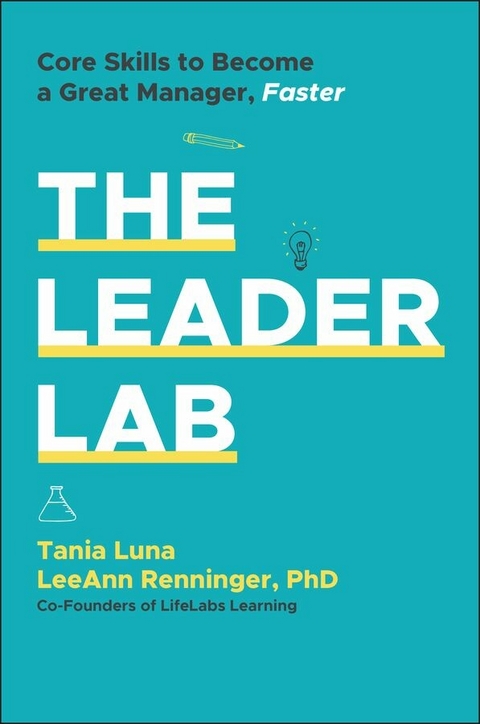
What if you could become a great manager, leader, and communicator faster?
The Leader Lab is a high-speed leadership intensive, equipping managers with the Swiss Army Knife of skills that help you handle the toughest situations that come your way.
Through painstaking research and training over 200,000 managers, authors Tania Luna and LeeAnn Renninger, PhD (co-CEOs of LifeLabs Learning) identified the most important skills that distinguish great managers from average. Most importantly, they've discovered how to help people rapidly develop these core skills. The result? You quickly achieve extraordinary team performance and a culture of engagement, fulfillment, and belonging.?
Too often, folks are promoted without any training for the countless crucial responsibilities of the modern manager: being part coach, part player, part therapist, part role model. The Leader Lab serves as your definitive guide to what it means to be a great manager today - and how to become a great leader faster. This book is based on LifeLabs Learning's wildly successful workshop series. It combines research, tools, and the playful, fluff-free style that's made LifeLabs the go-to professional development resource for over 1,000 innovative companies around the world.??
You'll learn how to:?
- Quickly improve performance and engagement
- Handle tough conversations with confidence
- Identify and resolve the underlying issues holding your team back
- Create a culture of inclusion
- Spark innovation
- Reduce stress and burnout
- Finetune your coaching, productivity, feedback, one-on-one, strategic thinking, meeting facilitation, people development, and leading change skills
- Learn the same high-leverage skills that new managers at the world's most innovative organizations are using to create impactful change in business and in life
This interactive, accessible, and brain-friendly resource will help you and your team ramp up and reach the tipping point of managerial greatness fast.
Tania Luna is the co-founder of LifeLabs Learning-a leadership skills accelerator for culture-conscious companies, including Google, TED, Slack, Reddit, and The New York Times. She is also a psychology researcher, TED speaker, writer for Psychology Today and Harvard Business Review, and co-host of the podcast Talk Psych to Me.
LeeAnn Renninger, PhD, is the co-founder and lead researcher at LifeLabs Learning. She has a doctorate in cognitive psychology, with an emphasis on idea transfer and rapid skill acquisition. She has lectured at Columbia Business School, Princeton, MIT, Yale, and the University College London. She is also the co-author of the book Surprise: Embrace the Unpredictable and Engineer the Unexpected.
TANIA LUNA is the co-founder of LifeLabs Learning--a leadership skills accelerator for culture-conscious companies, including Google, TED, Slack, Reddit, and The New York Times. She is also a psychology researcher, TED speaker, writer for Psychology Today and Harvard Business Review, and co-host of the podcast Talk Psych to Me. LEEANN RENNINGER, PHD, is the co-founder and lead researcher at LifeLabs Learning. She has a doctorate in cognitive psychology, with an emphasis on idea transfer and rapid skill acquisition. She has lectured at Columbia Business School, Princeton, MIT, Yale, and the University College London. She is also the co-author of the book Surprise: Embrace the Unpredictable and Engineer the Unexpected.
The Backstory
How to Use This Book
PART I: The Core BUs
1: Q-step
2: Playback
3: Deblur
4: Validate
5: Link up
6: Pause
7: Extract
PART II: The Core Skills
8: Coaching Skills
9: Feedback Skills
10: Productivity Skills
11: Effective One-on-Ones
12: Strategic Thinking
13: Meetings Mastery
14: Leading Change
15: People Development
Leader Lab Wrap-up
References
Acknowledgments
About the Authors
Index
The Backstory
Let's face it: great managers are rare, and becoming a great manager can take many (difficult) years. But what if there were a way to simplify the complexity of leadership, and become a great manager faster? There is a way to do just that, and we've written this book to show you how. The skills we'll share with you aren't hard, but they do require deliberate practice. As you master each skill, you'll notice your life getting easier, and you'll see yourself making a bigger difference in the world, every day. But first let's talk about why managers matter.
Why Managers Matter
Here's the bad news: 88% of people say they are relieved when their manager is out sick (Leone 2020). Worldwide, only 20% of employees strongly agree they are managed in a motivating way. Poor management costs roughly $7 trillion globally every year in terms of errors, inefficiencies, and turnover – not to mention people's mental and physical health (Wigert and Harter 2017). If you've ever had a bad manager, you've experienced firsthand how it can turn joyful work into daily dread.
There. Now that that's out of the way, let's spend the rest of this book together dwelling on the good news. Great managers make work and life better. They help teams achieve amazing results. They help individuals do their life's best work. We (Tania and LeeAnn) have seen this time and time again thanks to the work we do through our company, LifeLabs Learning, where we train hundreds of thousands of employees at innovative companies around the world, including Google, Warby Parker, the New York Times, Yale, TED, Sony Music, and over 1,000 others.
Our workshop participants told us countless stories of managers who changed their lives. There was Marta, whose team members said she helped them bring their real selves to work for the first time in their careers. There was John, who celebrated every milestone his team reached with such consistency that people said it taught them to be better parents. There was Bernardo, who helped lead a company from near extinction to success. There was Niko, who helped her team members keep updating their résumés so they could see how much they'd grown. And there were so many others. We saw that great managers had infinite ripple effects at work and in life, so we made it our mission to help more people become great managers faster.
Sure, folks can learn on the job, but experience is a slow and confusing teacher. We can't afford to sit around and wait for leadership skills to kick in. There are too many costs and too many people at stake.
Can someone really learn to be a better manager? You bet. Just as in any profession, from medicine to music, some people find some skills easier than others. We don't recommend that everyone be a manager, just as we don't recommend that everyone be a ballet dancer. But everyone can become a better manager faster by applying the lessons in this book.
How do we know? When we follow up with managers we've trained at LifeLabs Learning three months and one year later, over 90% say they are still applying the skills they've learned and are better managers as a result. Our clients report an increase in manager effectiveness, employee engagement, and company productivity. Our favorite part? Our workshop participants tell us that becoming better managers has also helped them become better versions of themselves.
What a Manager Is (Today)
Before we get into the skills of great managers, let's align on what a manager is in today's workplace. The etymology of the word “manager” is actually pretty cringeworthy. It comes from the term “to handle,” especially tools or horses. The dehumanizing implication is that people are resources to be managed. This way of thinking created efficiencies when craftspeople became factory workers, and managers had to ensure uniformity and predictability. Thinking was the manager's role, while doing was the responsibility of the workers.
As you know, things are different now. Given the growing rate of change and competition, companies today rely on everyone collaborating, communicating, learning, and innovating. Unlike the original managers who had to limit people's thinking, today's managers have to help people think faster and better. The best managers no longer manage people. They manage resources, processes, time, priorities, and even themselves. They catalyze results rather than control behavior. They help their team members achieve what neither the manager nor the team members could achieve alone.
The long-debated distinction between leaders and managers is also growing obsolete. It used to be said that leaders handled the unknown, while managers handled predictable work. It was once believed that leaders guide others through influence, while managers control through authority. While leaders don't have to be managers, nowadays managers must be leaders. For this reason, we'll use the terms “manager” and “leader” interchangeably throughout this book and equip you with skills to manage and lead well. So, if you want to become a great manager faster, where should you start?
The Surprising Skills That Matter Most
Great Managers, Assemble!
Consider this: in a 10-minute exchange with one person, a manager uses hundreds of words, microexpressions, and gestures. Which of these behaviors result in a team member who's productive and engaged and which result in the opposite? When we began our mission to help people become great managers faster, we couldn't separate the signal from the noise. So we thought back to the Martas, Johns, Bernardos, and Nikos. We wondered: can we learn directly from these leadership legends? Thanks to this insight, we assembled our first group of research participants.
At LifeLabs Learning, we had the unique opportunity of training people at many different companies around the world. So, every time we went into a company to lead workshops, we asked, “Who here is a great manager?” The people who were named again and again had the most engaged teams and a track record of achieving results. We also compared these “greats” with average managers. Our initial plan was to conduct interviews with the greats and the average, and look for differences in their answers. To make a long story short, this approach was mostly … a flop. When we asked managers which behaviors led to their success, the answers of the great and average folks were not predictive of performance. For example, guess which type of manager (average or great) most often said, “I think it's important to be a good listener.”
The answer? Nearly every manager talked about the importance of listening. So what actually made the greats different? We interviewed the managers’ teams to see if we could gather more helpful data. This approach yielded some interesting insights. For example, we learned there was no correlation between managers believing they were good listeners and their team members rating them as good listeners. But we were still no closer to understanding the behaviors that distinguished great managers.
What's in the Black Box?
You see, one of the challenges with studying management is that it is a uniquely private practice. Nearly all exchanges happen behind closed doors, whether physical or virtual. So, as our next plan of action, we wanted to see if managers would open their doors to us. We asked if we could watch them share feedback, lead meetings, and give pep talks. We wanted to recreate the “black box” of the aviation world – the recording device that has enabled countless improvements in flight crew dynamics. Surprisingly, many said yes. (And to them, we are eternally grateful.) As a result, we got to sit in on one-on-ones and team meetings, as well as solo working sessions where we asked managers to “think out loud” as they made complex decisions. With the black box open, we were able to observe their behaviors in action.
When we began our research on what makes great managers different, we started with the implicit premise that it is the big behaviors that count. Without realizing it, we were waiting for something cinematic to happen. We wanted to get goosebumps and imagine an orchestral crescendo while hearing an inspiring speech. What we found instead were behaviors so small we barely noticed them. But there they were, distinctly standing out again and again in the “black boxes” of the great managers. Even though these leaders came from different industries, professions, and cultures, they had a small set of small behaviors in common.
Discovering Behavioral Units
We've come to call each small behavior we observed a Behavioral Unit (or BU for short). No, they are not dramatic, but they are so elegant in their simplicity that they do give us goosebumps. We began to spot them in casual conversations, in times of conflict, and in every meeting. Even in the midst of our own debates about what makes great managers different, we'd stop one another and say, “Hey, nice BU!” Now that these BUs were visible to us, they were impossible to unsee. Once you learn them, you too will start to spot them everywhere.
The Manager Core: Your Leadership Swiss Army Knife
Once we learned how important BUs are, we...
| Erscheint lt. Verlag | 25.8.2021 |
|---|---|
| Sprache | englisch |
| Themenwelt | Wirtschaft ► Betriebswirtschaft / Management ► Unternehmensführung / Management |
| Schlagworte | Behavioral Leadership • Business & Management • Business Communication • communication skills • Führung • Increase Engagement • interpersonal skills • leadership advice • leadership development </p> • Leadership Training • LifeLabs • <p>Leadership skills • Management f. Führungskräfte • Management / Leadership • Managers • new managers • Soft Skills • Wirtschaft u. Management |
| ISBN-13 | 9781119793335 / 9781119793335 |
| Informationen gemäß Produktsicherheitsverordnung (GPSR) | |
| Haben Sie eine Frage zum Produkt? |
 EPUB (Adobe DRM)
Kopierschutz: Adobe-DRM
Adobe-DRM ist ein Kopierschutz, der das eBook vor Mißbrauch schützen soll. Dabei wird das eBook bereits beim Download auf Ihre persönliche Adobe-ID autorisiert. Lesen können Sie das eBook dann nur auf den Geräten, welche ebenfalls auf Ihre Adobe-ID registriert sind.
Details zum Adobe-DRM
Dateiformat: EPUB (Electronic Publication)
EPUB ist ein offener Standard für eBooks und eignet sich besonders zur Darstellung von Belletristik und Sachbüchern. Der Fließtext wird dynamisch an die Display- und Schriftgröße angepasst. Auch für mobile Lesegeräte ist EPUB daher gut geeignet.
Systemvoraussetzungen:
PC/Mac: Mit einem PC oder Mac können Sie dieses eBook lesen. Sie benötigen eine
eReader: Dieses eBook kann mit (fast) allen eBook-Readern gelesen werden. Mit dem amazon-Kindle ist es aber nicht kompatibel.
Smartphone/Tablet: Egal ob Apple oder Android, dieses eBook können Sie lesen. Sie benötigen eine
Geräteliste und zusätzliche Hinweise
Buying eBooks from abroad
For tax law reasons we can sell eBooks just within Germany and Switzerland. Regrettably we cannot fulfill eBook-orders from other countries.
aus dem Bereich