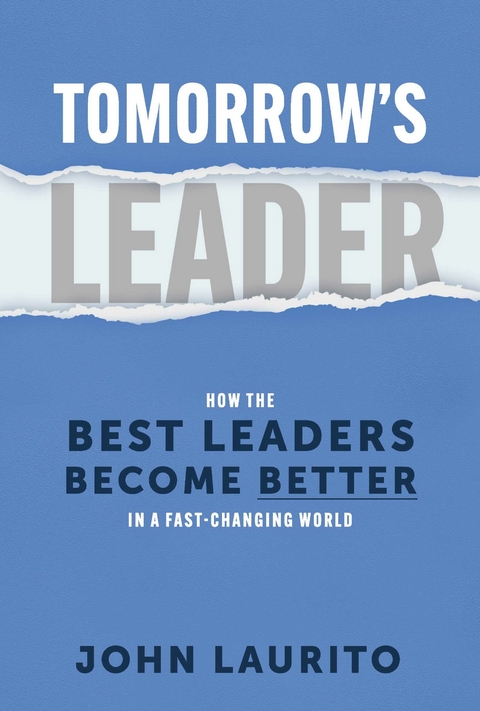
Tomorrow's Leader (eBook)
220 Seiten
Bookbaby (Verlag)
978-1-0983-7409-9 (ISBN)
"e;Tomorrow's Leader: How the Best Leaders Become Better in a Fast-Changing World"e; presents simple, actionable steps that anyone can follow to find their leadership style, have more influence, and even overcome anxiety as a leader. Author John Laurito knows that being a leader is a teachable-and learnable-skill. He has spent his career studying, practicing, and teaching leadership. His motivation for the book is not to just share the concepts of leadership but also to teach you how to apply them to your own career. You may discover that tomorrow's leader can be you!The book begins with the art of self-leadership, which describes setting a course, following it, and correcting as you go. It is important to practice these techniques for yourself before teaching others. Laurito then takes readers on what he calls the "e;Journey to Leadership,"e; explaining how to set and achieve goals, the different styles of successful leadership, and the importance of trust within an organization. The unique storytelling also includes overarching questions about leadership: What makes great leaders successful? How do effective leaders influence others to achieve great things? How do leaders inspire people, sometimes from very diverse backgrounds, to unite behind a shared vision? How can one person make a phenomenal difference in the world around them?Laurito developed his leadership skills throughout a 20-plus-year career in positions at Concord Wealth Management, the Boston Agency of Penn Mutual Life Company, and Ameriprise Financial, where he earned status as a turnaround agent. Today, he has earned an international reputation, teaching leadership to standing-room-only workshops and in private coaching sessions worldwide.
Chapter 1
Whether you realize it or not, you’re a leader
You lead yourself, every hour of every day – with every decision you make, and with every action you take.
It was every public speaker’s worst nightmare. And it was happening to me.
Without a doubt, the most uncomfortable moment in my life occurred when I was 33 years old. By then I had been a successful financial advisor for 7 years and then was promoted to be a leader (managing executive). After 4 years, I was running the Hartford, Connecticut office for my company, one of America’s largest financial services firms.
In one short year, I had helped transform our Hartford branch from one of the worst performers in the country (ranked #100 out of 110) to one of the best: we ranked in the Top 10. Eventually I helped our office reach #1 in the nation.
So when the Regional Vice President of our company called a meeting, and I was invited to make some remarks during a big gathering of executives and employees, it should have been a proud moment for me.
It was anything but.
The audience consisted of about 70 management executives who worked in our wealthy, upscale region. I knew every single one of them. The Regional Vice President spoke first; my direct supervisor spoke next. I knew that I was going to be third.
At first, I was looking forward to it. But as I sat in the audience, waiting to be called up to the stage, I felt my body temperature rising. My neck began to tingle with a flushing, hot, prickly feeling. It spread to my arms and my head. I could feel this thing building as it was getting closer and closer to the moment for me to speak.
The moment arrived. I was invited to say a few words about how we had achieved our remarkable turnaround.
I stood up, and as I walked up the aisle, my breathing became forced and shallow. I struggled to make my lungs take the next breath.
I stepped on stage, went to the podium, turned and faced the audience. And then it broke over me like a tidal wave.
A panic attack.
This was not a slight case of nerves. I am talking about a full-blown, “heart pounding out of your chest,” dry-mouthed, flop-sweat, PANIC ATTACK. I am a pretty big, athletic guy and people say that I normally project self-confidence. But at that moment, my face was turning bright red – and I knew it. I could feel my cheeks burning, and my forehead burning, and my ears burning. Rivers of sweat rolled off me.
I felt as if someone were strangling me! I could not get a single word out of my mouth -- and believe me, I tried. I just stood there, staring stupidly at the audience, looking helplessly at all those people I knew -- gripping the podium with both hands like a drowning man clutching at a life preserver, and wishing that I could disappear.
The seconds were ticking by in silence, and with every tick of the clock my problem was spiraling out of control. My temperature was going up and up. The amount of air in my lungs (and probably the amount of oxygen going to my brain) was going down and down. By now it was almost zero.
The audience – my friends, colleagues and superiors – all stared at me, wondering what was the matter with me. My boss frowned, as if he wanted to ask the person sitting next to him, “What the hell is wrong with John?”
At the time, I could not have told him, even if I had possessed the power of speech.
Oh, I recognized the symptoms. I had been having panic attacks since 8th grade. And, although I had developed a few rudimentary tricks on my own to calm myself down, I had never talked to a doctor or a therapist about my problem. I had never even read a book on the subject.
And so I had no idea there was a name for this terror that flooded over me whenever I became hyper self-conscious that I was the focus of attention. Or when I suddenly realized that I was in the middle of a crowd, even if they were all paying attention to other people and doing other things.
At that moment in the Hartford office, the only thing I could think to do was to turn my back to the audience so I would not have to look at all those staring eyes.
Behind me stood a whiteboard, and I grabbed a magic marker and just started writing like crazy. To this day, I have no idea what I was writing on that board. I was blindly charging forward, buying time, trying to relax myself, trying to think.
But my condition kept growing worse and worse. I felt like my shirt was shrinking. I turned back around as if to address the audience, but at this point my heart was racing like crazy -- probably north of 150 beats a minute -- and I could see that all those people were legitimately concerned about me. Some of them were probably wondering if I was having a heart attack.
I was plummeting out of the sky, heading for a spectacular crash. I was completely in the grip of this thing, and there was absolutely nothing I could do to control it. Instead, it had complete control of me, and I was totally helpless.
In the past, the only tactic I could figure out when I got like this was to get the hell out of there -- get away by myself – escape to a bathroom, an empty classroom, or outside – anyplace I could be alone -- and wait until the terror passed. Wait until my heart started working normally again. Wait until I could breathe and speak and think again.
I had no choice! I had to get out of there! Go! Go! GO!
I dropped the magic marker, leaped off the stage, and bolted out of the room.
Even in the moment, as I fled down the corridor outside the meeting room, I was thinking that this nightmare would have been easier to live with, if my breakdown had taken place in front of a roomful of strangers. But these were people I knew, and who all knew me. They were people whose respect and cooperation I depended on. Quite a few of them were people I liked. Good grief, what would they think of me now?
I raced to the men’s room because that’s all I could think of. I locked myself in a stall and tried to get control of my breathing.
In another minute or so, I heard the outer door opening and a bunch of guys coming into the restroom. They must have paused the program and told everyone to take a break. They probably didn’t know what else to do. But hiding in my stall, I could hear them all coming into the bathroom and I’m thinking, “Oh my God, they all know I’m in here!”
I decided to make noises like I was throwing up in the toilet. It was the only cover story I could think of. I thought, “I’ll just tell everyone I was sick to my stomach,” and after a few minutes, when I felt closer to normal, I emerged from the bathroom and that is exactly what I said.
I guess they believed me. But when I finally went home that night, I knew that I could not go on like this.
Hitting bottom, bouncing back
My panic attack that day turned out to be a major turning point in my life. As a matter of fact, it became an unexpected springboard to tremendous personal and professional growth.
When I had the time to sit down quietly and think clearly about my problem, I knew the worst had happened. I had screwed up in front of the company President, in front of my boss and in front of all my colleagues. Somehow, hitting that definitive low point gave me the ability to see and think objectively about myself and my situation.
On the one hand, I knew that I was achieving real success at my company, and was on the brink of what could be far greater success.
At the same time, I realized that unless I got my “episodes” under control, they would be a severe limiting factor -- not only in my career, but in my life. Feeling helpless and humiliated triggered a lot of anger in me. This was compounded by a lot of frustration, embarrassment, and a host of several other negative emotions.
I decided this was a problem I had to solve. I could no longer just “live with it” and hope it would not return, or that its manifestations would be mild. I faced the fact that it would return, and apparently it would keep getting worse until it ruined my career and damaged my life -- unless I acted.
At that moment I gave myself a mission. I told myself that I would have to try to figure out how to overcome these episodes. And in that moment, I began to practice (and learn) the art of self-leadership.
How I turned my stumbling block into a steppingstone
To make a long story short, I never did consult a doctor or read a book about panic attacks. Again, for many years I didn’t realize these episodes were considered a medical or psychological condition that had a standard diagnosis and set of treatments.
But working through the problem on my own, I gradually learned how to prevent my attacks. Oddly enough, much of it involved a kind of reverse psychology.
First I figured out how to trigger a panic attack -- by making myself vulnerable and concentrating on scary thoughts and feelings of everyone judging me. By visualizing myself hyperventilating, sweating, turning red, not being able to breathe, feeling my pulse race wildly out of control.
I got pretty good at triggering the onset of a panic attack.
But that sense of being able to control something about these episodes, even if it was how to bring on the very thing I hated, helped me slowly learn how...
| Erscheint lt. Verlag | 27.5.2021 |
|---|---|
| Sprache | englisch |
| Themenwelt | Wirtschaft ► Betriebswirtschaft / Management ► Unternehmensführung / Management |
| ISBN-10 | 1-0983-7409-6 / 1098374096 |
| ISBN-13 | 978-1-0983-7409-9 / 9781098374099 |
| Informationen gemäß Produktsicherheitsverordnung (GPSR) | |
| Haben Sie eine Frage zum Produkt? |
 EPUB (Ohne DRM)
Größe: 796 KB
Digital Rights Management: ohne DRM
Dieses eBook enthält kein DRM oder Kopierschutz. Eine Weitergabe an Dritte ist jedoch rechtlich nicht zulässig, weil Sie beim Kauf nur die Rechte an der persönlichen Nutzung erwerben.
Dateiformat: EPUB (Electronic Publication)
EPUB ist ein offener Standard für eBooks und eignet sich besonders zur Darstellung von Belletristik und Sachbüchern. Der Fließtext wird dynamisch an die Display- und Schriftgröße angepasst. Auch für mobile Lesegeräte ist EPUB daher gut geeignet.
Systemvoraussetzungen:
PC/Mac: Mit einem PC oder Mac können Sie dieses eBook lesen. Sie benötigen dafür die kostenlose Software Adobe Digital Editions.
eReader: Dieses eBook kann mit (fast) allen eBook-Readern gelesen werden. Mit dem amazon-Kindle ist es aber nicht kompatibel.
Smartphone/Tablet: Egal ob Apple oder Android, dieses eBook können Sie lesen. Sie benötigen dafür eine kostenlose App.
Geräteliste und zusätzliche Hinweise
Buying eBooks from abroad
For tax law reasons we can sell eBooks just within Germany and Switzerland. Regrettably we cannot fulfill eBook-orders from other countries.
aus dem Bereich