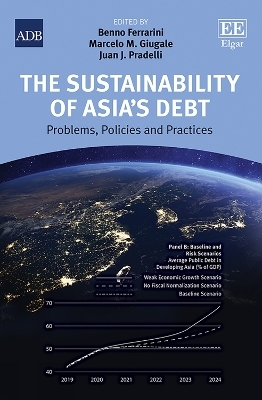
The Sustainability of Asia’s Debt
Edward Elgar Publishing Ltd (Verlag)
978-1-80088-371-0 (ISBN)
That roaring progress was, however, fueled by a lesser-known factor: borrowing. Governments, corporations, and households financed their path to prosperity with debt—lots of debt. Today, the volume of debt hanging over Asian economies is huge, in both absolute and relative terms. It was growing fast before the pandemic and is projected to grow even faster because of it. Demography is bound to make matters worse in the long term. How sustainable is this? What should policy makers do to keep Asia’s finances stable? Should markets worry? These are the core questions of this book.
Through a collection of chapters by renowned experts, a diagnosis of Asia’s debt accumulation is offered. The approach is both country- and issue-driven, so both idiosyncratic and common elements can be identified. Matters like Japan’s social insurance promises, the PRC’s state-owned enterprises, the Pacific islands’ aid dependency, and the saving habits of households in the Republic of Korea are dissected. As are trends that are present across countries, such as population aging, shrinking fiscal space, and contingent liabilities. This allows for a deeper understanding of what makes borrowing sustainable—or not. And it leads directly into policy recommendations, especially those involving the use of new financial instruments.
The final product is a book whose comprehensiveness and practicality are unprecedented in the field. It will be equally invaluable for governments, investors, and scholars in Asia and beyond.
Edited by Benno Ferrarini, Principal Economist, Economic Research and Regional Cooperation Department, Asian Development Bank, Marcelo M. Giugale, Adjunct Professor, Georgetown University and former Director, World Bank and Juan J. Pradelli, Researcher, Center for the Study of State and Society and former Senior Economist, World Bank and Inter-American Development Bank
Contents:
Foreword by Yasuyuki Sawada ix
Overview and synthesis 1
Benno Ferrarini, Marcelo M. Giugale, and Juan J. Pradelli
PART I A DIAGNOSIS OF ASIA’S DEBT
1 Debt in Asia: anatomy, evolution, and prospects 31
Juan Pablo Paladino and Juan J. Pradelli
2 Japan’s public debt sustainability before and after COVID-19 66
Jérémie Cohen-Setton and Keita Oikawa
3 People’s Republic of China: features and recent evolution of corporate debt 87
Ninghua Zhong and Mi Xie
4 Asia’s lower-income countries: concessional public debt, concessional rescues 108
Nicolas Depetris-Chauvin
5 Pacific Islands’ debt: financing post-COVID-19 recovery amid
precarious sustainability 136
Roland Rajah and Alexandre Dayant
6 Subnational debt: developing a sustainable market 167
Lili Liu
7 Asia’s corporate debt: assessing its role in financial vulnerability 188
Hernán D. Seoane
8 Household debt: supply-driven sugar rushes 214
Maria Teresa Punzi
PART II THE RISKS BEHIND ASIA’S DEBT
9 Fiscal uncertainty: the thankless task of forecasting Asia’s fiscal accounts 239
Ugo Panizza
10 Fiscal space: Asia’s fiscal safety net has shrunk 269
Andrea F. Presbitero
11 Contingent liabilities: monitoring exposures that are difficult to measure 299
Timothy C. Irwin
12 Debt generators: the case of energy subsidies 317
Klaus Enders
13 Population aging and debt 342
Sang-Hyop Lee, Andrew Mason, and Donghyun Park
PART III WHAT NEXT? POLICIES TO KEEP ASIA’S DEBT SUSTAINABLE
14 Debt management capacity: a tale of three Asias 367
Phillip Anderson
15 Fiscal insurance: a new tool of fiscal stability 389
Luis de la Plaza
16 Thematic bonds to diversify fiscal sources 409
Farah Imrana Hussain
Index 426
| Erscheinungsdatum | 18.02.2022 |
|---|---|
| Verlagsort | Cheltenham |
| Sprache | englisch |
| Maße | 169 x 244 mm |
| Themenwelt | Wirtschaft ► Volkswirtschaftslehre ► Makroökonomie |
| ISBN-10 | 1-80088-371-4 / 1800883714 |
| ISBN-13 | 978-1-80088-371-0 / 9781800883710 |
| Zustand | Neuware |
| Informationen gemäß Produktsicherheitsverordnung (GPSR) | |
| Haben Sie eine Frage zum Produkt? |
aus dem Bereich