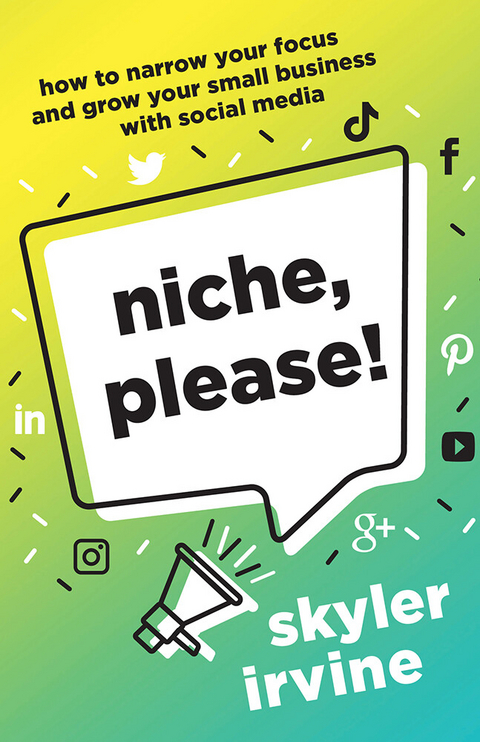
Niche, Please! (eBook)
196 Seiten
Lioncrest Publishing (Verlag)
978-1-5445-2172-5 (ISBN)
TikTok, YouTube, Facebook, Instagram. These words are enough to strike fear in the heart of any established business owner over thirty-five. But there's good news for entrepreneurs overwhelmed by social trends in digital media: you don't have to be an expert in every platform, change your business model, or hire a marketing intern. But this doesn't mean your work is done. You've already conquered the enormous challenge of building a successful company or small business. Now, it's time to find your niche and own it. In Niche, Please!, Skyler Irvine shows you how to adapt your marketing strategy, meaningfully connect with your customers, and focus on the platform that drives results. Technology may have changed, but your story hasn't. This book will show you how to build a lasting brand that survives downturns, capitalizes on opportunity, and thrives throughout change.
Chapter 2
2. “Everything’s Changed!”
I know what you’re thinking, and it’s probably what you would be saying to me right now if we were having this discussion live:
“Skyler, social media has changed everything about running a business today. We’ve never seen anything like this before.”
But we have seen changes like social media before. And smart businesses and entrepreneurs not only survived, but they also took advantage of that change, and you can too.
Let’s journey back to a time where smartphones, internet, and television were all absent, but gender stereotypes were prevalent.
Let’s go back to the 1930s.
Middle-class men across America worked while housewives stayed home, cleaning, cooking, and raising children. Women made decisions on household goods, which meant that household brands wanted their attention.
In the previous decade—the 1920s—Procter & Gamble, Colgate, and other household brands gained attention by advertising in various newspapers. That’s how marketing had been done for decades: if you wanted to gain someone’s attention, you did it with a print ad in a newspaper.
But then radio happened.
Alone on the weekdays, women started tuning in to hear their favorite daytime radio shows. Bachelor’s Children, Backstage Wife, Betty and Bob, Ma Perkins, and on and on. Each of these shows was packed, episode by episode, with family and women’s issues, and of course there was lots of drama. Each episode ended on a cliffhanger, prompting excited listeners to tune into the next one. These shows held women’s attention—the same attention household brands wanted. So, what did household brands do? The smart brands, instead of fighting the change, joined the new media by sponsoring and producing the shows, plastering their brand name across the new and dramatic storytelling medium. Oxydol, Super Suds, Double Danderine, Bab-O, Easy-Off, and dozens of other soaps and cleaning products became synonymous with these radio shows. Few realized it then, but when brands started sponsoring these daytime radio shows they were ushering in a new type of content. Today, we refer to these dramatic shows, originally funded and sponsored mostly by branded soaps, as soap operas.
In one sense, the radio offered a new type of media that appeared to differ greatly from the old way of marketing in newspapers. You can imagine the mad men of the day discussing it:
“How will we ever learn to market on the radio?”
“Radio is too new, too complicated.”
“We’ll never understand how to advertise with sound.”
On one hand, the mad men were right. Radio changed how consumers were spending their attention. The home radio meant brands had to reconsider marketing tactics. They had to leap off the printed newspaper page. They had to learn about audio and sound recordings. They had to incorporate the stars of the soap operas directly into their brand messaging.
But that was just one side of the coin, and it’s usually the only side people focus on.
The other truth is this: radio marketing didn’t change “everything.” Brands still retained their skills and, in general, continued to produce and sell their same products. They still retained everything they had learned about their customers from their previous years of running their businesses. They still had creative, fresh ideas about what to offer.
Plus, their products didn’t change. They still sold soaps. Radio barely affected that.
Lastly, the rule of marketing never changed. Marketing still boiled down to one thing—attention—and advertising on radio via soap operas was simply a different way to gain the same attention.
When you look at the scenario with all that in mind, radio didn’t change everything.
Yes, some companies were left in the dust, because they focused on the difficulty, rather than the opportunity, of radio. They saw radio as a major overhaul, an obstacle, something to fear. But one company in particular went all-in on this new media platform and eventually dominated the soap opera genre, sponsoring shows all the way into the 2010s. That company is Procter & Gamble, which today is pulling in about $70 billion a year, and worth almost $300 billion. Procter & Gamble still sells household brands, many of which are marketed to women. They remained true to themselves when radio happened; they just flexed their marketing plan to respond to changing attention.
So, yes, radio forever changed the game of marketing.
But then TV did it again in the 1950s.
In the 1990s, the internet took over.
In the 2000s, YouTube video took over.
In the 2010s, Instagram became the marketing king.
In the 2020s, TikTok started spreading from device to device at an unprecedented pace.
Oh, and by 2030, the hottest platform will be…
I don’t know yet, but I do know this:
We’ve been here before, and each new medium is simply a different way to gain the same attention.
The Three Niches You Need
Procter & Gamble recognized that radio changed how women spent their attention, but it didn’t change their business model. They just considered their own offerings in light of the market opportunity of the home radio. The result was that they helped develop a new kind of storytelling, called soap operas, which they added to their existing skills of selling soaps and other household goods. They deployed this new type of storytelling on radio channels.
And we can all copy Procter & Gamble’s process. When you break it down, Procter & Gamble followed a three-niche approach:
- Business Niche: they narrowly focused on selling soaps to women.
- Content Niche: they developed a specific type of audio content called soap operas for a specific group of people.
- Media Niche: they deployed their new soap operas through the most obvious method—radio channels.
Every business, every current and new entrepreneur, can use this same three-niche approach to maximize their business and marketing opportunities.
Biz-Niche
Business is selling. So, a business niche is simply selling, but selling specifically. Saying “I sell everything to everyone!” sounds nice. Yes: perhaps later you can focus on selling everything to everyone, but that is not a good place to start.
Lasers work on this basic premise: a conglomeration of otherwise low-power light waves coming together at one point to create enhanced, robust ability. That’s exactly what finding a business niche—or a Biz-Niche, as I like to call it—can do for you. A Biz-Niche allows you to pull all your business energy into one point to target your future customers. Essentially, the more you narrow your business focus, the more power you have. This type of narrowing helps increase your power and your profit margins, find your customers, and reduce competition. It explains why Walmart sells $200 bicycles to everyone and REI sells $5,000 mountain bikes specifically to competitive mountain bikers. A Biz-Niche can also take a general dance teacher to a ballet teacher who sells premium lessons to advanced fourteen- to sixteen-year-old dancers who hope to turn pro. A Biz-Niche could also be geography-specific. For instance, a high-end real estate company in Manhattan would be using geography as part of their Biz-Niche.
You can put all these elements together to help you find your Biz-Niche: the narrow focus of selling your product or service to a subcategory of people with low competition.
Your Biz-Niche: the narrow focus of selling your product or service to a subcategory of people with low competition.
Content Niche
A Content Niche is simply the specific type of content you produce directed at your customer. Many small-business owners and entrepreneurs get overwhelmed by all the available types of social media and digital marketing. They see blogs, vlogs, video, and other content types, and it’s just too much, and they don’t have time for all of it. So, they put someone else in charge of their marketing (for some reason, it’s always their favorite niece). While the favorite niece may understand aspects of social media, the business owner rarely gets involved enough to explain the business to her. So, she does her best, but with little direction, she spreads her efforts thin. The results are...
| Erscheint lt. Verlag | 27.7.2021 |
|---|---|
| Sprache | englisch |
| Themenwelt | Wirtschaft ► Betriebswirtschaft / Management |
| ISBN-10 | 1-5445-2172-3 / 1544521723 |
| ISBN-13 | 978-1-5445-2172-5 / 9781544521725 |
| Informationen gemäß Produktsicherheitsverordnung (GPSR) | |
| Haben Sie eine Frage zum Produkt? |
 EPUB (Ohne DRM)
Größe: 1,3 MB
Digital Rights Management: ohne DRM
Dieses eBook enthält kein DRM oder Kopierschutz. Eine Weitergabe an Dritte ist jedoch rechtlich nicht zulässig, weil Sie beim Kauf nur die Rechte an der persönlichen Nutzung erwerben.
Dateiformat: EPUB (Electronic Publication)
EPUB ist ein offener Standard für eBooks und eignet sich besonders zur Darstellung von Belletristik und Sachbüchern. Der Fließtext wird dynamisch an die Display- und Schriftgröße angepasst. Auch für mobile Lesegeräte ist EPUB daher gut geeignet.
Systemvoraussetzungen:
PC/Mac: Mit einem PC oder Mac können Sie dieses eBook lesen. Sie benötigen dafür die kostenlose Software Adobe Digital Editions.
eReader: Dieses eBook kann mit (fast) allen eBook-Readern gelesen werden. Mit dem amazon-Kindle ist es aber nicht kompatibel.
Smartphone/Tablet: Egal ob Apple oder Android, dieses eBook können Sie lesen. Sie benötigen dafür eine kostenlose App.
Geräteliste und zusätzliche Hinweise
Buying eBooks from abroad
For tax law reasons we can sell eBooks just within Germany and Switzerland. Regrettably we cannot fulfill eBook-orders from other countries.
aus dem Bereich