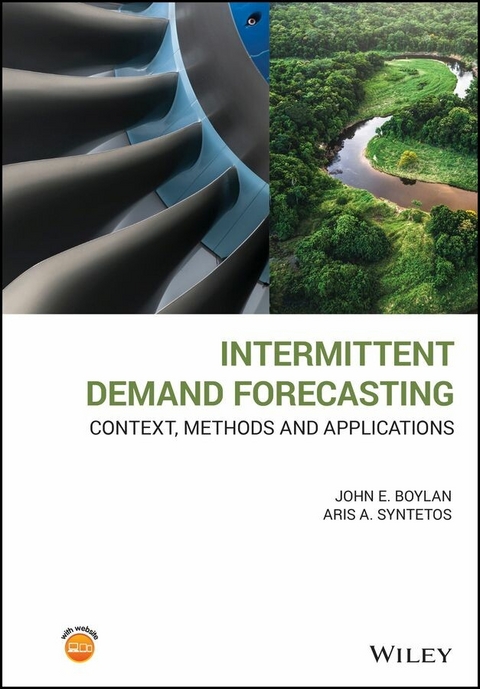
Intermittent Demand Forecasting (eBook)
John Wiley & Sons (Verlag)
978-1-119-13530-2 (ISBN)
The first text to focus on the methods and approaches of intermittent, rather than fast, demand forecasting
Intermittent Demand Forecasting is for anyone who is interested in improving forecasts of intermittent demand products, and enhancing the management of inventories. Whether you are a practitioner, at the sharp end of demand planning, a software designer, a student, an academic teaching operational research or operations management courses, or a researcher in this field, we hope that the book will inspire you to rethink demand forecasting. If you do so, then you can contribute towards significant economic and environmental benefits.
No prior knowledge of intermittent demand forecasting or inventory management is assumed in this book. The key formulae are accompanied by worked examples to show how they can be implemented in practice. For those wishing to understand the theory in more depth, technical notes are provided at the end of each chapter, as well as an extensive and up-to-date collection of references for further study. Software developments are reviewed, to give an appreciation of the current state of the art in commercial and open source software.
'Intermittent demand forecasting may seem like a specialized area but actually is at the center of sustainability efforts to consume less and to waste less. Boylan and Syntetos have done a superb job in showing how improvements in inventory management are pivotal in achieving this. Their book covers both the theory and practice of intermittent demand forecasting and my prediction is that it will fast become the bible of the field.'
-Spyros Makridakis, Professor, University of Nicosia, and Director, Institute for the Future and the Makridakis Open Forecasting Center (MOFC).
'We have been able to support our clients by adopting many of the ideas discussed in this excellent book, and implementing them in our software. I am sure that these ideas will be equally helpful for other supply chain software vendors and for companies wanting to update and upgrade their capabilities in forecasting and inventory management.'
-Suresh Acharya, VP, Research and Development, Blue Yonder.
'As product variants proliferate and the pace of business quickens, more and more items have intermittent demand. Boylan and Syntetos have long been leaders in extending forecasting and inventory methods to accommodate this new reality. Their book gathers and clarifies decades of research in this area, and explains how practitioners can exploit this knowledge to make their operations more efficient and effective.'
-Thomas R. Willemain, Professor Emeritus, Rensselaer Polytechnic Institute.
John E. Boylan (right) is Professor of Business Analytics at Lancaster University, an Editor-in-Chief of the Journal of the Operational Research Society, and President of the International Society for Inventory Research.
Aris A. Syntetos (left) is Professor of Operational Research and Operations Management at Cardiff University, an Editor-in-Chief of the IMA Journal of Management Mathematics, and Director of the International Institute of Forecasters.
INTERMITTENT DEMAND FORECASTING The first text to focus on the methods and approaches of intermittent, rather than fast, demand forecasting Intermittent Demand Forecasting is for anyone who is interested in improving forecasts of intermittent demand products, and enhancing the management of inventories. Whether you are a practitioner, at the sharp end of demand planning, a software designer, a student, an academic teaching operational research or operations management courses, or a researcher in this field, we hope that the book will inspire you to rethink demand forecasting. If you do so, then you can contribute towards significant economic and environmental benefits. No prior knowledge of intermittent demand forecasting or inventory management is assumed in this book. The key formulae are accompanied by worked examples to show how they can be implemented in practice. For those wishing to understand the theory in more depth, technical notes are provided at the end of each chapter, as well as an extensive and up-to-date collection of references for further study. Software developments are reviewed, to give an appreciation of the current state of the art in commercial and open source software. Intermittent demand forecasting may seem like a specialized area but actually is at the center of sustainability efforts to consume less and to waste less. Boylan and Syntetos have done a superb job in showing how improvements in inventory management are pivotal in achieving this. Their book covers both the theory and practice of intermittent demand forecasting and my prediction is that it will fast become the bible of the field. Spyros Makridakis, Professor, University of Nicosia, and Director, Institute for the Future and the Makridakis Open Forecasting Center (MOFC). We have been able to support our clients by adopting many of the ideas discussed in this excellent book, and implementing them in our software. I am sure that these ideas will be equally helpful for other supply chain software vendors and for companies wanting to update and upgrade their capabilities in forecasting and inventory management. Suresh Acharya, VP, Research and Development, Blue Yonder. As product variants proliferate and the pace of business quickens, more and more items have intermittent demand. Boylan and Syntetos have long been leaders in extending forecasting and inventory methods to accommodate this new reality. Their book gathers and clarifies decades of research in this area, and explains how practitioners can exploit this knowledge to make their operations more efficient and effective. Thomas R. Willemain, Professor Emeritus, Rensselaer Polytechnic Institute.
John E. Boylan is Professor of Business Analytics at Lancaster University, an Editor-in-Chief of the Journal of the Operational Research Society, and President of the International Society for Inventory Research. Aris A. Syntetos is Professor of Operational Research and Operations Management at Cardiff University, an Editor-in-Chief of the IMA Journal of Management Mathematics, and Director of the International Institute of Forecasters.
"Intermittent demand forecasting may seem like a specialized area but actually is at the center of sustainability efforts to consume less and to waste less. Boylan and Syntetos have done a superb job in showing how improvements in inventory management are pivotal in achieving this. Their book covers both the theory and practice of intermittent demand forecasting and my prediction is that it will fast become the 'bible' of the field."
--Spyros Makridakis, Professor, University of Nicosia, and Director, Institute for the Future and the Makridakis Open Forecasting Center (MOFC)
"We have been able to support our clients by adopting many of the ideas discussed in this excellent book, and implementing them in our software. I am sure that these ideas will be equally helpful for other supply chain software vendors and for companies wanting to update and upgrade their capabilities in forecasting and inventory management."
--Suresh Acharya, VP, Research and Development, Blue Yonder
"As product variants proliferate and the pace of business quickens, more and more items have intermittent demand. Boylan and Syntetos have long been leaders in extending forecasting and inventory methods to accommodate this new reality. Their book gathers and clarifies decades of research in this area, and explains how practitioners can exploit this knowledge to make their operations more efficient and effective."
--Thomas R. Willemain, Professor Emeritus, Rensselaer Polytechnic Institute
1
Economic and Environmental Context
1.1 Introduction
Demand forecasting is the basis for most planning and control activities in any organisation. Unless a forecast of future demand is available, organisations cannot commit to staffing levels, production schedules, inventory replenishment orders, or transportation arrangements. It is demand forecasting that sets the entire supply chain in motion.
Demand will typically be accumulated in some pre‐defined ‘time buckets’ (periods), such as a day, a week, or a month. The determination of the length of the time period that constitutes a time bucket is a very important decision. It is a choice that should relate to the nature of the industry and the volume of the demand itself but it may also be dictated by the IT infrastructure or software solutions in place. Regardless of the length of the time buckets, demand records eventually form a time series, which is a sequence of successive demand observations over time periods of equal length.
On many occasions, demand may be observed in every time period, resulting in what is sometimes referred to as ‘non‐intermittent demand’. Alternatively, demand may appear sporadically, with no demand at all in some periods, leading to an intermittent appearance of demand occurrences. Should that be the case, contribution to revenues is naturally lower than that of faster‐moving demand items. Intermittent demand items do not attract much marketing attention, as they will rarely be the focus of a promotion, for example. However, they have significant cost implications for a simple reason: there are often many of them!
Service or spare parts are very frequently characterised by intermittent demand patterns. These items are essentially components or (sub‐) assemblies contributing to the build‐up of a final product. However, they face ‘independent demand’, which is demand generated directly from customers, rather than production requirements for a particular number of units of the final product. In the after‐sales environment (or ‘aftermarket’), we deal exclusively with ‘independent demand’ items. Service parts facing intermittent demand may represent a large proportion of an organisation's inventory investment. In some industries, this proportion may be as high as 60% or 70% (Syntetos 2011). The management of these items is a very important task which, when supported by intelligent inventory control mechanisms, may yield dramatic cost reductions.
Industries that rely heavily on after‐sales support, including the automotive, IT, and electronics sectors, are dominated by intermittent demand items. The contributions of the after‐sales services to the total revenues of organisations in these industries have been reported to be as high as 60% (Johnston et al. 2003). This signifies an opportunity not only to reduce costs but also to increase revenues through a careful balancing of keeping enough in stock to satisfy customers but not so much as to unnecessarily increase inventory investments. There are tremendous economic benefits that may be realised through the reappraisal of managing intermittent demand items.
There are also significant environmental benefits to be realised by such a reappraisal. Because of their inherent slow movement, intermittent demand items are at the greatest risk of obsolescence. The problem is exacerbated by the greatly reduced product life cycles in modern industry. This affects the planning process for all intermittent demand items (both final products and spare parts used to sustain the operation of final products). Better forecasting and inventory decisions may reduce overall scrap and waste. Furthermore, the sustained provision of spare parts may also reduce premature replacement of the original equipment.
The area of intermittent demand forecasting has been neglected by researchers and practitioners for too long. From a business perspective, this may be explained in terms of the lack of focus on intermittent demand items by the marketing function of organisations. However, the tough economic conditions experienced from around 2010 onwards have resulted in a switch of emphasis from revenue maximisation to cost minimisation. This switch repositions intermittent demand items as the focus of attention in many companies, as part of the drive to dramatically cut down costs and remain competitive. In addition, the more recent emergence of the after‐sales business as a major determinant of companies' success has also led to the recognition of intermittent demand forecasting as an area of exceptional importance.
Following a seminal contribution in this area by John Croston in 1972, intermittent demand forecasting received very little attention by researchers over the next 20 years. This was in contrast to the extensive research conducted on forecasting faster‐moving demand items. Research activity grew rapidly from the mid‐1990s onwards, and we have now reached a stage where a comprehensive body of knowledge, both theoretical and empirical, has been developed in this area. This book aims to provide practitioners, students, and academic researchers with a single point of reference on intermittent demand forecasting. Although there are considerable openings for further advancements, the current state of knowledge offers organisations significant opportunities to improve their intermittent demand forecasting. Numerous reports, to be discussed in more detail later in this chapter, indicate that intermittent demand forecasting is one of the major problems facing modern organisations. Specialised software packages offer some forecasting support to companies but they often lag behind new developments. There are great benefits that have not yet been achieved in this area, and we hope that this book will make a contribution towards their realisation.
There are three main audiences for this book:
- Supply chain management (SCM) practitioners, broadly defined, who wish to realise the full benefits of managing intermittent demand items.
- Software designers wanting to incorporate new developments in forecasting into their software.
- Students and academics wishing to learn and incorporate into their curricula, respectively, the state of the art in intermittent demand forecasting.
In summary, business pressures to reduce costs and environmental pressures to reduce scrap (often introduced in the form of prescribed policies imposed by national governments or the EU for example) render intermittent demand items, and forecasting their requirements, one of the most important areas in modern organisations.
There are great benefits associated with forecasting intermittent demand more accurately, and those benefits are far from being realised. This may be explained by the well reported innovation–adoption gap, which arises from the divergence between innovations and real‐world practices. Organisational practices typically lag behind software developments, and software developments typically lag behind the state of the art in the academic literature. It is the aim of this book to bridge these gaps and show how intelligent intermittent demand forecasting may result in significant economic and environmental benefits.
In the remainder of this chapter, we first discuss in more detail the potential benefits that may be realised through improved intermittent demand forecasting. We then provide an overview of the current state of supply chain software packages and enterprise resource planning (ERP) solutions with regard to intermittent demand forecasting. This is followed by a section where we elaborate on both the structure of this book and the perspective that we take regarding the material presented here. We close with a summary of the chapter.
1.2 Economic and Environmental Benefits
Intermittent demand for products appears sporadically, with some time periods showing no demand at all. Moreover, when demand occurs, the demand size may be constant or variable, perhaps highly so, leading to what is often termed ‘lumpy demand’. Later in this chapter, we discuss why forecasting sporadic and lumpy demand patterns is a very difficult task. Specific characterisations of intermittent demand series are considered in detail in Chapters 4 and 5.
1.2.1 After‐sales Industry
Intermittent demand items dominate service and repair parts inventories in many industries (Boylan and Syntetos 2010). A survey by Deloitte Research (2006) benchmarked the service businesses of many of the world's largest manufacturing companies with combined revenues reaching more than $1.5 trillion; service operations accounted for an average of 25% of revenues. In addition to their contribution to revenues, these items present a distinct opportunity for cost reductions. Maintenance, repair, and operations (MRO) inventories typically account for as much as 40% of the annual procurement budget (Donnelly 2013). Increased revenues and reduced costs naturally lead to increased profits. Many organisations have repeatedly testified to the importance of after‐sales services for their businesses and the profits they generate. Companies such as Beretta, Canon, DAF Trucks, Electrolux, EPTA, GE Oil & Gas, and Lavapiu have reported contributions of the after‐sales services to their total profit of up to 50% (Syntetos 2011). Comparable numbers have been reported by Gaiardelli et al....
| Erscheint lt. Verlag | 2.6.2021 |
|---|---|
| Sprache | englisch |
| Themenwelt | Mathematik / Informatik ► Mathematik ► Angewandte Mathematik |
| Mathematik / Informatik ► Mathematik ► Statistik | |
| Mathematik / Informatik ► Mathematik ► Wahrscheinlichkeit / Kombinatorik | |
| Wirtschaft ► Betriebswirtschaft / Management ► Unternehmensführung / Management | |
| Schlagworte | Bedarfsanalyse • Betriebswirtschaft • Betriebswirtschaft u. Operationsforschung • Business & Management • Industrial Engineering • Industrial Engineering / Manufacturing • Industrielle Verfahrenstechnik • Management Science/Operational Research • Produktion • Produktion i. d. Industriellen Verfahrenstechnik • Qualität, Produktivität u. Zuverlässigkeit • Quality, Productivity & Reliability • Statistics • Statistik • Wirtschaft u. Management |
| ISBN-10 | 1-119-13530-3 / 1119135303 |
| ISBN-13 | 978-1-119-13530-2 / 9781119135302 |
| Informationen gemäß Produktsicherheitsverordnung (GPSR) | |
| Haben Sie eine Frage zum Produkt? |
 EPUB (Adobe DRM)
Kopierschutz: Adobe-DRM
Adobe-DRM ist ein Kopierschutz, der das eBook vor Mißbrauch schützen soll. Dabei wird das eBook bereits beim Download auf Ihre persönliche Adobe-ID autorisiert. Lesen können Sie das eBook dann nur auf den Geräten, welche ebenfalls auf Ihre Adobe-ID registriert sind.
Details zum Adobe-DRM
Dateiformat: EPUB (Electronic Publication)
EPUB ist ein offener Standard für eBooks und eignet sich besonders zur Darstellung von Belletristik und Sachbüchern. Der Fließtext wird dynamisch an die Display- und Schriftgröße angepasst. Auch für mobile Lesegeräte ist EPUB daher gut geeignet.
Systemvoraussetzungen:
PC/Mac: Mit einem PC oder Mac können Sie dieses eBook lesen. Sie benötigen eine
eReader: Dieses eBook kann mit (fast) allen eBook-Readern gelesen werden. Mit dem amazon-Kindle ist es aber nicht kompatibel.
Smartphone/Tablet: Egal ob Apple oder Android, dieses eBook können Sie lesen. Sie benötigen eine
Geräteliste und zusätzliche Hinweise
Buying eBooks from abroad
For tax law reasons we can sell eBooks just within Germany and Switzerland. Regrettably we cannot fulfill eBook-orders from other countries.
aus dem Bereich