


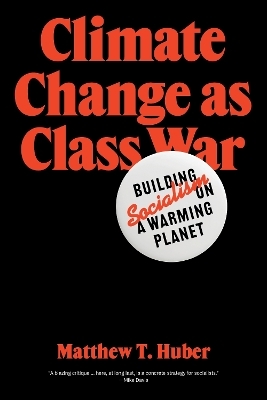
Climate Change as Class War
Building Socialism on a Warming Planet
Seiten
2022
Verso Books (Verlag)
978-1-78873-388-5 (ISBN)
Verso Books (Verlag)
978-1-78873-388-5 (ISBN)
Eco-socialism or eco-barbarism!
The climate crisis is not primarily a problem of 'believing science' or individual 'carbon footprints' - it is a class problem rooted in who owns, controls and profits from material production. As such, it will take a class struggle to solve. In this ground breaking class analysis, Matthew T. Huber argues that the carbon-intensive capitalist class must be confronted for producing climate change. Yet, the narrow and unpopular roots of climate politics in the professional class is not capable of building a movement up to this challenge. For an alternative strategy, he proposes climate politics that appeals to the vast majority of society: the working class. Huber evaluates the Green New Deal as a first attempt to channel working class material and ecological interests and advocates building union power in the very energy system we so need to dramatically transform. In the end, as in classical socialist movements of the early 20th Century, winning the climate struggle will need to be internationalist based on a form of planetary working class solidarity.
The climate crisis is not primarily a problem of 'believing science' or individual 'carbon footprints' - it is a class problem rooted in who owns, controls and profits from material production. As such, it will take a class struggle to solve. In this ground breaking class analysis, Matthew T. Huber argues that the carbon-intensive capitalist class must be confronted for producing climate change. Yet, the narrow and unpopular roots of climate politics in the professional class is not capable of building a movement up to this challenge. For an alternative strategy, he proposes climate politics that appeals to the vast majority of society: the working class. Huber evaluates the Green New Deal as a first attempt to channel working class material and ecological interests and advocates building union power in the very energy system we so need to dramatically transform. In the end, as in classical socialist movements of the early 20th Century, winning the climate struggle will need to be internationalist based on a form of planetary working class solidarity.
Matthew T. Huber is Professor of Geography in the Maxwell School of Citizenship and Public Affairs at Syracuse University. He is formerly the author of Lifeblood: Oil, Freedom and the Forces of Capital (University of Minnesota Press, 2013).
| Erscheinungsdatum | 20.05.2021 |
|---|---|
| Verlagsort | London |
| Sprache | englisch |
| Maße | 123 x 234 mm |
| Gewicht | 291 g |
| Themenwelt | Naturwissenschaften ► Biologie ► Ökologie / Naturschutz |
| Sozialwissenschaften ► Politik / Verwaltung ► Politische Systeme | |
| Sozialwissenschaften ► Politik / Verwaltung ► Politische Theorie | |
| Wirtschaft ► Volkswirtschaftslehre ► Wirtschaftspolitik | |
| ISBN-10 | 1-78873-388-6 / 1788733886 |
| ISBN-13 | 978-1-78873-388-5 / 9781788733885 |
| Zustand | Neuware |
| Informationen gemäß Produktsicherheitsverordnung (GPSR) | |
| Haben Sie eine Frage zum Produkt? |
Mehr entdecken
aus dem Bereich



aus dem Bereich
Gewinnung - Aufbereitung - Speicherung - Verteilung
Buch | Softcover (2022)
Springer Vieweg (Verlag)
CHF 55,95
Methoden – Lösungen – Anwendungen
Buch | Hardcover (2025)
Hanser (Verlag)
CHF 69,95


