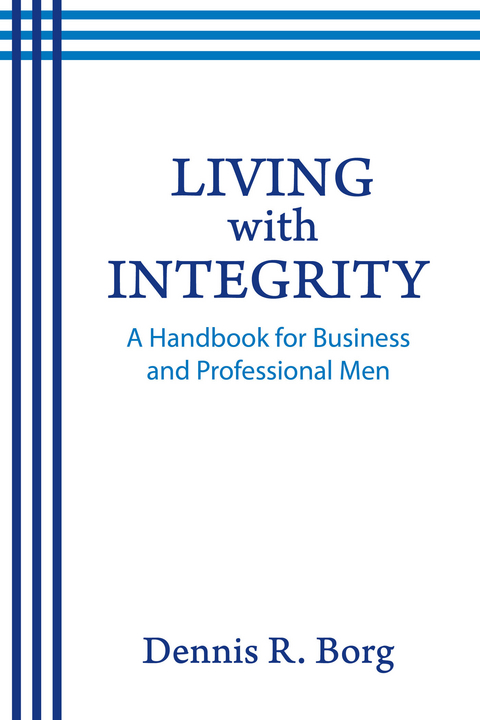
Living with Integrity (eBook)
360 Seiten
Bookbaby (Verlag)
978-1-0983-6180-8 (ISBN)
Christian business and professional men face extra challenges as they attempt to live out their values and convictions in a world that is less-than-sympathetic to their views. Businessmen not only carry the responsibility to provide financially for their own families, but also to supply income and a work-friendly environment for those they employ. In addition to the above, professional men feel an extra burden for the well-being of the clients, patients or parishioners they serve. And the extra demands on their time and energy, combined with mental stress of their work, leaves these men with special, and often unrecognized, needs. Living with Integrity was written to address this need by an author who has been a mentor to these men for 26 years. He uses his training and experience, both as a pastor and a family counselor, to focus on the key areas of the business and professional man's life with insights and practical suggestions for application, all from a Christian perspective. For instance, this book contains a chapter on maintaining one's spiritual life on a busy schedule. Another chapter discusses using common business practices for more effective family leadership. Two chapters address the art of fathering and being a husband that his wife can both love and respect. All men (including Christians) have to deal with their sex lives and so the author has included a separate chapter on this subject, looking at it from several different angles. Four chapters deal directly with the Christian man's professional life; balancing work and leisure, having proper motives, using good people skills, and showing exemplary character in the way he conducts his affairs. Additional chapters speak to issues like attitudes and emotions, handling times of adversity, and preparing for retirement. Written in handbook form, each chapter stands on its own so the reader can pick and choose areas of personal interest to peruse. The chapters are also divided into sections, with questions for personal reflection and/or group discussion at the end of each section. Thus, the book is useful for both an individual or a group.
“Unless our love and care for our family is a high priority, we may find that we may gain the whole world and lose our own children.”
—Michael Green
Chapter Two: Leading with Integrity at Home
The Bible clearly places responsibility for leadership in the home primarily on men. In fact, one of the requirements for leadership in the church is that a man is able to manage his own family well. (1 Tim.3:4 & 12) The underlying Greek word used here is translated in other places as “to direct,” (1 Tim. 5;17) “to devote oneself to,” (Tit. 3:8 & 14) and “to provide leadership or oversight to.” (Rom. 12:8, 1 Thess. 5:12) Yet, it’s interesting how many business and professional men drop the ball when it comes to leading at home. The demands of leadership and decision-making at work leave them tired at the end of the day, and happy to let their wives run things in the family. This is understandable to a degree. Wives and mothers (especially stay-at-home moms) tend to be more tuned in to what’s going on in the family, and typically are very capable of running a household. But this doesn’t excuse a lack of involvement and initiative on our part as men.
Taking Business Home
One of the things I have noticed is that men in positions of responsibility have a tendency to leave their work at the office (unless they are workaholics). And it’s natural to want to escape the stresses of our jobs and retreat into the safe haven of home at night. The irony is, in the process, we ignore our God-given gifts of family leadership. And we also leave valuable management practices at the office, which could benefit our families at home. In this chapter, I would like to discuss some of these work skills, and how they might apply in your family. In next chapters, we will get into the specific roles of husband and father.
Getting Perspective
A problem many families face is one of being over-scheduled, over-stressed, and under-organized. We often lack both quality time together and a clear plan as to how to fix it. What these families need is leadership, using the experience, skills, and techniques we learned in the workplace. Complicating this are three factors:
1. We often feel more competent at work than at home. Maybe it’s because we didn’t have fathers who were good role models for us to follow. Or perhaps we’re convinced that women are just innately better at parenting than we are. This isn’t true. By nature, they may generally be more nurturing, especially when children are young. But recent studies have shown the important place fathers have in a child’s life, and the devastating results when fathering is missing. It always amazes me how long it takes for modern researchers to catch up with what the Bible says, and what common sense has taught us for centuries.
2. Our culture encourages men to focus on work rather than home. For one thing, we get our identity and self-worth primarily from our career. For another, our primary role in the family is often seen as mostly being a financial provider. Our society is slowly changing in this area, as more women are combining careers with motherhood and fathers are taking a more active role at home. Some families are even experimenting with women as the providers and dads staying home. In most of these cases, it’s because the wife is able to earn more, or because the husband is more interested in being a parent. But, as a family counselor, I have never seen this arrangement work out well in practice.
3. As men, we typically need some challenge and adventure in our lives, and most of the time we get this from our professions. If not, we try to manufacture it through sports, hobbies, or service projects on the weekends, or we experience it vicariously via TV, movies, or books that stir our sense of masculinity.
But what if we looked at our leadership role in the family as more than simply a duty? What if we saw it as a privilege, an adventure, and the biggest challenge of our lives? What if we realized that having a good marriage and raising responsible, God-fearing children would bring us the greatest satisfaction and rewards in the long run? Always keep in mind that you are dispensable at work. If you died tomorrow, it wouldn’t take long for someone to step in and take your job, but your family could never really replace you and what you bring to their lives.
Questions for Personal Reflection or Group Discussion
1. How much responsibility for your home life falls on your wife, and how much on you? Give a percentage and think about (or discuss) why that is true.
2. Does the idea of using management principles at home strike a negative vibe with you? If so, why?
3. Of the three complicating factors listed above, which one hits the closest to home for you, and how could that change?
Our Calling
As Christian men, our calling is to be committed followers of Jesus Christ and to make disciples for Christ by our life and witness. (Matt. 28:19-20) It is also to provide leadership in the home as loving husbands and “hands on” fathers. (Eph. 5:29-33, 6:4) This involves both leading by example and by service. Leading by example is so important, because in everyday life “more is caught than taught.” Leading by serving is the model Jesus gave us. (Mark 10:42-45, John 13:3-17) Interestingly, in recent years, the concept of servant leadership has even caught on in parts of the business community (More on this in Chapter Eight).
Servant Leadership at Home
What exactly is servant leadership? It is being willing to identify and meet the needs of others, and to sacrifice our own needs for those we lead. At the root of servant leadership is love—not primarily as an emotion, but a choice, an act of the will. It involves extending ourselves for others by seeking their highest good. (Phil. 2:4-8) And it’s by serving that we gain, not lose, authority. This is true both in the workplace and (especially) in our homes. Being a servant leader does not mean giving up control or relinquishing the ability to determine the direction, values, and policies of our businesses, or our families. It is largely an attitude. It’s wanting to see everyone succeed and doing whatever we can to help them, by offering assistance and encouragement.
Being a servant leader in your home means putting the needs of your wife and children ahead of your own agenda and needs, to help them become everything they are capable of becoming. It means providing leadership, in partnership with your wife, by sensitively taking the initiative to address the concerns and problems of the family in a caring, loving way. Taking initiative is the key. I don’t believe that, as husbands and fathers, we need to have all the answers, or do all the decision-making by ourselves. But I am convinced we need to be quick to recognize situations requiring attention (just like at work) and to take the lead in working out a solution with our wives, even if they are the ones who are better at implementing it. Some men try to use power tactics to micro-manage their families, and it just doesn’t work. They may gain temporary compliance, but their wives resent their attempts to exert control in areas where the wives are more competent. And their children eventually will either rebel in overt or subtle ways, or grow up lacking the confidence to make decisions on their own.
Questions for Personal Reflection or Group Discussion
1. What’s your style of leadership at home? Your wife’s?
2. Who generally takes the initiative in family plans, and why?
3. Do you see any advantages of servant leadership? If so, what are they?
Strategizing
As leaders at work, we constantly work on strategies to improve performance. Among other things, this involves knowing our purpose and core values and setting goals, priorities, and schedules for our organization. However, when it comes to our homes, we’re often not nearly as intentional in these areas as we could be. Take purpose statements, for example. One question every organization has to answer is, “Why do we exist? What do we have to offer to our customers or clients that others don’t have?” But how many families ask similar questions when it comes to their home life? Questions like, “What is our purpose as a family?” “Do we have an overall sense of who we are?” “What makes our family unique?” “How do we differ from other families we know?” If you don’t have answers to these questions, you won’t have a firm basis for making decisions, and you’ll end up caving under the peer influence of other families around you. For instance, is your family time consumed with running kids to soccer practices and games because you really want this, or because several other families in your neighborhood are doing the same?
When it comes to core values, every organization or business has certain principles and characteristics that are fundamental to its culture. These are the guidelines by which it operates on a...
| Erscheint lt. Verlag | 30.6.2021 |
|---|---|
| Sprache | englisch |
| Themenwelt | Wirtschaft ► Betriebswirtschaft / Management ► Unternehmensführung / Management |
| ISBN-10 | 1-0983-6180-6 / 1098361806 |
| ISBN-13 | 978-1-0983-6180-8 / 9781098361808 |
| Informationen gemäß Produktsicherheitsverordnung (GPSR) | |
| Haben Sie eine Frage zum Produkt? |
 EPUB (Ohne DRM)
Größe: 662 KB
Digital Rights Management: ohne DRM
Dieses eBook enthält kein DRM oder Kopierschutz. Eine Weitergabe an Dritte ist jedoch rechtlich nicht zulässig, weil Sie beim Kauf nur die Rechte an der persönlichen Nutzung erwerben.
Dateiformat: EPUB (Electronic Publication)
EPUB ist ein offener Standard für eBooks und eignet sich besonders zur Darstellung von Belletristik und Sachbüchern. Der Fließtext wird dynamisch an die Display- und Schriftgröße angepasst. Auch für mobile Lesegeräte ist EPUB daher gut geeignet.
Systemvoraussetzungen:
PC/Mac: Mit einem PC oder Mac können Sie dieses eBook lesen. Sie benötigen dafür die kostenlose Software Adobe Digital Editions.
eReader: Dieses eBook kann mit (fast) allen eBook-Readern gelesen werden. Mit dem amazon-Kindle ist es aber nicht kompatibel.
Smartphone/Tablet: Egal ob Apple oder Android, dieses eBook können Sie lesen. Sie benötigen dafür eine kostenlose App.
Geräteliste und zusätzliche Hinweise
Buying eBooks from abroad
For tax law reasons we can sell eBooks just within Germany and Switzerland. Regrettably we cannot fulfill eBook-orders from other countries.
aus dem Bereich