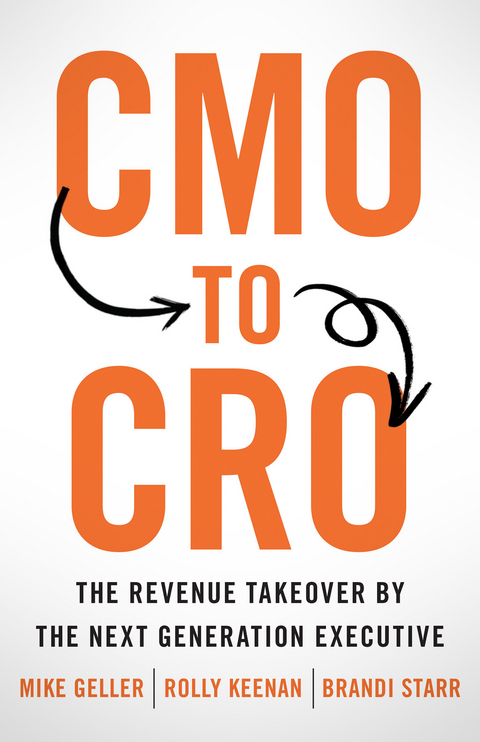
CMO to CRO (eBook)
262 Seiten
Lioncrest Publishing (Verlag)
978-1-5445-1779-7 (ISBN)
As your company's chief marketing officer, you're responsible for your organization's growth and reputation-but you don't have enough control. Your organization works in departmental silos, functional leaders pushing their own solutions and feeling satisfied with functional KPIs. But the kind of exponential growth that creates unstoppable momentum requires your customer-facing departments to fight for the customer instead of their own departmental wins. You're not the only one who notices-but you are the only one in the perfect position to do something about it. Discover how to reach your potential and stand out as more than a marketing professional. In CMO to CRO, industry experts Brandi Starr, Mike Geller, and Rolly Keenan show you how to bring revenue to the forefront and make every team's number one objective a seamless customer experience. You'll learn how to create consistency by reorganizing your business, following the customer, prioritizing revenue, and using CX technology to succeed where your competition fails.This book presents a revolutionary approach to not only unite the silos but position you as an innovative leader and finally uncover what CX is really about: revenue growth.
Introduction
The buying landscape has changed in a big way. The technologies have changed. Most of all, customer expectations have changed. We’re living in a digital transaction world that rises and falls on the success or failure of the customer experience, CX.
Over in the consumer world, some companies are getting CX right. Want to know what to order for dinner or watch on TV? Which car to buy or home mortgage to go with? These decisions are just a few clicks away because those industries figured out that delivery of a consistent, seamless, end-to-end experience is what customers want.
So why are so many companies still selling like it’s 1999? They tackle the digital game from every direction, from Marketing to Sales, Customer Support to Customer Success, but most are behind the curve and struggling to catch up. And without a unified strategy, the end result is inconsistent, disjointed, and frustrating for customers.
The customer isn’t the only one who’s frustrated. Business leaders, and especially Marketing, want the rewards of getting the customer experience right. If only they could find a way to bring together all the tech, all the people—all the work—to optimize the customer experience…now that would be a game changer. It would change how they market, how they sell, and how they make money for the business.
The “solution” seems to be out there. People are talking about it, especially people who think they have it. Martech experts in industry magazines and blogs, at conferences, and on webinars believe they have a quick fix for your customer experience challenges. If you look closely, however, the solutions they offer are usually just more technology. They’re Band-Aids that might fix one issue, but don’t consider the bigger problem—how companies are organized, or disorganized, around the people and technology responsible for customer experience.
More Tech Is Not the Answer
Throwing technology at a problem just leads to more technology to manage. You might have too much technology, not enough, or the wrong technology. And when you think you have the right mix, you realize the people supporting it don’t talk to each other. They’re playing for different teams with different goals and different leadership. Everybody owns a little piece of CX, but no one owns all of it. Like a bunch of specialists treating different symptoms, but no one doctor addressing the patient’s disease.
This isn’t a big company problem or a small company problem, and it isn’t limited to any one industry. It’s a problem that’s happening all over. A consistent, end-to-end customer experience is possible—and when done right, it leads to more customers buying more products.
Because of the transactional nature of their customer interactions, consumer businesses are better positioned to let technology drive the customer experience and put their departments, people, and processes behind it. Still, few get it right, and fewer still B2B companies even come close. We’ve seen clients manage parts of CX very well. However, a holistic, end-to-end solution—which is what we propose in this book—is the surest way to solve your CX problem.
In the simplest terms, we believe the key to effective, sustainable customer experience relies on four actions:
- Get the right technology.
- Create a revolutionary revenue operations team.
- Align leadership compensation and goals.
- Introduce a new kind of CRO.
This may sound revolutionary—even a little “out there.” While it’s a big shift from what most companies do now, they (and you) can get there from here.
The Revenue Problem
This situation offers a huge opportunity for marketing leadership. If you’re a chief marketing officer or a director of marketing, or have a leadership position somewhere along the marketing chain of command, you already know how different teams and technologies impact the customer experience. You also understand the connection between CX, more customers, more sales, and revenue growth.
Customer experience is a key lever to revenue growth. Companies need revenue to pay salaries, fund projects, and invest in infrastructure and research and development. Companies want to turn a profit for their shareholders too. Without revenue, none of that happens. Ultimately, the CEO is responsible for revenue, but unless you’re a startup, that’s not who’s out there closing deals. CEOs look to Sales for revenue, and more recently, to digital technologies and the teams that own them. But still, Sales is #1 in the CEO’s “big book of revenue.” For decades—generations—Sales has sat proudly on the revenue throne. Businesses have depended on salespeople to bring in the cash; they also blame Sales when revenue goals are missed.
We want to let you in on a secret: Sales no longer sits on that throne. They abdicated the revenue throne a long time ago. Salespeople are only one piece of the revenue puzzle. They know it. Marketing knows it. Somebody needs to say it out loud—and do something about those missed revenue goals. In this book, we’ll show you what you can do. It’s not fair to the CEO to keep missing revenue goals, it’s not fair to Sales to take the blame, and it’s not fair to Marketing to have to stand aside. Because marketing leaders are the solution to the customer experience and, therefore, the revenue problem.
Customer experience is a key lever to revenue growth.
Revenue Takeover
In the simplest terms, most revenue comes from sales. Some sales (lowercase “s”) are driven by Sales (uppercase “S”), but a massive number of transactions have nothing to do with the capital S salespeople or the sales department. Transactions that generate revenue are largely driven by customer experience. A positive customer experience turns prospects into customers and customers into repeat buyers.
While revenue comes from sales, which are more often than not driven by customer experience, CX is driven by technology. Yet when it comes to anything that’s more than just a pair of socks, most companies treat the customer experience as if Sales is still on the revenue throne and all that technology doesn’t even exist.
Marketers know this is true. Some are trying to do something about it—like finding the best tech to solve their problems. But if that’s all they’re doing, it’s not enough. Unless marketers want to be left behind, they’re looking at major changes in how marketing operates: how it’s structured and how the company is structured to support it. That’s the big scary news because—we know—leaders have enough on their plates, and a company re-org is the last thing on a CMO’s mind. But there’s good news too.
The good news is that more marketers have identified the problem. They just haven’t found a solution. The truth is, the same challenges caused by technology—the proliferation of tech that doesn’t always work together to create a consistent customer experience—can also be solved by technology. We know this from working with company after company and seeing the impact small steps in the right direction can make. However, few are brave enough to take the giant leap required to make a comprehensive and lasting impact on their CX problem. Instead of scrambling to catch up, marketers have to get behind—behind the tech.
It starts with Marketing. Not with Sales and not with IT. The CMO has the depth and breadth of knowledge about marketing, CX, and revenue to put a plan into action that leverages tech holistically and intelligently to help the business make sales, help the CEO meet revenue goals, and confidently seat themselves on the revenue throne. To effectively go from CMO to CRO.
This CRO isn’t the chief revenue officer in the traditional sense. They don’t track revenue. They provide leadership to drive it.
In a Revenue Takeover, the CRO doesn’t track revenue. They provide leadership to drive it.
No, This Is Not Another Magic Pill
What we’re proposing is not a magic pill. As consultants, we help marketers get to the root of the problem and fix it from the ground up. We’ve spent the last couple of decades working with businesses to organize, manage, and leverage marketing technology to drive revenue. We’ve seen what works and what doesn’t. We’ve seen the organizational challenges businesses face, especially as they affect marketing, the customer experience, and ultimately, revenue. A Revenue Takeover is hard work, but the results are worth it. And no one is in a better position to make it happen than a marketing leader.
We’ve seen firsthand what the elements of a Revenue Takeover can do for businesses and the people who work there. It doesn’t just change the company; it changes people’s lives. Formerly frustrated marketing people sleep better at night. Salespeople breathe...
| Erscheint lt. Verlag | 18.5.2021 |
|---|---|
| Sprache | englisch |
| Themenwelt | Wirtschaft ► Betriebswirtschaft / Management ► Unternehmensführung / Management |
| ISBN-10 | 1-5445-1779-3 / 1544517793 |
| ISBN-13 | 978-1-5445-1779-7 / 9781544517797 |
| Informationen gemäß Produktsicherheitsverordnung (GPSR) | |
| Haben Sie eine Frage zum Produkt? |
 EPUB (Ohne DRM)
Größe: 2,5 MB
Digital Rights Management: ohne DRM
Dieses eBook enthält kein DRM oder Kopierschutz. Eine Weitergabe an Dritte ist jedoch rechtlich nicht zulässig, weil Sie beim Kauf nur die Rechte an der persönlichen Nutzung erwerben.
Dateiformat: EPUB (Electronic Publication)
EPUB ist ein offener Standard für eBooks und eignet sich besonders zur Darstellung von Belletristik und Sachbüchern. Der Fließtext wird dynamisch an die Display- und Schriftgröße angepasst. Auch für mobile Lesegeräte ist EPUB daher gut geeignet.
Systemvoraussetzungen:
PC/Mac: Mit einem PC oder Mac können Sie dieses eBook lesen. Sie benötigen dafür die kostenlose Software Adobe Digital Editions.
eReader: Dieses eBook kann mit (fast) allen eBook-Readern gelesen werden. Mit dem amazon-Kindle ist es aber nicht kompatibel.
Smartphone/Tablet: Egal ob Apple oder Android, dieses eBook können Sie lesen. Sie benötigen dafür eine kostenlose App.
Geräteliste und zusätzliche Hinweise
Buying eBooks from abroad
For tax law reasons we can sell eBooks just within Germany and Switzerland. Regrettably we cannot fulfill eBook-orders from other countries.
aus dem Bereich