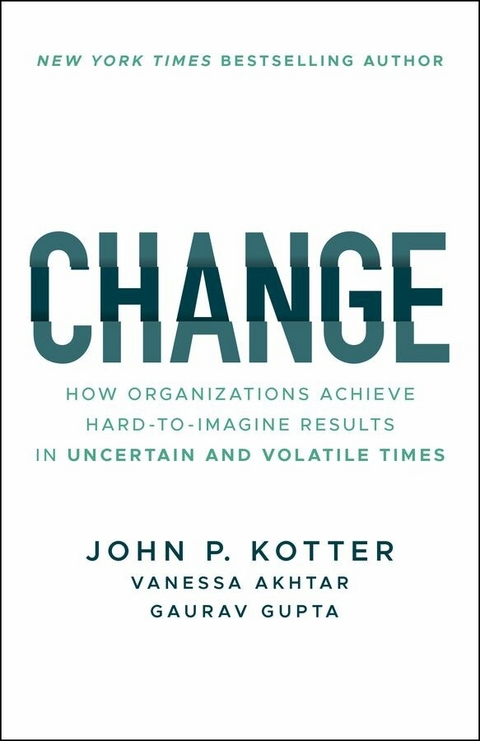
Change (eBook)
217 Seiten
John Wiley & Sons (Verlag)
978-1-119-81588-4 (ISBN)
Transform your organization with speed and efficiency using this insightful new resource
Incremental improvement is no longer sufficient in helping organizations navigate the complexity, uncertainty and volatility of today's world. In Change: How Organizations Achieve Hard-to-Imagine Results in Uncertain and Volatile Times, authors John P. Kotter, Vanessa Akhtar, and Gaurav Gupta explore how to create non-linear, dramatic change in your organization. You'll discover the emerging science of change that teaches us about how to build organizations - from businesses to governments - that change and adapt rapidly.
In Change you'll discover:
- Why the ability of organizations to deal with threats and take advantage of opportunities in the face of ever greater complexity and uncertainty is being severely challenged
- In-depth, evidence-based, actionable solutions for dealing with institutional resistance to change
- Case studies and success stories that describe organizations who have successfully built the ability to change quickly into their DNA
- A universal approach for how to dramatically improve outcomes from various change efforts, including: strategy execution, digital transformation, restructuring, and more
Perfect for managers, executives, and leaders at companies of all types and sizes, Change will also prove to be a valuable asset to other professionals who serve these organizations. This book is for anyone seeking a proven approach for delivering fast, sustainable and comprehensive results.
JOHN P. KOTTER is the Konosuke Matsushita Professor of Leadership, Emeritus, at Harvard Business School and a New York Times bestselling author. He is Co-founder of the management consulting firm Kotter International and the author of 21 books. VANESSA AKHTAR works at Kotter International, specializing in guiding clients through their transformation journey. She also helps drive Kotter's ongoing research and development efforts. GAURAV GUPTA works at Kotter International and is a Co-founder of Ka Partners. He specializes in change leadership and strategy execution. He researches and develops successful approaches to large-scale change implementation.
Preface ix
Part I Introduction 1
Chapter 1 Threats and Opportunities in a Rapidly Changing World 3
Chapter 2 The Emerging Science of Change 17
Part II There is a Better Way to Accelerate: 37
Chapter 3 "Strategic Planning" That Delivers Results 39
Chapter 4 Digital Transformation That is Truly Transformational 61
Chapter 5 Restructuring Without Killing Innovation and Your Future 79
Chapter 6 Cultural Change That Helps You Adapt 101
Chapter 7 Mergers and Acquisitions That Create Real Value 125
Chapter 8 Agile Methodologies That Build Sustained and Scalable Agility 143
Chapter 9 Broad Social Initiatives That Can Help Billions 159
Part III In the End, It is Mostly About This 175
Chapter 10 More Leadership from More People 177
Chapter 11 The New Normal 199
Notes 209
Acknowledgments 219
About the Authors 223
Chapter 1
Threats and Opportunities in a Rapidly Changing World
As we write this, we are going through a rather extraordinary spike in uncertainty, change, and volatility caused by the COVID-19 pandemic. There is a lot of discussion about what the “new normal” will be in 6 to 18 months. While this conversation is interesting and can be provocative, it is all too often misleading. A focus on this pandemic as a once-in-a-lifetime phenomenon can lead us to be passive and to miss the most important lesson: that this crisis is not an aberration but a spike in a trend that has long and deep roots.
Specifically, the amount, complexity, and volatility of change going on around us has been in general expanding in waves since even before the start of the industrial revolution. And virtually all the data says that this trend will continue in any number of ways after the current COVID-19 crisis abates. The potential forces of change are not limited to another pandemic. There are plenty of additional possibilities: artificial intelligence, other disruptive technologies, global integration, as well as social and political movements that now have worldwide impact.
Furthermore, a gap is clearly growing between the amount of change happening around us and the change we are successfully, smartly implementing in most of our organizations and lives. As we will show you in the following chapters, this disconnect is increasingly dangerous, especially when people have been convinced that their continuous incremental improvements are all that is needed.
The risks we are taking are also increasingly unnecessary, because the emerging science of change, outlined in the next chapter, offers steps to mitigate bad outcomes. This information is accessible and actionable. It draws on brain research, business history, organizational studies, leadership, and more. We have found it possible to turn the science into replicable, teachable methodologies and then, in any specific situation, into executable playbooks.
Some enterprises have already tapped into this knowledge base. These companies are mobilizing their people to produce hard-to-imagine results by taking advantage of the opportunities presented by more change. These opportunities also have the potential to add great value to society at large.
“The Storm Is Just Beginning”
On January 16, 2020, Volkswagen Group CEO Herbert Diess told VW's senior managers, “If we continue at our current speed, it is going to be tough.…The storm is just beginning. The era of classic car making is over.”
We would only add that both our formal research and our advisory work suggest that the long-term change trend has reached a point where the era of classical business and government may be over or may soon be over.
Whether dealing with threats from low-cost competitors or opportunities for growth from innovative products or acquisitions, organizations today need greater speed and flexibility, sometimes much greater, not just to deal with extraordinary events like COVID-19, but to deal with the shifting reality of our present and future. More broadly, the need to adapt rapidly is equally important for society to resolve threats like climate change or food security, as well as to continue capitalizing on opportunities for progress toward a more equitable and prosperous world.
A few enterprises have become adept at facing these challenges by identifying trends early, changing quickly, and successfully maneuvering at speeds that feel like 100 miles per hour. We will share some of these stories in the pages that follow. We're confident in their integrity because, in most of these cases, we watched these events unfold up close in our advisory work. These leading enterprises are outliers from which you can learn much. And learn we must, because the vast majority of organizations are struggling to adapt at a remotely adequate pace.
The need to adapt is nothing new; after all, Benjamin Franklin said, “When you are finished changing, you are finished.” What is new is how often we need to change, the pace at which we need to move, and the complexity and volatility of the context in which we are operating.
The Challenge: A More Volatile, Uncertain, and Rapidly Changing World
For centuries, the world has been speeding up, changing more and more often and in increasingly complicated ways. This trend has accelerated as we've moved from an Industrial Age to an Information Age.
Examples of this increased pace and complexity are easily found. The total number of patents granted by the United States Patent and Trademark Office doubled from 1960 to 1990. Then the number of patents quadrupled in the last three decades. While it took the telephone 75 years to reach 50 million users, cell phones took only 12 years, and the iPhone took just three to hit that milestone. A 2018 IBM study estimated that 90% of all data on the internet was produced in the immediately preceding two years.
The average tenure of companies on the S&P 500 in 1965 was 33 years. Today, it is half that. Reputational risks, though hard to quantify, have certainly increased with the growing use of social media, constant news alerts, and venues for publicly accessible employee feedback. Glassdoor has 32 million unique visitors each month. These examples are representative of changes that can be found in many different contexts.
The increased change around us drives an increased effort to change within the organizations that employ us, supply us with needed goods and services, and govern us. There are many variations of what this looks like by industry, sector, or region. But in general, the sheer number of organizational initiatives to produce change is now much larger than 30 years ago. Fifty years ago, virtually no organizations talked about changing their cultures, while today this is commonplace. The growing number of initiatives has led to more and more companies adopting formal project management offices (PMOs).
Source: Adapted from Ahir H, N Bloom, and H Furceri (2018) “World Uncertainty Index”, Stanford mimeo. The WUI is computed by counting the percent of the word “uncertain” (or its variants) in the Economist Intelligence Unit country reports.
Along with, and directly related to, the increase in the pace and complexity of change, the last two decades have seen a steep increase in the level of uncertainty. Complex change does that. The high level of economic and political uncertainty can make it difficult to know what initiatives will be necessary to stay competitive and to take advantage of new opportunities.
Unfortunately, as we will see in the examples laid out in this book, the internal change in organizations is not keeping pace with external change and volatility. This challenge affects everything: the quality and availability of health care; the stock market; the environment; the affordability of products that make life easier, more interesting, or more fun; the economy; the responsiveness of government; poverty; our ability to deal with medical emergencies, including pandemics; how many of us will lead comfortable and satisfying lives; even how many of us will die needlessly. The list is endless.
The Change Problem and Solution
In this book, we will dig into this increasing uncertainty, volatility, and change. We discuss the implications, as we now understand them, for people who are trying to make things better for their enterprises (and society). We argue that if we continue to improve our capacity to adapt and change only incrementally, we are taking a huge and unnecessary risk.
The good news is that we have learned much over the past few decades about why so many people and organizations struggle with change, why a minority thrive, and why more than a few literally do not survive. As you will see, for perfectly understandable but correctable reasons, much of this knowledge is not yet used in most organizations.
Our collective struggle with change often seems to be the result of ill-equipped, seemingly incompetent, or stubbornly myopic people. The stories of companies like Kodak, Blockbuster, or Borders are often told as cases of arrogant, stubborn leaders who refuse to see what should have been obvious. In hindsight, we question whether they even tried to change. To some degree these critiques are true. But they are not the whole story and hence are misleading.
The bigger story is that neither the core of human nature, hardwired into us many thousands of years ago, nor the central design of modern organizations, very much a late nineteenth- and early twentieth-century invention, were built to change quickly, easily, and smartly. People and organizations were designed mostly to be efficient and reliable enough to ensure survival. We do have the capacity to innovate and create new habits or products. But that capacity is not the most powerful force except in young people and organizations. With maturity comes all sorts of mechanisms that lean toward stability and short-term safety. So even when companies recognize new threats, they are often unable to change enough or fast enough to overcome these challenges.
Today, in a more complex and rapidly evolving twenty-first century, when we put a person designed for a world long gone into an organization that was not designed for this century, we regularly see too slow a pace of change in the face of uncertainty. We see too painful a process as individuals and organizations try to deal with inevitable...
| Erscheint lt. Verlag | 4.5.2021 |
|---|---|
| Sprache | englisch |
| Themenwelt | Wirtschaft ► Betriebswirtschaft / Management ► Unternehmensführung / Management |
| Schlagworte | Business & Management • Change Management • company disruption • company restructuring • culture change • Digital transformation • Disruption • evidence-based change management • kotter international • Management • Organizational change • Organizational change management • Restructuring • Strategy Execution • Wirtschaft u. Management |
| ISBN-10 | 1-119-81588-6 / 1119815886 |
| ISBN-13 | 978-1-119-81588-4 / 9781119815884 |
| Informationen gemäß Produktsicherheitsverordnung (GPSR) | |
| Haben Sie eine Frage zum Produkt? |
 EPUB (Adobe DRM)
Kopierschutz: Adobe-DRM
Adobe-DRM ist ein Kopierschutz, der das eBook vor Mißbrauch schützen soll. Dabei wird das eBook bereits beim Download auf Ihre persönliche Adobe-ID autorisiert. Lesen können Sie das eBook dann nur auf den Geräten, welche ebenfalls auf Ihre Adobe-ID registriert sind.
Details zum Adobe-DRM
Dateiformat: EPUB (Electronic Publication)
EPUB ist ein offener Standard für eBooks und eignet sich besonders zur Darstellung von Belletristik und Sachbüchern. Der Fließtext wird dynamisch an die Display- und Schriftgröße angepasst. Auch für mobile Lesegeräte ist EPUB daher gut geeignet.
Systemvoraussetzungen:
PC/Mac: Mit einem PC oder Mac können Sie dieses eBook lesen. Sie benötigen eine
eReader: Dieses eBook kann mit (fast) allen eBook-Readern gelesen werden. Mit dem amazon-Kindle ist es aber nicht kompatibel.
Smartphone/Tablet: Egal ob Apple oder Android, dieses eBook können Sie lesen. Sie benötigen eine
Geräteliste und zusätzliche Hinweise
Buying eBooks from abroad
For tax law reasons we can sell eBooks just within Germany and Switzerland. Regrettably we cannot fulfill eBook-orders from other countries.
aus dem Bereich