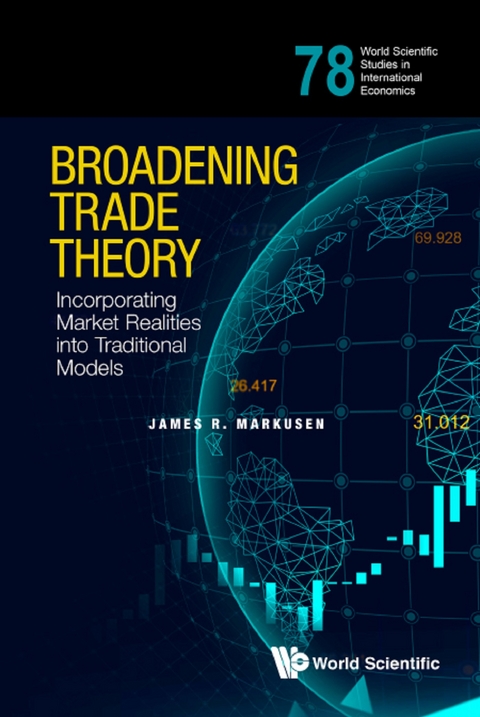
BROADENING TRADE THEORY (eBook)
384 Seiten
World Scientific Publishing Company (Verlag)
978-981-12-2297-9 (ISBN)
This volume is a collection of the author's past and recent research. It concentrates on some topics that continue to be neglected in mainstream trade theory, but which have grown in empirical relevance as the decades have passed and allow us to broaden our world view. These include adding multinational firms and a major role for the demand side of general equilibrium to our conventional portfolio of models.
Part I in the volume focuses on multinational firms and the incorporation of endogenous location and ownership choices into general-equilibrium trade models. A particular emphasis, repeatedly confirmed in empirical studies, is on horizontal firms that replicate activities across borders. Two chapters on the vertical integration versus outsourcing decision reveal the non-excludable property of knowledge-based assets.
Part II focuses on the demand side of general equilibrium, arguing and showing empirically that non-homothetic preferences, which give an important role to per capita income, help explain many of the empirical puzzles that trade economists keep trying to explain only from the production side of general equilibrium.
Part III is eclectic, but the chapters in this section share the common thread of showing how distortions and allowing trade in factors of production both modify traditional policy ideas and also create additional sources of gains from trade.
Contents:
- About the Author
- Acknowledgments
- Introduction
- Adding Multinational Firms to the Theory of International Trade:
- Multinationals, Multi-Plant Economies, and the Gains from Trade
- Endogenous Market Structures in International Trade (Natura Facit Saltum)
- Multinational Firms and the New Trade Theory
- The Theory of Endowment, Intra-Industry, and Multinational Trade
- Estimating the Knowledge-Capital Model of the Multi-National Enterprise
- Export-Platform Foreign Direct Investment
- Multinational Firms, Technology Diffusion and Trade
- Contracts, Intellectual Property Rights, and Multinational Investment in Developing Countries
- Preferences and Per-Capita Income: Trade Theory for the Demand Side of General Equilibrium:
- Explaining the Volume of Trade: An Eclectic Approach
- Putting Per-Capita Income Back into Trade Theory
- International Trade Puzzles: A Solution Linking Production and Preferences
- Per-Capita Income and the Demand for Skills
- An Alternative Base Case for Modeling Trade and the Global Environment
- General Equilibrium with Market Imperfections and Trade Complementarities:
- Trade and the Gains from Trade with Imperfect Competition
- Factor Movements and Commodity Trade as Complements
- International Externalities and Optimal Tax Structures
Readership: Faculty and graduate students specializing in international trade and in international macro/finance. Another academic group is those specializing in the development economics of open economies. It should also be of interest to trade and macro economists working in government ministries and in international institutions such as the World Bank, IMF, United Nations, WTO, etc.
Professor James R Markusen earned his BA and PhD degrees in Economics from Boston College. In 1990, he moved to the University of Colorado, Boulder where he holds the rank of University Distinguished Professor.Much of his research has concentrated on the location, production, and welfare effects of multinational corporations. He is particularly known for developing the horizontal model of multinationals: the replication of firm activities in many countries better characterizes multinationals than vertical models based on production fragmentation. More recent work shows how rising incomes lead to shifts toward consuming skilled-labor intensive goods and services, thus helping to explain several international trade and skilled-wage premium puzzles.Prof Markusen served as a researcher and advisor during the mid 1980's for the McDonald Royal Commission in Canada, which laid the foundation for the US-Canada free-trade agreement. He later worked on the North American auto industry, estimating the effects of the (then) proposed NAFTA. He has extensive experience teaching all over the world.
| Erscheint lt. Verlag | 22.2.2021 |
|---|---|
| Reihe/Serie | World Scientific Studies in International Economics |
| World Scientific Studies in International Economics | |
| WS STUDIES IN INTERNATIONAL ECONOMICS | WS STUDIES IN INTERNATIONAL ECONOMICS |
| Verlagsort | Singapore |
| Sprache | englisch |
| Themenwelt | Wirtschaft |
| ISBN-10 | 981-12-2297-5 / 9811222975 |
| ISBN-13 | 978-981-12-2297-9 / 9789811222979 |
| Informationen gemäß Produktsicherheitsverordnung (GPSR) | |
| Haben Sie eine Frage zum Produkt? |
 EPUB (Adobe DRM)
Kopierschutz: Adobe-DRM
Adobe-DRM ist ein Kopierschutz, der das eBook vor Mißbrauch schützen soll. Dabei wird das eBook bereits beim Download auf Ihre persönliche Adobe-ID autorisiert. Lesen können Sie das eBook dann nur auf den Geräten, welche ebenfalls auf Ihre Adobe-ID registriert sind.
Details zum Adobe-DRM
Dateiformat: EPUB (Electronic Publication)
EPUB ist ein offener Standard für eBooks und eignet sich besonders zur Darstellung von Belletristik und Sachbüchern. Der Fließtext wird dynamisch an die Display- und Schriftgröße angepasst. Auch für mobile Lesegeräte ist EPUB daher gut geeignet.
Systemvoraussetzungen:
PC/Mac: Mit einem PC oder Mac können Sie dieses eBook lesen. Sie benötigen eine
eReader: Dieses eBook kann mit (fast) allen eBook-Readern gelesen werden. Mit dem amazon-Kindle ist es aber nicht kompatibel.
Smartphone/Tablet: Egal ob Apple oder Android, dieses eBook können Sie lesen. Sie benötigen eine
Geräteliste und zusätzliche Hinweise
Buying eBooks from abroad
For tax law reasons we can sell eBooks just within Germany and Switzerland. Regrettably we cannot fulfill eBook-orders from other countries.
aus dem Bereich