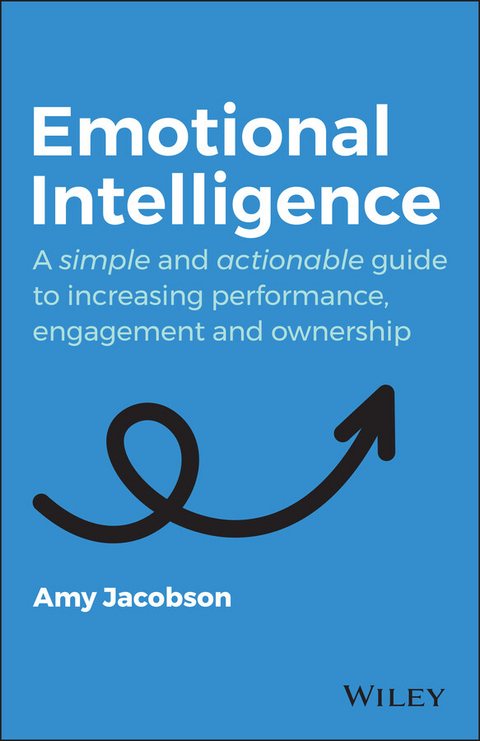
Emotional Intelligence (eBook)
184 Seiten
Wiley (Verlag)
978-0-7303-9150-0 (ISBN)
Boost Emotional Intelligence in any situation to achieve exceptional results for any organisation
As organisations around the world are putting more focus on the mindset and wellbeing of staff, the need to develop Emotional Intelligence (EI) has never been greater. Emotional Intelligence in the workplace-including the five key concepts of self-awareness, self-regulation, empathy, social skills and motivation-is defined as your ability to identify and manage your personal emotions and the emotions of your colleagues and co-workers. Emotional Intelligence is in high demand and is expected to become an essential component of success in the future of work. Emotional Intelligence: A Simple and Actionable Guide to Increasing Performance, Engagement and Ownership is designed to help you master EI and empower you to achieve the very best outcome for everyone in your organisation.
Cutting through the hype and dispelling the myths about EI, this practical, easy-to-use resource provides clear guidance, powerful tools, and actionable steps for developing and implementing EI in the workplace for immediate results. Amy Jacobson, an experienced EI specialist, leadership trainer and coach, shares the tools, methodologies, concepts and actions that increase EI in any situation. Packed with real-life examples and case studies, insightful questions, and useful diagrams to create action, this must-have guide:
- Offers a powerful 5-part methodology-Own It, Face It, Feel It, Ask It, and Drive It-to help you understand and immediately implement Emotional Intelligence principles in both your personal and professional life
- Increases your Emotional Intelligence in the workplace to enable you to inspire and energise staff, support empathy and self-awareness, and drive high levels of performance
- Improves the way you handle high pressure environments, manage challenging situations, and interact with people with different communication styles
- Helps you solve difficult problems in the workplace such as loss of purpose and engagement, cultural issues, poor communication, and low productivity
- Provides concrete steps for eliminating negative behaviors and for owning the role you play, your impact on others, and the decisions and choices you make
Emotional Intelligence: A Simple and Actionable Guide to Increasing Performance, Engagement and Ownership is an indispensable book for anyone interacting with others in the workplace, especially those with leadership roles such as senior executives, board members, department heads, managers and supervisors.
Amy Jacobson is an experienced Emotional Intelligence specialist, sought-after speaker and inspirational leadership trainer and coach. She works with organisations and career-minded individuals to achieve outstanding results, high performance and success.
Boost Emotional Intelligence in any situation to achieve exceptional results for any organisation As organisations around the world are putting more focus on the mindset and wellbeing of staff, the need to develop Emotional Intelligence (EI) has never been greater. Emotional Intelligence in the workplace including the five key concepts of self-awareness, self-regulation, empathy, social skills and motivation is defined as your ability to identify and manage your personal emotions and the emotions of your colleagues and co-workers. Emotional Intelligence is in high demand and is expected to become an essential component of success in the future of work. Emotional Intelligence: A Simple and Actionable Guide to Increasing Performance, Engagement and Ownership is designed to help you master EI and empower you to achieve the very best outcome for everyone in your organisation. Cutting through the hype and dispelling the myths about EI, this practical, easy-to-use resource provides clear guidance, powerful tools, and actionable steps for developing and implementing EI in the workplace for immediate results. Amy Jacobson, an experienced EI specialist, leadership trainer and coach, shares the tools, methodologies, concepts and actions that increase EI in any situation. Packed with real-life examples and case studies, insightful questions, and useful diagrams to create action, this must-have guide: Offers a powerful 5-part methodology Own It, Face It, Feel It, Ask It, and Drive It to help you understand and immediately implement Emotional Intelligence principles in both your personal and professional life Increases your Emotional Intelligence in the workplace to enable you to inspire and energise staff, support empathy and self-awareness, and drive high levels of performance Improves the way you handle high pressure environments, manage challenging situations, and interact with people with different communication styles Helps you solve difficult problems in the workplace such as loss of purpose and engagement, cultural issues, poor communication, and low productivity Provides concrete steps for eliminating negative behaviors and for owning the role you play, your impact on others, and the decisions and choices you make Emotional Intelligence: A Simple and Actionable Guide to Increasing Performance, Engagement and Ownership is an indispensable book for anyone interacting with others in the workplace, especially those with leadership roles such as senior executives, board members, department heads, managers and supervisors.
Chapter 5
Own it: Becoming self‐aware and owning who we are
‘Owning it’ is an easy way to summarise emotional intelligence in one short statement. It relates to owning our mindset, owning our situation, owning the impact we have on those around us, owning our communication ability, and owning our performance and motivation. It's about owning our life knowing that no‐one else is responsible, or to blame, for what we have or haven't done.
It's where we start, yet it flows through every part of EI. Let's begin by understanding how the mind works.
The emotional mind
Sigmund Freud's model of the awareness of the human mind details three levels:
- the unconscious mind
- the conscious mind
- the subconscious mind.
Let's break down what each of the levels means in simple terms.
The unconscious mind is basically what keeps us alive, with its usage estimated at 30 to 40 per cent of our mind's capacity. It ensures our organs are all functioning and our body is doing what it needs to do to survive. Nice and simple.
The conscious mind is the front end of our mind, and its usage is estimated at 10 per cent. It's responsible for quick responses. You know those moments when we say something and then think, ‘Why did I say that?’ or ‘I probably shouldn't have said that!’ We can thank our conscious mind for that quick, sometimes inappropriate, response. It also analyses all incoming data, so, for example, everything we read in a book will enter through our conscious mind before either going into our subconscious mind or being forgotten.
Our conscious mind holds many factual and simple answers along with the ability to focus, while at the same time our subconscious mind can be thinking of something completely different.
Have you ever been driving somewhere and your mind is thinking about what you will cook for dinner that night or the report that you need to complete, and all of a sudden you magically arrive at your destination thinking, ‘How did I get here? Was I doing the speed limit?’
This is our talented conscious mind's ability to focus.
Now don't confuse this with multitasking. This is the conscious mind on autopilot, rather than needing to actively think or learn something, and we know that neither of the things that our conscious or subconscious mind are concentrating on is getting our full attention. Research says that our mind does not have the ability to multitask: it jumps back and forth between tasks, so we are not truly ‘multitasking’. It's more like we're doing several things alongside one another.
Picture yourself in the kitchen cooking a new recipe while having your current TV series obsession playing in front of you. When you are cooking a brand‐new recipe, it requires focus and brain power to create this new memory. Our mind is not working off an existing memory. Our ability to follow this recipe and actually take in the TV episode at the same time becomes extremely challenging and it's unlikely to be able to be done. The recipe also takes quite a while to cook.
Let's swap that now for a dinner that you have cooked numerous times that you don't require the recipe for and know how to make. Your ability to do this while watching your TV episode becomes a lot easier and you will take more of the episode in. You are still not completely focused on either of them; however, the cooking is tapping into your long‐term memory and running on ‘autopilot’ while your conscious mind is taking in the TV episode. The cooking requires very little of your mind power.
The more competent we are at the task at hand, and the less new learning our brain is doing, the less our mind needs to switch back and forth between tasks.
What I love the most about the conscious mind is that it presents factual information to the subconscious mind asking for the correct emotional response.
Living within our subconscious mind are our emotions, values, beliefs, habits and long‐term memory. Our subconscious mind's usage is estimated at 50 to 60 per cent, with many researchers suggesting that it is 30 000 times more powerful than the conscious mind! That's huge, right? When we know how to utilise and leverage our subconscious mind, we ultimately influence the outcome and our level of success.
So, our conscious mind turns to our subconscious mind and delivers the situation: ‘It's Monday morning, the middle of winter, raining outside, it's a workday … how do I feel about this?’
Our subconscious mind taps into our beliefs, our values, our long‐term memory and finds out how we feel about Mondays, winter, rain and work. It works together with our amygdala (the part of our brain that is responsible for our emotions) to generate our emotional response to the situation. This response is then delivered through every part of our body and drives our mindset.
The need to be right!
If our emotional response is not in favour of a situation, we may find our body slouching, our energy lacking and we may start to look for reasons to justify our mindset. As humans, we have been programmed since we were kids to be right. All through our childhood and in particular during our schooling years, we have been rewarded for being ‘right’ based on our grades and our behaviour.
It's no surprise that as adults, we also like to be right. So, when our mindset decides that ‘I don't like this’ and ‘it's not going to be a good day’, it starts looking for confirmation or validation to show it is correct. You know those moments when we start to say ‘of course’: Of course I got every red light on the way to work. Of course I just missed the train by seconds. Of course my first customer is angry. That is our subconscious mind validating our mindset to prove that we are right! If someone tries to tell us otherwise, they are wrong because if they were right, that would make us wrong and we don't like to be wrong!
On the reverse side, if our subconscious mind and amygdala tell us ‘yes, we love Mondays / we love winter / rain is great / I like going to work’, then our energy levels lift. We might even get a bit of a bounce in our step and our mindset is now looking for confirmation or validation to show it is a great day!
We know that every day brings with it the opportunity to be both optimistic and pessimistic. We can choose our mood and how we will react. This is basically the only real thing we have control of in this world — our emotions and how we choose to react.
It's not the day, it's not the circumstances, it's not the people around us that make us feel the way we do. Ultimately, it's 100 per cent us and our mindset.
When our conscious mind delivers the facts to our subconscious mind — which holds our values, beliefs and long‐term memories — we decide how we feel and what our mindset will be. It's our choice, and it’s time to own it!
Tapping into the subconscious mind
Now that we understand the three levels of the mind, the challenge is knowing how to move through the conscious mind and tap into the subconscious mind as much as possible. In order to learn or build our EI, we need to be in our subconscious mind.
There are three ways to reach our subconscious mind:
- using the power of the pause
- challenging or confusing the conscious mind
- asking the same type of question 5 to 7 times.
The power of the pause
The power of the pause is having the ability to ask a question, then pause … Even after the other person answers the question, we continue to pause … As humans, we have been encouraged to talk from the moment we were born. So much so, that silences can become awkward. When faced with those awkward silences, we tend to talk to fill the silence and avoid the awkward feeling.
The first response is likely to come straight from the conscious mind and as the conscious mind gets confused by the silence or starts to feel awkward, it will turn to the subconscious mind for help. Our emotional mind starts to answer the silence by incorporating our values, beliefs, long‐term memories and experiences. This is when we tend to hear how someone is really feeling. Even when we know someone is using the ‘power of the pause’ with us, it is very hard not to want to fill that silence.
This is a fantastic tool to use in a sales environment, leadership conversation, Q&A time at an event or in a meeting, and even as parents we tend to use it on our children. The longer we pause, the deeper the other person will go in their mind and the more raw and emotionally honest the answer tends to be. I will address this in more detail in chapter 8.
Challenging or confusing the conscious mind
The conscious mind handles and tends to triage any questions, requests or activities. The second way to tap into the subconscious mind is to really challenge or confuse the conscious mind. When it can't answer the question easily, it feels the need to engage the subconscious mind for assistance.
There is an ‘ice breaker’ activity that I use at the start of a workshop to get the audience into their...
| Erscheint lt. Verlag | 26.4.2021 |
|---|---|
| Sprache | englisch |
| Themenwelt | Sachbuch/Ratgeber ► Beruf / Finanzen / Recht / Wirtschaft ► Bewerbung / Karriere |
| Wirtschaft ► Betriebswirtschaft / Management | |
| ISBN-10 | 0-7303-9150-7 / 0730391507 |
| ISBN-13 | 978-0-7303-9150-0 / 9780730391500 |
| Informationen gemäß Produktsicherheitsverordnung (GPSR) | |
| Haben Sie eine Frage zum Produkt? |
 EPUB (Adobe DRM)
Größe: 588 KB
Kopierschutz: Adobe-DRM
Adobe-DRM ist ein Kopierschutz, der das eBook vor Mißbrauch schützen soll. Dabei wird das eBook bereits beim Download auf Ihre persönliche Adobe-ID autorisiert. Lesen können Sie das eBook dann nur auf den Geräten, welche ebenfalls auf Ihre Adobe-ID registriert sind.
Details zum Adobe-DRM
Dateiformat: EPUB (Electronic Publication)
EPUB ist ein offener Standard für eBooks und eignet sich besonders zur Darstellung von Belletristik und Sachbüchern. Der Fließtext wird dynamisch an die Display- und Schriftgröße angepasst. Auch für mobile Lesegeräte ist EPUB daher gut geeignet.
Systemvoraussetzungen:
PC/Mac: Mit einem PC oder Mac können Sie dieses eBook lesen. Sie benötigen eine
eReader: Dieses eBook kann mit (fast) allen eBook-Readern gelesen werden. Mit dem amazon-Kindle ist es aber nicht kompatibel.
Smartphone/Tablet: Egal ob Apple oder Android, dieses eBook können Sie lesen. Sie benötigen eine
Geräteliste und zusätzliche Hinweise
Buying eBooks from abroad
For tax law reasons we can sell eBooks just within Germany and Switzerland. Regrettably we cannot fulfill eBook-orders from other countries.
aus dem Bereich