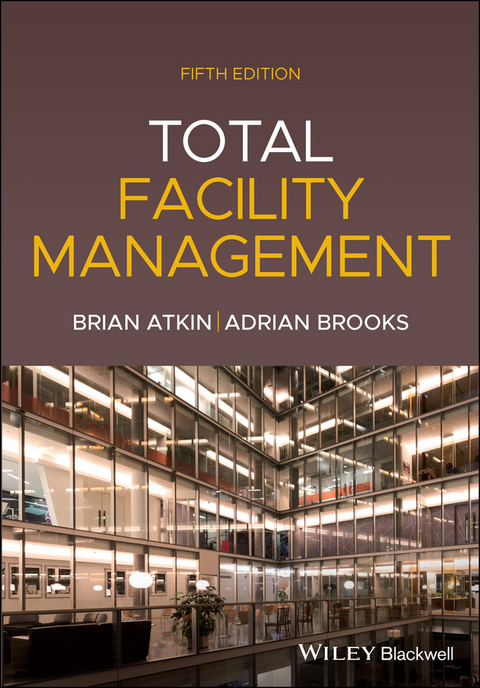
Total Facility Management (eBook)
John Wiley & Sons (Verlag)
978-1-119-70796-7 (ISBN)
A comprehensive review of what facility management means to owners, operators, occupiers, facility managers and professional advisors
The newly revised Fifth Edition of Total Facility Management is an accessible and practical text that shows readers how the concept and principles of facility management can be implemented in practice. The book deals with the most common and intractable challenges facing professionals, academics and students in the field and provides practical solutions with the means to implement them.
The new edition includes a greater focus on applicable ISO standards in facility management as well as maintaining an international perspective throughout. The book contains easy-to-access advice on how facilities can be better managed from a range of perspectives, and the subjects covered provide a comprehensive treatment of facility management.
Readers will benefit from the inclusion of:
The book is the perfect choice for undergraduate and graduate studies in facility management, construction management, project management, surveying and other AEC disciplines. Total Facility Management will also earn a place on the desk of practicing facility managers, as well as in the libraries of academics and researchers whose work requires them to understand the theory and practice of facility management.
Brian Atkin BSc, MPhil, PhD, FRICS, FCIOB is a management consultant who focuses on project management, facility management and construction management. He is a member of the British Standards Institution's FM Strategy Group and FM Technical Committee, as well as the ISO Technical Committee on facility management as head of the UK delegation.
Adrian Brooks BSc (Hons), MBA, MRICS is a Principal in Avison Young's Workplace and Facility Management business, focused on the delivery of a broad range of services for property owners and corporate occupiers. He is Chairman of the FM Strategy Group and Member of the Construction & Built Environment Sector Policy and Strategy Committee for the British Standards Institution.
TOTAL FACILITY MANAGEMENT A comprehensive review of what facility management means to owners, operators, occupiers, facility managers and professional advisorsThe newly revised Fifth Edition of Total Facility Management is an accessible and practical text that shows readers how the concept and principles of facility management can be implemented in practice. The book deals with the most common and intractable challenges facing professionals, academics and students in the field and provides practical solutions with the means to implement them.The new edition includes a greater focus on applicable ISO standards in facility management as well as maintaining an international perspective throughout. The book contains easy-to-access advice on how facilities can be better managed from a range of perspectives, and the subjects covered provide a comprehensive treatment of facility management.Readers will benefit from the inclusion of:A thorough introduction to the fundamentals of facility management, including key roles, responsibilities and accountabilities and the core competencies of facility managementAn exploration of facility planning, facility management strategy, outsourcing, procurement, facility management organization, facility maintenance management and business continuity and recovery planningAn examination of human resources management, well-being, workplace productivity, performance management health, safety, security and the environmentA review of sustainable practices, change management, facility management systems, information management (including building information models and digital twins) and innovative technology.The book is the perfect choice for undergraduate and graduate studies in facility management, construction management, project management, surveying and other AEC disciplines. Total Facility Management will also earn a place on the desk of practicing facility managers, as well as in the libraries of academics and researchers whose work requires them to understand the theory and practice of facility management.
Brian Atkin BSc, MPhil, PhD, FRICS, FCIOB is a management consultant who focuses on project management, facility management and construction management. He is a member of the British Standards Institution's FM Strategy Group and FM Technical Committee, as well as the ISO Technical Committee on facility management as head of the UK delegation. Adrian Brooks BSc (Hons), MBA, MRICS is a Principal in Avison Young's Workplace and -Facility Management business, focused on the delivery of a broad range of services for property -owners and corporate occupiers. He is Chairman of the FM Strategy Group and Member of the Construction & Built Environment Sector Policy and Strategy Committee for the British -Standards -Institution.
1
Fundamentals
Key points
The following points are covered in this chapter.
- There are several definitions of facility management. A standardized term now exists to emphasize the importance of people in facility management: organizational function which integrates people, place and process within the built environment with the purpose of improving the quality of life of people and the productivity of the core business.
- In any discussion of facility management, it is also necessary to stress the importance of integrative, interdependent disciplines whose overall purpose is to support an organization in the pursuit of its business objectives.
- The correct implementation of facility management enables an organization to provide the right environment for conducting its core business as signified by the achievement of user satisfaction and best value.
- There is a close relationship between facility management and asset management – a key difference is that facility management is more focused on people and quality of life.
- If a facility is not managed properly, it can impact organizational performance and productivity. Conversely, a well-managed facility can enhance performance by contributing towards the optimal working environment.
- Facility management covers a range of functions, including real estate management, financial management, human resources management, health, safety, security and the environment (HSSE), change management and contract management, in addition to maintenance, facility services (e.g. cleaning, security and catering), business support services and utility supplies.
- There is no universal approach to managing a facility since each organization will have its own distinct needs – understanding those needs is the key to effective facility management measured in terms of user satisfaction and best value.
- Quality of service or performance is a critical factor in any definition of value and the relationship between quality (or performance) and cost (or price) has to be properly understood.
- Cost savings cannot be looked at in isolation from value; it should not be assumed that paying less today is evidence of better value for money.
- The many issues and risks involved in the search for best value should be recognized and allocated to those who are able to manage them effectively.
Introduction
This opening chapter sets the scene, by discussing the importance of facility management to an organization – typically, a facility owner, operator or occupier as the recipient of facility services – and how approaches can differ between organizations even within the same sector. There is no single arrangement for facility management that will fit all situations. Nonetheless, the concept of the informed client function is common to all and is discussed in this chapter – see Section ‘Key concepts’. It is a theme that stands behind this book and one that reflects the facility owner’s perspective, its values, culture and needs. Recognizing that the organization responsible for managing the facility and for service delivery can be an entity in its own right is important too – see Section ‘Key roles, responsibilities and accountabilities’.1 This chapter also discusses the necessity of securing best value in the delivery of services and examines some of the associated issues and risks. The context for facility management is first described and an overview follows in the form of a simple functional model. This is developed to show the distinction between core and non-core business – something that is essential to understand the focus for facility management.
Background
Origins of facility management
Facility management – the operational environment needed to support and enhance an organization’s core business processes and activities – has evolved over the past 150 years or so. It originated in the 1800s, when the American railroad companies thought it better to provide the utility of facilities and not merely buildings. This broader interpretation of facility is reflected in this book.
It was not until the late 1950s that facility management became associated with the effective and efficient coordination of services applied holistically to enhance the performance of an organization. The collective practices that we recognize today have therefore evolved relatively slowly.
Forty years ago, there was only brief mention of facility management. Buildings were maintained, serviced and cleaned: that was about it. Building maintenance was arguably the term most commonly identified with these tasks, yet it explicitly excluded a role that embraced the softer side of an organization’s support services and concern for the health, safety and general well-being of personnel. A unified concept for facility management was far from attracting broad acceptance in the real estate (or property management) world. Few common practices and procedures were in circulation and it was left to innovative organizations – many of them in the fast-growing financial services, information and communication technology (ICT) and media sectors – to devise ways of more effectively managing their facilities. Today, facility management is a service sector in its own right and has helped to establish a new professional discipline with its own concepts, principles, processes, standards, codes and technical vocabulary.
Definitions
Facility management has been regarded as a relative newcomer among the real estate, architecture, engineering and construction disciplines. This is because it has been seen in the traditional sense of cleaning, janitorial services, helpdesk, repairs and maintenance. Nowadays, it covers real estate management, financial management, human resources management, HSSE, change management and contract management, in addition to minor building works, building maintenance, building services engineering maintenance, facility services and utility supplies. These last four areas are arguably the most visible. The others are perhaps less obvious, although of no less importance. For facility management to be effective, both the hard issues, such as building services engineering maintenance, and the soft issues, such as managing people and change, have to be considered.
The International Facility Management Association (IFMA) has defined facility management as a profession that encompasses multiple disciplines to ensure functionality, comfort, safety and efficiency of the built environment by integrating people, place, process and technology. This definition underscores the holistic nature of the discipline and the interdependence of multiple factors in its success. Elsewhere, it has been defined as the integration of processes within an organization to maintain and develop the agreed services that support and improve the effectiveness of its primary activities.
A long-standing definition is provided by Barrett and Baldry (2003), who saw it as an integrated approach to operating, maintaining, improving and adapting the buildings and infrastructure of an organization in order to create an environment that strongly supports the primary objectives of that organization. They continue by reminding us that the scope of facility management is not constrained by the physical characteristics of buildings. The behaviour and efficiency of users and the effectiveness of ICT are important too. Whatever definition is adopted, either in this book or by individual organizations, it should stress the importance of integrative, interdependent disciplines whose overall purpose is to support the organization in the pursuit of its business objectives.
International standards have defined facility management as an organizational function which integrates people, place and process within the built environment with the purpose of improving the quality of life of people and the productivity of the core business (see ISO 41011). It is unusual for a definition to repeat a word. People appears twice to emphasize its importance in the management of a facility.
Practice note – Three perspectives
Facility management occupies an interesting position alongside asset management and, for that matter, real estate (or property) management. With a focus on people and spaces, facility management has differentiated itself clearly from the other two functions and disciplines. In some organizations, real estate management, asset management and facility management can co-exist; in others, one takes the lead and the other two act in support. Much depends on the history of an organization, i.e. how it got to where it is today, and the context in which it operates. The emphasis will be different from one organization to the next. A large municipality might have care-homes, schools, libraries, sports halls and housing under its ownership and so property management might be the appropriate term. The services needed to support people at work and in their leisure-time would be provided as part of facility management. Household and business waste disposal and local highways maintenance would constitute an interest in asset management. There are no hard and fast rules by which an organization should categorize its interests, with custom and practice varying...
| Erscheint lt. Verlag | 6.4.2021 |
|---|---|
| Sprache | englisch |
| Themenwelt | Technik ► Bauwesen |
| Wirtschaft ► Betriebswirtschaft / Management ► Unternehmensführung / Management | |
| Schlagworte | Baubetrieb • Bauingenieur- u. Bauwesen • Civil Engineering & Construction • Facilities Management • facilities management handbook • facilities management textbook • Facility Design • Facility Management • facility management consulting</p> • facility management handbook • facility management textbook • Facility Planning • Gebäudeausrüstung u. -management • <p>FM |
| ISBN-10 | 1-119-70796-X / 111970796X |
| ISBN-13 | 978-1-119-70796-7 / 9781119707967 |
| Informationen gemäß Produktsicherheitsverordnung (GPSR) | |
| Haben Sie eine Frage zum Produkt? |
 EPUB (Adobe DRM)
Kopierschutz: Adobe-DRM
Adobe-DRM ist ein Kopierschutz, der das eBook vor Mißbrauch schützen soll. Dabei wird das eBook bereits beim Download auf Ihre persönliche Adobe-ID autorisiert. Lesen können Sie das eBook dann nur auf den Geräten, welche ebenfalls auf Ihre Adobe-ID registriert sind.
Details zum Adobe-DRM
Dateiformat: EPUB (Electronic Publication)
EPUB ist ein offener Standard für eBooks und eignet sich besonders zur Darstellung von Belletristik und Sachbüchern. Der Fließtext wird dynamisch an die Display- und Schriftgröße angepasst. Auch für mobile Lesegeräte ist EPUB daher gut geeignet.
Systemvoraussetzungen:
PC/Mac: Mit einem PC oder Mac können Sie dieses eBook lesen. Sie benötigen eine
eReader: Dieses eBook kann mit (fast) allen eBook-Readern gelesen werden. Mit dem amazon-Kindle ist es aber nicht kompatibel.
Smartphone/Tablet: Egal ob Apple oder Android, dieses eBook können Sie lesen. Sie benötigen eine
Geräteliste und zusätzliche Hinweise
Buying eBooks from abroad
For tax law reasons we can sell eBooks just within Germany and Switzerland. Regrettably we cannot fulfill eBook-orders from other countries.
aus dem Bereich