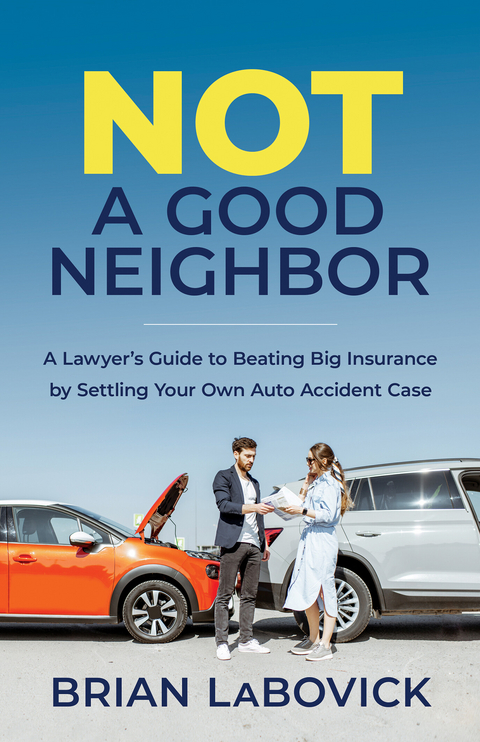
Not a Good Neighbor (eBook)
260 Seiten
Lioncrest Publishing (Verlag)
978-1-5445-1969-2 (ISBN)
It's late. You're tired. After a long day, you just want to be home in time for dinner. As you enter an intersection, a truck barrels through a stop sign, smashing into your passenger side. Within seconds, every plan is changed, every project delayed, and every concern you had before this moment overshadowed by an uncertain future. Following hours in the hospital and a wrecked car awaiting insurance-approved repairs, you're stuck. You're mad. And you're starting to think that you'll never recover-in more ways than one. In Not a Good Neighbor, injury lawyer Brian LaBovick shows you how to navigate the paperwork and pitfalls of an automobile accident case. Brian shares stories from nearly three decades in practice to help you maximize benefits in this often complicated process. Learn the ins and outs of auto accident insurance and ways to increase your settlement with the strategies you need to attain the money you deserve. In today's world, insurance alone cannot protect you. Learn how to protect yourself and fight for fairness so you're never a victim again.
Introduction
You’ve just had an automobile accident. You were moving innocently through a busy intersection when—BAM!—some clown runs a light and rams the back of your car.
Do you need a lawyer?
Maybe.
But maybe not.
You may be reading this and think, What? A lawyer telling me I don’t need a lawyer? Isn’t that like a doctor telling you to “walk it off” or a politician advising you to skip an election?
I’m sure skeptical people out there will say that if you ask a lawyer whether you need a lawyer, the answer is always yes! And that’s probably a truthful statement. Most lawyers will tell you that you need to hire them if you want your auto accident handled in a way that protects your rights and ensures you get fair compensation. That’s because lawyers are like other experienced professionals in that they can quickly see how to fix a problem. If you go to a surgeon to fix a medical problem, for example, chances are, you are going to be offered a surgical fix. That’s what the surgeon knows. When I went with my daughter to the orthodontist, they not only showed me how terrible my daughter’s bite was, but they also made me realize I needed braces, too!
But the fact is, in the legal world, especially in the car accident injury world, the majority of accidents do not need a lawyer. That is not to say that you can just sit back while the checks pour in from the insurance company to pay for all your suffering, expenses, and inconveniences. If you’ve been in a car wreck that wasn’t your fault, you still need to take certain steps, investigate diligently, and negotiate carefully to ensure the insurance companies treat you fairly and honestly. You have to know how and when to seek medical treatment, and you have to understand how insurance policies are structured and how insurance adjusters work. You have to know your state laws about insurance coverage, and you certainly need to fully understand your own auto insurance policy and how to use it in case you have to. Most of all, you must recognize when the value of the claim is so high that the discount you will suffer doing the case alone will not be worth it and that you need to consult with a qualified injury lawyer to see if you can better maximize the case. Those cases are not as common as one may think. Most of the time, you can do this on your own.
There is a lot to know and remember, but you can do it—particularly if you’re holding this book in your hands right now. In the chapters that follow, you’ll find everything you need to navigate the process successfully. If the accident wasn’t your fault, you can still negotiate a settlement with the other driver’s insurance company and make as much as you would if you had a lawyer—but without having to pay the lawyer’s percentage and costs.
Do I Need a Lawyer?
With thousands of lawyers bombarding us on TV, billboards, radio, and internet ads, it seems like everyone needs a lawyer to handle every car accident case, right? How is it possible that most of us don’t need lawyers?
What’s more, how is it possible that one of those lawyers advertising about car accidents—me, for instance—is telling you that you don’t need one?
Here’s why: I want the cases where my client has significant, tragic, or catastrophic damages. Cases where people need surgery or have broken bones or a brain injury. Those are the types of cases that a nonlawyer will never get to full value on their own. The stakes are too high, and the insurance companies are far too crafty and experienced in cases like that for you to go it alone. You need an experienced hand to guide you, someone who understands all the insurance industry tricks and has a few tricks of their own. I will review some of those cases here, but my advice will be centered on understanding them and protecting your rights and not on handling that kind of complicated case on your own.
For all those other run-of-the-mill fender benders where drivers walk away with minor injuries, you’re better off going it alone. All it takes is a little perseverance—and the advice found in this book.
Going Solo
I recently got a call from a man in Tampa named Surget, who was injured when a commercial pickup truck driver ran a red light and slammed into his Ford Edge in the middle of an intersection. The accident totaled Surget’s vehicle. It sent him to the hospital with serious injuries.
Surget carried Florida’s required personal injury protection insurance (PIP), which helped pay for his hospital bills, chiropractor visits, and MRI diagnostic exams. He made the claim on his own by calling the toll-free number on his insurance card. The operator he spoke to took his information and gave him a PIP claim number, and he used that for all his bills. It was fast and easy for him.
But Surget felt he needed some help dealing with the other driver’s insurance company. He needed to get from point A—getting medical treatment for his injuries—to point B—getting a fair settlement from the other driver’s insurance company. There seemed to be a lot of information, posturing, and evidence that needed to be developed before he could cross from point A to B, and he wasn’t sure what the correct steps were. How would he go about getting a fair offer? What had to happen for that insurance company to say, “We want to give you X dollars to take care of you”? Surget did a great job providing the insurance companies the information they needed to evaluate his case. He even started the negotiation process, but it broke down because the adjuster was lowballing Surget on the offer to settle.
Surget was fortunate to call my office for help. I listened to what he’d done so far, and I was impressed with how smart and properly developed his case had become. So instead of taking him on as a client, I offered to coach him through the process. I explained that he needed to send the other driver’s insurance company a more comprehensive demand letter, which is a formal offer to settle the case. I coached him on what he should say and what he should ask for in a way that would make sense to the adjuster. He wrote the letter and sent it off.
The other driver had a $100,000 policy limit. We asked them to tender their limits, and the company came back with an increased offer of $12,000, which was $9,000 more than their previous offer.
Surget countered with another demand, and they went back and forth with the negotiations until Surget got the offer up to $40,000. At that point, he called me back.
“I want you to take my case,” he said. “I think we can get the full $100,000 limit!”
Surget was smart. He’d negotiated well, but he also knew that settlement offers often increase when you hire a lawyer.
I agreed that a lawyer could get him a higher offer from the insurance company. However, he was going to have a hard time getting the case to $100,000 with or without a lawyer. He was not getting any surgical intervention. His other value drivers were somewhat weak, and the property damage was not spectacular. It wasn’t a bad case, but it was simply not a policy limits case without litigation. If we took his case into litigation, we could be offered the $100,000 near the trial date, but by that time, we would have incurred $20,000 in pretrial costs, which is the average amount it takes to prepare a case for court. When you do the math, it looks like this: The lawyer gets 40 percent of litigated case value; in this case, it would be around $40,000. In addition, the lawyer gets his investment back, which in this case would be the $20,000 pretrial costs. That means that $40,000 plus $20,000 is $60,000, and $60,000 minus $100,000 is $40,000! The adjuster recognized that Surget would get the same amount ($40,000) for settling early, just as he would if he hired an attorney and got the entire policy limits. In the end, the most he could hope to get was $40,000, and that payday might be two years away.
“Why don’t you take your $40,000 now and skip the aggravation of litigation and the risk of a jury trial?” I said. Surget readily saw the logic. He took the $40,000 and was happy.
How to Protect Yourself
Surget is an excellent example of why I’m writing this book.
Drivers like Surget who have been in an accident and find themselves negotiating with an insurance company can often negotiate their claims without hiring an attorney, saving time, money, and anxiety. To do that, however, those drivers need advice about how the system works and knowledge of how insurance companies think.
It is critical that you understand the process. It makes a big difference if you know how to best communicate with insurance companies—your own insurance company, as well as the other driver’s insurers. What can you expect from them?
You need to know what you should do immediately after an accident to protect your rights. You must know where to get medical treatment that will help you recover, how to document your injuries for purposes of claim settlement, and how to build your case.
It is also wise to protect yourself before the accident ever happens. That’s why you buy insurance, right? To make certain that when something bad happens, you are properly...
| Erscheint lt. Verlag | 23.3.2021 |
|---|---|
| Sprache | englisch |
| Themenwelt | Wirtschaft ► Betriebswirtschaft / Management |
| ISBN-10 | 1-5445-1969-9 / 1544519699 |
| ISBN-13 | 978-1-5445-1969-2 / 9781544519692 |
| Informationen gemäß Produktsicherheitsverordnung (GPSR) | |
| Haben Sie eine Frage zum Produkt? |
 EPUB (Ohne DRM)
Größe: 9,0 MB
Digital Rights Management: ohne DRM
Dieses eBook enthält kein DRM oder Kopierschutz. Eine Weitergabe an Dritte ist jedoch rechtlich nicht zulässig, weil Sie beim Kauf nur die Rechte an der persönlichen Nutzung erwerben.
Dateiformat: EPUB (Electronic Publication)
EPUB ist ein offener Standard für eBooks und eignet sich besonders zur Darstellung von Belletristik und Sachbüchern. Der Fließtext wird dynamisch an die Display- und Schriftgröße angepasst. Auch für mobile Lesegeräte ist EPUB daher gut geeignet.
Systemvoraussetzungen:
PC/Mac: Mit einem PC oder Mac können Sie dieses eBook lesen. Sie benötigen dafür die kostenlose Software Adobe Digital Editions.
eReader: Dieses eBook kann mit (fast) allen eBook-Readern gelesen werden. Mit dem amazon-Kindle ist es aber nicht kompatibel.
Smartphone/Tablet: Egal ob Apple oder Android, dieses eBook können Sie lesen. Sie benötigen dafür eine kostenlose App.
Geräteliste und zusätzliche Hinweise
Buying eBooks from abroad
For tax law reasons we can sell eBooks just within Germany and Switzerland. Regrettably we cannot fulfill eBook-orders from other countries.
aus dem Bereich