


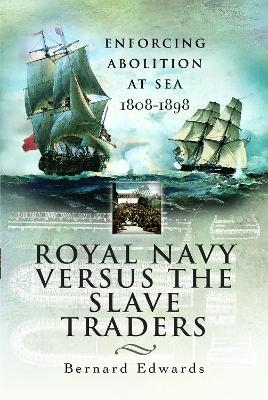
Royal Navy Versus the Slave Traders
Enforcing Abolition at Sea 1808-1898
Seiten
2021
Pen & Sword Maritime (Verlag)
978-1-3990-1350-5 (ISBN)
Pen & Sword Maritime (Verlag)
978-1-3990-1350-5 (ISBN)
Thrilling naval action in the Atlantic against a ruthless enemy.
On 16 March 1807, the British Parliament passed The Abolition of the Slave Trade Act. In the following year the Royal Navy's African Squadron was formed, its mission to stop and search ships at sea suspected of carrying slaves from Africa to the Americas and the Middle East. With typical thoroughness, the Royal Navy went further, and took the fight to the enemy, sailing boldly up uncharted rivers and creeks to attack the barracoon's where the slaves were assembled ready for shipment. For much of its long campaign against the evil of slavery Britain's Navy fought alone and unrecognised. Its enemies were many and formidable. Ranged against it were the African chiefs, who sold their own people into slavery, the Arabs, who rode shotgun on the slave caravans to the coast, and the slave ships of the rest of the world, heavily armed, and prepared to do battle to protect their right to traffic in the forbidden black ivory. The war was long and bitter and the cost to the Royal Navy in ships and men heavy, but the result was worthy of the sacrifices made. The abolition of the slave trade led to a scramble for empires and, in place of slaves, Africa began to export cocoa, coffee, timber, palm oil, cotton and ores, all very much in demand in the West.
On 16 March 1807, the British Parliament passed The Abolition of the Slave Trade Act. In the following year the Royal Navy's African Squadron was formed, its mission to stop and search ships at sea suspected of carrying slaves from Africa to the Americas and the Middle East. With typical thoroughness, the Royal Navy went further, and took the fight to the enemy, sailing boldly up uncharted rivers and creeks to attack the barracoon's where the slaves were assembled ready for shipment. For much of its long campaign against the evil of slavery Britain's Navy fought alone and unrecognised. Its enemies were many and formidable. Ranged against it were the African chiefs, who sold their own people into slavery, the Arabs, who rode shotgun on the slave caravans to the coast, and the slave ships of the rest of the world, heavily armed, and prepared to do battle to protect their right to traffic in the forbidden black ivory. The war was long and bitter and the cost to the Royal Navy in ships and men heavy, but the result was worthy of the sacrifices made. The abolition of the slave trade led to a scramble for empires and, in place of slaves, Africa began to export cocoa, coffee, timber, palm oil, cotton and ores, all very much in demand in the West.
Bernard Edwards is one of the UK's foremost naval historians. A former merchant navy Captain, he has written numerous books including Beware Raiders!, The Road to Russia; The Quiet Heroes and The Twilight of the U-Boat. He lives in Gwent, Wales.
| Erscheinungsdatum | 01.09.2021 |
|---|---|
| Zusatzinfo | 8pp B&W photos |
| Verlagsort | South Yorkshire |
| Sprache | englisch |
| Maße | 156 x 234 mm |
| Themenwelt | Geisteswissenschaften ► Geschichte ► Teilgebiete der Geschichte |
| Wirtschaft ► Volkswirtschaftslehre ► Makroökonomie | |
| ISBN-10 | 1-3990-1350-5 / 1399013505 |
| ISBN-13 | 978-1-3990-1350-5 / 9781399013505 |
| Zustand | Neuware |
| Informationen gemäß Produktsicherheitsverordnung (GPSR) | |
| Haben Sie eine Frage zum Produkt? |
Mehr entdecken
aus dem Bereich


aus dem Bereich
Mythen und Legenden aus der Seefahrt
Buch | Hardcover (2025)
Regionalia Verlag
CHF 13,90
das bewegte Leben des Aimé Felix Tschiffely
Buch | Hardcover (2025)
Weber Verlag
CHF 49,00


