


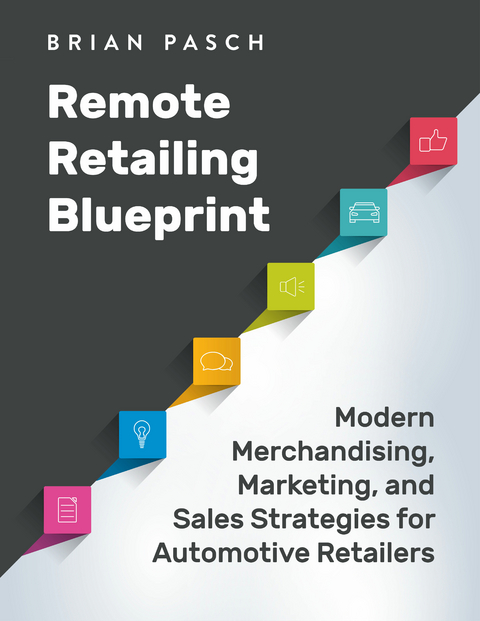
Remote Retailing Blueprint (eBook)
70 Seiten
Bookbaby (Verlag)
978-1-0983-3491-8 (ISBN)
The COVID crisis of 2020 greatly accelerated change in automotive retailmerchandising, marketing, and sales process. In 2019, some dealers may havebeen considered early adopters with their implementation of digital retailingtechnology. But in 2020, dealers who exit the year with no remote retailingtools on their websites will have fallen behind their competition and beconsidered behind the times. This is my ninth book that I have published for the automotive industry. Thiswork is designed to start conversations within dealership management, dealergroups, and manufacturers on the future of automotive retail. My previousbook on digital retailing "e;Just Faster"e; (published in 2018) was a starting pointfor rethinking automotive retailing but lacked specific strategies and successstories from a wider range of national franchisees. Today, I have much more todiscuss and share with readers. While the pace of change has been accelerated due to stay-at-homerestrictions in 2020, dealers who exhibit successful experiences with remoteretailing will fuel the second wave of change in automotive retail. That wavewill be known for lower operating costs, broader appeal for careerprofessionals to consider working in automotive retail, higher employeeretention, and a more personalized, convenient, and frictionless consumerbuying experience.
Refreshing your local Brand Message.
This chapter may be hard for you to read. Try to remain open-minded about your approach to local marketing and the message your advertising conveys to in-market shoppers. This is especially true for second and third-generation dealership managers who have utilized the same tagline or market message for years. How well does your current market message communicate the experience you want consumers to have when they visit and transact?
If your dealership has been using the Brand Message “An experience you will never forget” in all your commercials for the past 50 years, any thought of scrapping that tagline could be met with strong emotional resistance. Or you may have a brand message that includes your dealer group name like “Huffines has It!” that was used on TV and in radio commercials for years. Changing this tagline might be the farthest thing on your mind.
I hope you can approach this chapter with an open mind. Let’s go back to the tagline “An experience you will never forget.” What type of experience does it say the consumer will have? Was it faster, friendlier, and easier than another dealer in town? Couldn’t the same open-ended phrase mean that the experience was so poor the consumer will never forget it?
Disney chose “Fastpass+” because the name implies what the experience will be. There is no way a consumer would see that name and ask if the FastPass+ experience was slower than a normal park ticket.
I want to challenge you to review your local marketing messages based on what consumers value in 2020 and beyond. Consumers’ expectations have changed, and what was a great tagline 25 years ago before the internet is likely not effective today. Some of the most successful brands have evolved their brand message and identity to stay in the conversation of consumers.
Let’s look more closely at some of the popular marketing messages that I shared in Chapter I. Again, don’t get defensive especially if you are a profitable dealer who thinks that your marketing is working perfectly.
Claim #1: I Have the Largest Inventory.
Today, having the largest inventory in the local market may not have the impact that it once had. Why does the messaging have to change?
Before the Internet, being the volume leader had value to consumers because it implied that consumers would more likely get exactly what they wanted when they visited. Today, websites like Cars.com, CarGurus, Autotrader.com, Edmunds, and TrueCar give consumers access to the largest inventory to help them find exactly what they want from the comfort of their home. They shop online to save time and to narrow down their choices, as long as the information provided online is trustworthy.
Claim #2: We Are the Oldest Dealership in the Area.
Today, being the oldest dealer in the local market may not have the impact that it once had. Why does the messaging have to change?
Touting that your dealership has been operating for 30 years under the same leadership was valuable in the past. Consumers valued stability and knowing the family behind the store and its values of supporting the local community.
Today, that message could easily be interpreted to mean the dealership is old-fashioned and not up-to-speed with the latest trends and technology in retailing. I also don’t think most customers care about who owns the dealership as long as the price is fair, and the transaction is simple.
Respectfully, any business owner that has been in business for 30+ years or has the largest inventory is a wonderful accomplishment. However, we need to evolve the conversation to educate consumers that your dealership is the easiest and smartest place to buy their next vehicle.
Claim #3: We Will Treat You Like Family.
That phrase gives your dealership a 50-50 chance that the consumer had a happy family life or that their family treated them well.
Let’s do a quick test. Do you have any family members that owe you money? Do you have a family member that you don’t speak with anymore? How about a family member that stole from you? How many families do you know that went through a bitter divorce?
With this greater understanding about our world, and that 50% of shoppers could have had a bad family experience, why would you tie your business to that jump ball message? The statement “We will treat you like family” to a cynical consumer could also mean that you will take advantage of them!
Claim #4: We Have the Lowest Prices.
This is a very popular claim and used in numerous commercials. For years, the Huffines Automotive Group had a tagline that said “Huffines Has It!” which is ambiguous to me. However, when they play their jingle and advertise their stores in video, the associated message is that they are the only place with the “Low Price Guarantee.” You can see this in action on this YouTube video.
What is that Low Price Guarantee? The consumer would have to call and ask them about that, which was the hook to get a sales opportunity. This type of advertising helped to develop a general belief that car dealers will say anything to get someone in the showroom, and that promised low prices rarely ever materialize.
I could go on to debunk other recycled marketing messages, but I hope that you would see that while these four messages will appeal to a small segment of the population, everyone values saving time and having an easier experience.
If you feel that some of these messages are still critical for your local marketing, the compromise would be to include them in your Brand Promise but refresh your Brand Message. So instead of leading with “Home of the Low-Price Guarantee,” you can add that statement as one of the elements in your Brand Promise.
What do most consumers appreciate?
Today, most consumers are not driven by price alone, and they know that any advertised price is just the lowest starting point for a purchase. Consumers have become educated about loss leader ads and bait-n-switch pricing. A group of consumers will always be driven by price, but most consumers are more concerned about the affordability of a vehicle. This concern translates into a desire to know the monthly payment and what they, individually, could qualify to buy or lease.
While price is important, saving time, having a better experience, and allowing the transaction to be more convenient can often trump price. Here is one of the lessons learned from digital retailing: when the car buying process is made easier and consumers are driving the experience with digital retailing tools, they tend to negotiate less and PVR is higher.
What do consumers want their next car buying experience to look like? I asked 100 consumers who were either shopping for a vehicle or had just purchased a vehicle to describe their ideal car buying experience in two words. Here is the word cloud that was generated from their responses:
You will see a theme here that I summarize with this statement: Your Brand Promise should make the buying process faster, easier, and mostly available online to save the consumer time. By saving them time, you reduce aggravation and allow your customers to do more of the fun things like test drives and going over the features of the car they purchased.
If you gave customers a choice between taking 4-5 hours on a Saturday to purchase a vehicle or purchasing a vehicle in one hour with a payment of $10 more per month, you might be surprised how many people would pay more for a better experience.
Disney didn’t call their upgraded ticket DreamPass+ or MickeyPass+ because there were no implied benefits in the name. They chose FastPass+ because no one wants to wait in long lines at a theme park, and no one want to wait 2 hours in line for the F&I office to become available on a busy weekend.
It is time to put a name to your retail experience.
In Chapter I, we discussed the definition for Brand Promise and Brand Message. It’s time for you to create your own Brand Message; something short that can be used for both sales and service. The word(s) you use should support your vision for how consumers will describe their experience at your dealership.
If your vision for remote retailing is to save consumers time, then pick words that convey or support that vision. Here are some words that consumers could associate with saving time: FastPass, Express Pass, FastTrack, FastLane, Express Store, RapidPass, and Express Lane.
When you select your Brand Message, I would suggest that you trademark the phrase. When Access Ford decided to use AccessPass, they trademarked it and submitted their logo and a link to their website that showed their use of the mark.
If you are working to create a Brand Message for a dealer group, you will want to stay away from phrases that are tied to one OEM brand. For example, the Wyler Automotive Family created Wyler Direct as their go-to-market Brand Message. Wyler Direct is used in their marketing messages, and their Brand Promise outlines what “direct” means to a consumer.
Here are the elements of their Brand Promise that support their Brand Message:
- Pick & Click -...
| Erscheint lt. Verlag | 4.2.2021 |
|---|---|
| Sprache | englisch |
| Themenwelt | Wirtschaft ► Betriebswirtschaft / Management ► Marketing / Vertrieb |
| ISBN-10 | 1-0983-3491-4 / 1098334914 |
| ISBN-13 | 978-1-0983-3491-8 / 9781098334918 |
| Informationen gemäß Produktsicherheitsverordnung (GPSR) | |
| Haben Sie eine Frage zum Produkt? |
 EPUB (Adobe DRM)
Größe: 38,3 MB
Kopierschutz: Adobe-DRM
Adobe-DRM ist ein Kopierschutz, der das eBook vor Mißbrauch schützen soll. Dabei wird das eBook bereits beim Download auf Ihre persönliche Adobe-ID autorisiert. Lesen können Sie das eBook dann nur auf den Geräten, welche ebenfalls auf Ihre Adobe-ID registriert sind.
Details zum Adobe-DRM
Dateiformat: EPUB (Electronic Publication)
EPUB ist ein offener Standard für eBooks und eignet sich besonders zur Darstellung von Belletristik und Sachbüchern. Der Fließtext wird dynamisch an die Display- und Schriftgröße angepasst. Auch für mobile Lesegeräte ist EPUB daher gut geeignet.
Systemvoraussetzungen:
PC/Mac: Mit einem PC oder Mac können Sie dieses eBook lesen. Sie benötigen eine
eReader: Dieses eBook kann mit (fast) allen eBook-Readern gelesen werden. Mit dem amazon-Kindle ist es aber nicht kompatibel.
Smartphone/Tablet: Egal ob Apple oder Android, dieses eBook können Sie lesen. Sie benötigen eine
Geräteliste und zusätzliche Hinweise
Buying eBooks from abroad
For tax law reasons we can sell eBooks just within Germany and Switzerland. Regrettably we cannot fulfill eBook-orders from other countries.
aus dem Bereich


