


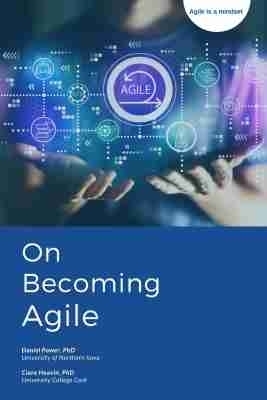
On Becoming Agile
Seiten
2021
Business Expert Press (Verlag)
978-1-63742-008-9 (ISBN)
Business Expert Press (Verlag)
978-1-63742-008-9 (ISBN)
Some agile project approaches are appropriate for many types of projects and a mix of agile approaches coupled with some traditional approaches can make organizations more agile. This book is for anyone who wants to better understand agile.
Digital disruption and transformation of industries and organizations has created a need for more agile attitudes, behaviors, and culture. Becoming more agile is important for individuals, teams, and organizations for three major reasons: 1) the requirements for faster, more responsive execution requires a reduction in bureaucratic processes, 2) changing technology environments reward more customer-focused processes, and 3) rapid internal collaboration and communication that is coordinated using technology is both possible and a requirement.
One way to explain Agile is with a ""dance"" metaphor. Traditional processes are often a slow bureaucratic dance, like a classic waltz. Slow dancing is an important skill to know, but most of us would not want to do that dance all of the time. Today individuals, teams and organizations should perform and practice a wide variety of dances in appropriate contexts to be successful. Agile processes have various rhythms, rituals, and styles. We all need to learn new dances and we need to dance faster much of the time. Also, we need to be able to change dances in an elegant and seamless way. Despite the heightened interest, many people misunderstand or fail to understand becoming agile and applying agile methods and principles. For what types of projects should we use an Agile process? When is a structured development life cycle approach more appropriate? Some agile project approaches are appropriate for many types of projects and a mix of agile approaches coupled with some traditional approaches can make organizations more agile. Some managers and organizations strive for a contingent or a hybrid approach - a mix of agile and more traditional processes. This book is aimed at students, IT practitioners, and managers who seek answers to these questions and want to better understand agile.
Digital disruption and transformation of industries and organizations has created a need for more agile attitudes, behaviors, and culture. Becoming more agile is important for individuals, teams, and organizations for three major reasons: 1) the requirements for faster, more responsive execution requires a reduction in bureaucratic processes, 2) changing technology environments reward more customer-focused processes, and 3) rapid internal collaboration and communication that is coordinated using technology is both possible and a requirement.
One way to explain Agile is with a ""dance"" metaphor. Traditional processes are often a slow bureaucratic dance, like a classic waltz. Slow dancing is an important skill to know, but most of us would not want to do that dance all of the time. Today individuals, teams and organizations should perform and practice a wide variety of dances in appropriate contexts to be successful. Agile processes have various rhythms, rituals, and styles. We all need to learn new dances and we need to dance faster much of the time. Also, we need to be able to change dances in an elegant and seamless way. Despite the heightened interest, many people misunderstand or fail to understand becoming agile and applying agile methods and principles. For what types of projects should we use an Agile process? When is a structured development life cycle approach more appropriate? Some agile project approaches are appropriate for many types of projects and a mix of agile approaches coupled with some traditional approaches can make organizations more agile. Some managers and organizations strive for a contingent or a hybrid approach - a mix of agile and more traditional processes. This book is aimed at students, IT practitioners, and managers who seek answers to these questions and want to better understand agile.
Daniel J. Power is a Professor of Information Systems and Management at the College of Business Administration at the University of Northern Iowa, Cedar Falls, Iowa and the editor of DSSResources.COM, the Web-based knowledge repository about computerized systems that support decision making, the editor of Planning Skills.COM, and the editor of DSS News, a bi-weekly e-newsletter. Dan writes the column ""Ask Dan!"" in DSS News. Also, Dan is the Decision Support Expert at the Business Intelligence Network.
| Erscheinungsdatum | 11.06.2021 |
|---|---|
| Verlagsort | Sterling Forest |
| Sprache | englisch |
| Maße | 152 x 228 mm |
| Gewicht | 333 g |
| Themenwelt | Wirtschaft ► Betriebswirtschaft / Management ► Unternehmensführung / Management |
| ISBN-10 | 1-63742-008-0 / 1637420080 |
| ISBN-13 | 978-1-63742-008-9 / 9781637420089 |
| Zustand | Neuware |
| Informationen gemäß Produktsicherheitsverordnung (GPSR) | |
| Haben Sie eine Frage zum Produkt? |
Mehr entdecken
aus dem Bereich

aus dem Bereich
wie Teams funktionieren und wann sie effektiv arbeiten
Buch | Softcover (2024)
Vahlen (Verlag)
CHF 45,95
wie man Menschen wirklich weiterbringt
Buch | Softcover (2024)
Vahlen (Verlag)
CHF 37,65
ein Navigationssystem für Führungskräfte
Buch (2023)
Carl-Auer Verlag
CHF 48,90


