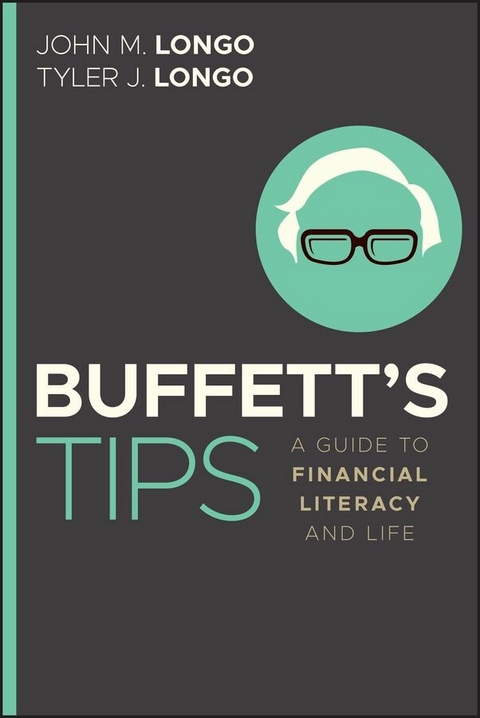
Buffett's Tips (eBook)
John Wiley & Sons (Verlag)
978-1-119-76371-0 (ISBN)
Praise for BUFFETT'S TIPS
'John Longo and his son, Tyler, have performed a valuable service, taking the wisdom of Warren Buffett (the supply of which is ample) and distilling from it 100 'tips,' with the authors' own explanatory text, to guide the reader from financial ignorance to a degree of financial literacy. Along the way, there are useful lessons for life in general. If you have a friend, child, or parent who needs a pathway to a better understanding of some financial fundamentals, get this book for them-it'll go a long way to bringing them up to speed.' -Simon Lorne, Vice Chairman and Chief Legal Officer, Millennium Management LLC; former Partner, Munger, Tolles & Olson
'Priceless. 100 investment and life tips from the Oracle-a great read for the beginning investor.' -S. Basu Mullick, retired Portfolio Manager and Managing Director, Neuberger Berman; former General Partner, Omega Advisors; noted value investor; former 'Marketwatch Fund Manager of the Year'
'John Longo has a well-earned reputation for excellence in teaching at the University level. Working with his son Tyler, John now extends his passion for education out of the classroom and across generations with this guidebook to the essential tools for financial proficiency.' -Gregory P. Francfort, noted value investor; former Institutional Investor 'All-Star Analyst'
'John and his son have written an invaluable guide steeped in the wisdom of Warren Buffett. Marrying sound financial advice with general life lessons, Buffett's Tips provides a solid foundation for advancing financial literacy across a broad multi-generational audience.' -Joshua Rosenbaum, Joshua Pearl, Joseph Gasparro, co-authors, The Little Book of Investing Like the Pros and Investment Banking: Valuation, LBOs, M&A, and IPOs
JOHN M. LONGO is a Professor of Profes- sional Practice in the Finance and Economics Department at the Business School of Rutgers University. He has also been visiting professor of finance at EMBA-Global Asia-the joint Executive MBA program of Columbia Business School, London Business School, and The University of Hong Kong. He has more than 25 years of professional investment experience and is currently serving as Chief Investment Officer of Beacon Trust, a $3+ billion registered investment advisor. A Chartered Financial Analyst (CFA), Professor Longo earned an MBA in Finance and a PhD in Finance from Rutgers, where he also received his BA degree.
TYLER J. LONGO is a high school student in the Princeton, NJ area. He has completed the Introduction to Business, Finance, and Economics program for high school students at Columbia University and additional coursework in AP Economics, AP Statistics, and Financial Literacy. He has become financially literate in large part due to his work on this book.
What if you could learn financial literacy from Warren Buffett himself? Finance is a language like any other: the more fluently you speak it, the further and more comfortably you travel. And if you want to improve your financial literacy, what better teacher could you have than Warren Buffett? Often described as the greatest investor of all time, Warren Buffett started his investment firm with$100 in the late 1950s and went on to become the billionaire and sage we know today. Along the way he's reaped huge profits for fellow investors in Berkshire Hathaway and remains one of the most sought-after and closely watched figures in the business world. So how did he do it? In Buffett's Tips, award-winning professor and professional investor John M. Longo demonstrates just how by translating decades of Buffett's writings and media appearances into a 100 straightforward tips and strategies anyone can follow for enhanced financial literacy and independence, including: Essential concepts like the time value of money and compound interest Basic financial instruments, such as savings and checking accounts and certificates of deposit Approaches to valuing stock, including discounted cash flow and relative valuation How to build a portfolio in accordance with Buffett's two golden rules Whether you want to grow your personal finances, develop your business acumen, or improve softer career skills such as emotional intelligence, there's no one better to learn from than the most famous investor in the world and no better way to do that than having a copy of Buffett's Tips close at hand.
JOHN M. LONGO is a Professor of Profes- sional Practice in the Finance and Economics Department at the Business School of Rutgers University. He has also been visiting professor of finance at EMBA-Global Asia--the joint Executive MBA program of Columbia Business School, London Business School, and The University of Hong Kong. He has more than 25 years of professional investment experience and is currently serving as Chief Investment Officer of Beacon Trust, a $3+ billion registered investment advisor. A Chartered Financial Analyst (CFA), Professor Longo earned an MBA in Finance and a PhD in Finance from Rutgers, where he also received his BA degree. TYLER J. LONGO is a high school student in the Princeton, NJ area. He has completed the Introduction to Business, Finance, and Economics program for high school students at Columbia University and additional coursework in AP Economics, AP Statistics, and Financial Literacy. He has become financially literate in large part due to his work on this book.
1
Who Is Warren Buffett?
“I tap dance to work, and when I get there I think I'm supposed to lie on my back and paint the ceiling. It's tremendous fun.”
—Warren Buffett, Tap Dancing to Work: Warren Buffett on Practically Everything, 1966–2012
Introduction
Everyone wants to be financially literate and, ultimately, financially independent. What better way to become financially literate than to use the mindset of Warren Buffett, likely the greatest and richest investor who ever lived? That's the premise of this book. Through his decades of writings, interviews, and speeches, Buffett has provided reams of advice, but he has never written a book on financial literacy. This book takes much of that material and rearranges it in a way to make you financially literate and puts you on the path to becoming financially independent. It may be the next best thing to having Buffett on speed dial!
Buffett's net worth—the amount of money he would have after paying off any debts—was recently pegged at about $80 billion. But minting money just scratches the surface of Buffett's accomplishments. He'll also go down in history as one of the greatest philanthropists ever. He's giving away virtually all of his money to charitable organizations. If that's not enough, he and Bill Gates—the co-founder of Microsoft—set up the Giving Pledge, an organization where many of the world's billionaires have pledged to give at least half of their wealth to philanthropy. Buffett's also a great guy, a genuine down-to-earth person who enjoys life on his own terms. He also has an amazing sense of humor.
Here's a sample. When asked why he has a diet filled with junk food, Buffett replied, “I checked the actuarial tables, and the lowest death rate is among six-year-olds. So I decided to eat like a six-year-old.” In short, Buffett's a great role model for all people, regardless of age—if you can get past his diet.
In this book, we take some of the experiences, quotes, wit, and wisdom of Warren Buffett and apply them not only to issues related to financial literacy, but also to lessons on having a successful life. It's a boot camp on personal finance and life, with the backbone of the book constructed by the lessons of Warren Buffett from his many writings, interviews, and external biographies. Although the topic of financial literacy may be of greatest benefit to teens and young adults, since they are often starting with a clean slate, the concepts are really applicable to people of all ages, especially those without a financial background. You're probably thinking, “What can I learn from a 90-year-old?” A lot! At least in our view. And we promise to make it painless for you and, hopefully, fun!
Buffett the Teen
Buffett wasn't born rich, and he didn't turn into a financial superstar when he was an older adult. The foundation to his success was laid during his pre-teen years. When Buffett was in elementary school, in Omaha, Nebraska, he sold Wrigley's chewing gum and bottles of Coca-Cola—both future investments for him—to make money. He bought his first stock at the age of 11! We'll devote two whole chapters in this book to the stock market, but for now you can think of stock as something that makes you part owner of a business. He filed his first tax return at the age of 13, deducting the costs of his watch and bicycle as business expenses, resulting in a net payment to the U.S. Treasury of $7. Paying taxes is about as exciting as watching paint dry, but they're something you won't be able to avoid down the road, especially if, make that when, you get richer. One of America's Founding Fathers, Benjamin Franklin, once wrote, “In this world nothing can be said to be certain, except death and taxes.”
Buffett's father, Howard, was a United States Congressman for 6 years, and Warren moved with his family to Washington, DC, during the 1940s. Buffett got a newspaper route in DC delivering The Washington Post (another future stock investment). By the age of 15 he had used the profits from his business ventures to buy 40 acres of farmland in Nebraska. As a teenager, he and a friend also bought pinball machines and put them in barbershops, splitting the profits with the shop owners. Thus, we hope you can see that the experiences of the young Warren Buffett played an important role, making him the man that he is today.
Who Are We to Write This Book?
Well, first we think there's a gap in the teachings of Warren Buffett. He participated in a cartoon series, Secret Millionaires Club, over the 2011–2013 period that provided some simple tips on financial literacy, but not enough to make someone financially competent. Buffett also writes a detailed letter to the stockholders of his firm, Berkshire Hathaway, each year. Stockholders own stock and, therefore, are part owners of a business. You can find Buffett's Berkshire letters going back to 1977 on the web at http://www.berkshirehathaway.com/letters/letters.html.
You may not have heard of Berkshire Hathaway, but you've almost certainly come across some of its businesses. It owns Dairy Queen, GEICO Insurance (the car insurance company with the funny commercials), Duracell batteries, See's Candy, and dozens of other businesses. It's also one of the biggest stockholders in several of the companies that you likely know, such as Coca Cola, Kraft Heinz (maker of ketchup and mac & cheese), American Express, Wells Fargo, Bank of America, Amazon.com, Apple, and many others.
We're guessing you may not want to read a bunch of annual reports and letters to shareholders, even ones as insightful and often humorous as Berkshire's. But we've read them and extracted many nuggets of information that apply to financial literacy and life. There’ve been several excellent books written about Buffett, such as Alice Schroeder's The Snowball: Warren Buffett and the Business of Life. It's the only book on Buffett that had his explicit cooperation, but at 832 pages, it's almost the size of War and Peace! Plus, these and other excellent Buffett-oriented books and websites assume you know a fair amount about business and finance. This book doesn't take that knowledge for granted and teaches you financial literacy concepts along the way. So one way to think of this book is that it's like a CliffsNotes on the life of Buffett that makes you financially literate and gives you some life skills to boot—but don't sign up just yet for the reality TV show Survivor. :-)
John is a finance professor and investment manager who has met Buffett on four separate occasions. He also teaches graduate college classes on Value Investing, a style of making investments that Buffett follows. He teaches mostly at Rutgers University but also on a part-time basis in the global Executive MBA Program at Columbia University—the same university where Buffett got his master's degree. More precisely, it's a joint Executive MBA program among Columbia, London Business School, and the University Hong Kong, one of the most highly ranked in the world. He's also served as chief investment officer for two billion-dollar-plus investment firms for more than 15 years in total.
Younger people may not want to hear advice from a middle-aged college professor and money manager any more than they want to hear it from their parents. Enter Tyler, a teenage high school student who is learning about personal finance issues in real time. He's completed coursework in financial literacy, economics, statistics, and the Introduction to Business, Finance, and Economics Program for high school students at Columbia University. He is co-author of this book, having written portions of the book, and has his finger on the pulse of teens and young adults to a much greater extent than any college professor. And, perhaps most importantly, his understanding of the concepts in this book acts as an important filter to make sure the book is understandable to teens, young adults, and people new to finance of all ages. Plus, if you see slang words, such as savage, lit, and take the L, used to make the book more readable and less stuffy, that's probably Tyler's influence too. You can also thank him for the handy glossary near the end of this book, so you can brush up on your vocab when you hear a financial term that you don't know. He also contributed some important stories, such as the one related to the Patagonian toothfish that we'll get to in Chapter 11.
What Is Financial Literacy and Why Does It Matter?
Literacy means being able to read and write. The President's Advisory Council on Financial Literacy defines personal financial literacy as “the ability to use knowledge and skills to manage financial resources effectively for a lifetime of financial well-being.” In plain English, it means understanding things related to money and being able to make good financial decisions.
In this book, we'll examine a bunch of concepts related to financial literacy including bank accounts, credit cards, credit scores, balancing a checkbook, the stock market, the bond market, mutual funds, real estate, car loans, student loans, mortgage loans, financial websites, financial apps, retirement accounts, and tips for saving money....
| Erscheint lt. Verlag | 8.12.2020 |
|---|---|
| Sprache | englisch |
| Themenwelt | Sachbuch/Ratgeber ► Beruf / Finanzen / Recht / Wirtschaft ► Geld / Bank / Börse |
| Recht / Steuern ► Wirtschaftsrecht | |
| Wirtschaft ► Betriebswirtschaft / Management | |
| Schlagworte | Basic Finance • build a stock market portfolio • Business Accounting • Finance & Investments • finance guide • finance skills • financial literacy • Financial Management • Finanz- u. Anlagewesen • improve personal finance • investor's guide • learn accounting • personal finance • Personal investing • Private Finanzplanung • Stock Market Investing • Warren Buffett |
| ISBN-10 | 1-119-76371-1 / 1119763711 |
| ISBN-13 | 978-1-119-76371-0 / 9781119763710 |
| Informationen gemäß Produktsicherheitsverordnung (GPSR) | |
| Haben Sie eine Frage zum Produkt? |
 EPUB (Adobe DRM)
Kopierschutz: Adobe-DRM
Adobe-DRM ist ein Kopierschutz, der das eBook vor Mißbrauch schützen soll. Dabei wird das eBook bereits beim Download auf Ihre persönliche Adobe-ID autorisiert. Lesen können Sie das eBook dann nur auf den Geräten, welche ebenfalls auf Ihre Adobe-ID registriert sind.
Details zum Adobe-DRM
Dateiformat: EPUB (Electronic Publication)
EPUB ist ein offener Standard für eBooks und eignet sich besonders zur Darstellung von Belletristik und Sachbüchern. Der Fließtext wird dynamisch an die Display- und Schriftgröße angepasst. Auch für mobile Lesegeräte ist EPUB daher gut geeignet.
Systemvoraussetzungen:
PC/Mac: Mit einem PC oder Mac können Sie dieses eBook lesen. Sie benötigen eine
eReader: Dieses eBook kann mit (fast) allen eBook-Readern gelesen werden. Mit dem amazon-Kindle ist es aber nicht kompatibel.
Smartphone/Tablet: Egal ob Apple oder Android, dieses eBook können Sie lesen. Sie benötigen eine
Geräteliste und zusätzliche Hinweise
Buying eBooks from abroad
For tax law reasons we can sell eBooks just within Germany and Switzerland. Regrettably we cannot fulfill eBook-orders from other countries.
aus dem Bereich