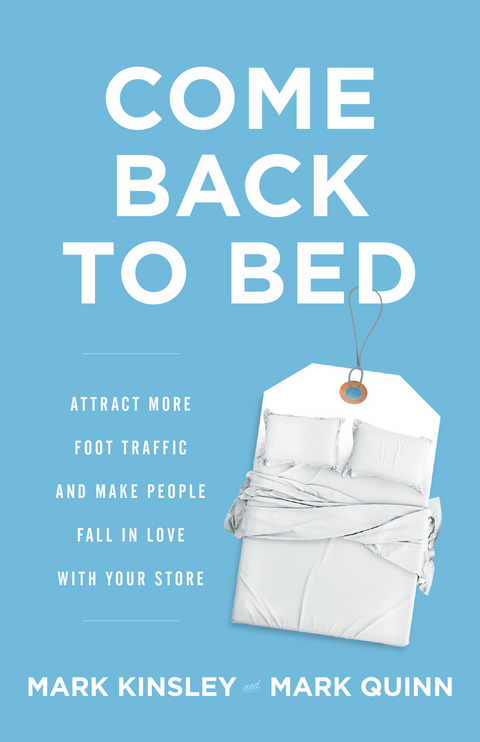
Come Back to Bed (eBook)
174 Seiten
Lioncrest Publishing (Verlag)
978-1-5445-1732-2 (ISBN)
What does it take for today's independent retailers to survive and thrive? Retail is experiencing a massive transition. Thousands of independent retailers have been bobbing in the ocean, clinging to planks of splintered wood and struggling to stay afloat. Today, those who remain have washed ashore on a new island, and the rules have changed. But where there's life, there's hope, as long as you're willing to roll up your sleeves and do the work. In Come Back to Bed, Mark Kinsley and Mark Quinn offer strategies and principles retailers can use to forge lasting customer relationships that will weather any storm. Bring in new business and reclaim your path to success (and profits!) as you learn how to build your brand, connect with customers in a more meaningful way, drive foot traffic, and become notorious in your marketplace.
Chapter One
State of the Mattress Industry
Even before COVID-19, few industries had been more disrupted than the mattress business.
For decades, people shopping for a mattress visited a retail store. They’d test a few beds, pay for the mattress, strap that white rectangle to the top of their station wagon, and head home.
The business model for mattresses stayed constant because beds are bulky and hard to move. Manufacturers would ship products to a retailer’s warehouse, and retailers would sell to consumers, who hauled the mattress home or had it delivered. There weren’t many ways to skip a step.
Until compressed mattresses came along.
In terms of industries e-commerce has massively disrupted, books and beds are both near the top of the list.
Amazon began selling books online in 1995 and has since wiped out major brick-and-mortar retailers. Few people would have imagined the fate of books and beds would collide. Today, Amazon is the number one seller of books and roll-packed mattresses in the United States.
To roll-pack a mattress, you place it into a machine that compresses it, folds it, and rolls it like a burrito. The mattress is shipped in a box about the size of a mini fridge. Shippers like UPS or FedEx deliver the mattress to a consumer’s front door. They unroll it, cut the plastic seal, and voilà, the mattress expands back to life and fully recovers in about twenty-four hours.
While working at Leggett & Platt, the world’s largest manufacturer of mattress innersprings and bedding components, we often pondered this question: What component technology would disrupt springs? Was there a support system that could be produced at scale that would swallow innersprings and send the industry in a new direction? Few people thought innovations in mattress compression, packaging, and shipping would forever alter the coastline of mattress country.
A company called BedInABox was an early pioneer in selling compressed mattresses online. The BedInABox.com website says, “In the fall of 2004, a foam expert, a digital marketer and a machine builder with a wild idea got together in Johnson City, Tennessee, to discuss the concept of putting a queen size mattress into a box that the freight companies would accept. Eighteen months later an industry was born from the imagination and leadership of Bill Bradley, the creator of that first machine used to put a BedInABox.”
Even though BedInABox introduced the concept of shippable mattresses, Tuft & Needle took it to a new level.
JT Marino and Daehee Park launched Tuft & Needle in 2012 shortly after JT and his wife endured a frustrating mattress-shopping experience. At the time, Park and Marino were Penn State graduates working in Silicon Valley. The duo was looking to start a business in an industry whose consumers hated their shopping experience. Traditional mattress retail was known for slimy salespeople and a confusing process. JT and Daehee created a list of things they disliked about mattress shopping, and from that hate list, Tuft & Needle was born.
Then came Casper, a money-raising, brand-building juggernaut that followed Tuft & Needle into the online mattress retail business. Casper raised millions of dollars from big-name investors like Leonardo DiCaprio, 50 Cent, and Ashton Kutcher. Kylie Jenner even posted a picture of her new Casper mattress that got 870,000 likes on Instagram. With all this attention, the brand generated $1.8 million in sales in its first two months.
Online upstarts understood the shift to a consumer-centric world. Their founders felt the pain customers experienced when shopping for a mattress. By limiting selection and creating a convenient way to shop, they drew adoring fans to mattress websites that promised better sleep at a better price, shipped to your door.
Soon after Tuft & Needle and Casper launched their perfect mattress business model, the floodgates for look-alikes and imitators burst. Brands like Nectar, Saatva, Leesa, and Purple entered the roll-pack mattress space. The list of newbies mushroomed from a dozen or so startups to more than 175 online brands in less than seven years. All this awareness and advertising around mattresses came at a time when people’s attitudes toward sleep were changing.
Shifting Feelings about Sleep
At 2:39 a.m. on Thursday, January 4, 2018, an earthquake struck near the historic Claremont Hotel in Berkeley, California. The 4.4 magnitude temblor shook the San Francisco Bay Area and jolted people awake.
Developers working at Fitbit received a flood of data from people wearing fitness-tracking devices. When the earthquake rumbled through Berkeley, the number of people awake jumped from 8 percent to 52 percent.
Farther from the epicenter of the quake, data showed more people stayed asleep.
While seismologists likely found the data useful, those following the sleep space saw something else unfolding. For the first time in history on any large scale, human beings got a glimpse of what happens during the one-third of their lives spent asleep. That glimpse into the unknown, even if the data wasn’t entirely accurate, may have sparked an interest in and basic understanding of sleep.
It’s common knowledge that we need to eat right, sleep right, and exercise in order to live our best life. We can measure our diet with a scale, we can quantify the benefit of exercise as we lift more and run farther, but when it comes to sleep the feedback is mostly subjective. As Kinsley’s Grandma Minnie used to say when asked how she slept, “I’m not sure. I didn’t stay awake to find out.”
Back to the earthquake and fitness trackers. Early Fitbits only measured movement. To accurately measure sleep quality, researchers monitor breathing rate, heart rate, and body temperature. So that Fitbit data wasn’t 100 percent accurate. But that’s not the point. For the first time ever, people had quantifiable data attached to sleep, and they became interested in getting better rest.
Politicians and business leaders have often worn their lack of needing sleep as a badge of honor. The “I don’t need sleep” attitudes are slowly disappearing as those who spent their lives getting by on less than six hours begin to develop dementia. Yes, lack of sleep is now shown to be a cause of Alzheimer’s.
As people stare at Fitbit data and listen to mattress advertisements, they might realize they feel haggard. The attitude toward sleep is shifting. The public is beginning to learn that their sleep needs are biological. There’s no shortcut.
Professional sports teams have hired sleep coaches, and athletes are celebrating the performance benefits of sleep. Arianna Huffington wrote an entire book about how she collapsed from lack of sleep and is now on a mission to make people understand how dangerous ignoring sleep needs can be.
We’re exposed to more data about our sleep through smartphones and fitness trackers. Hell, we’re tired of being tired and aren’t willing to take it anymore.
The growing appreciation for sleep and the products that have an impact on it is good for the mattress industry—especially if we continue connecting the mattress to better sleep and keep the public from believing a bottle of pills is the only way to find restorative rest.
An amazing mattress that fits your body gives you much more than a bottle of pills. A more positive attitude, weight loss, better focus throughout the day, improved memory, better sex life, reduction in illness, and a more beautiful appearance are all by-products of a healthy sleep life. How many products in the world can deliver that same list of benefits?
Where Is the Industry Heading?
The landscape for digital disruptors has changed. Tuft & Needle merged with the world’s largest bedding manufacturer, Serta Simmons Bedding (SSB). Casper filed for an IPO and took its company public. Since then, Casper’s stock has dropped more than 50 percent. It appears investors don’t see a clear path to profitability for Casper, which is now true for many direct-to-consumer brands. Purple went public and has experienced success thanks to its great marketing and sleep tech, while Nectar is aggressively expanding into brick and mortar.
Meanwhile, another brand may be a strong predictor of how mattress industry leaders could go about building and managing their brands.
Select Comfort (now Sleep Number) seems to have written a playbook for how direct-to-consumer brands may be built in the future. Sleep Number operates approximately six hundred stores and its annual sales surpass $1 billion. The adjustable air mattress company owns its manufacturing, distribution, and retail operation, and has led the way toward integrating biometric measurement technology into its products, a project we helped with in its early stages. This is a true D2C company that combines online and physical retail to create an end-to-end customer experience that outpaces the market. There’s only one other brand that seems to be positioned as well as or better than Sleep Number.
Tempur-Pedic’s Preference
No conversation about the state of the mattress industry is complete without talking about Tempur-Pedic. Like Sleep Number, Tempur-Pedic started out telling its story using long-form infomercial advertising. Tempur-Pedic’s message was incredibly convincing, and its customer base was happy with the product. This led to Tempur-Pedic becoming the “most recommended brand” in the mattress industry.
Tempur-Pedic is part of Tempur Sealy...
| Erscheint lt. Verlag | 8.12.2020 |
|---|---|
| Sprache | englisch |
| Themenwelt | Wirtschaft ► Betriebswirtschaft / Management |
| ISBN-10 | 1-5445-1732-7 / 1544517327 |
| ISBN-13 | 978-1-5445-1732-2 / 9781544517322 |
| Informationen gemäß Produktsicherheitsverordnung (GPSR) | |
| Haben Sie eine Frage zum Produkt? |
 EPUB (Ohne DRM)
Größe: 1,9 MB
Digital Rights Management: ohne DRM
Dieses eBook enthält kein DRM oder Kopierschutz. Eine Weitergabe an Dritte ist jedoch rechtlich nicht zulässig, weil Sie beim Kauf nur die Rechte an der persönlichen Nutzung erwerben.
Dateiformat: EPUB (Electronic Publication)
EPUB ist ein offener Standard für eBooks und eignet sich besonders zur Darstellung von Belletristik und Sachbüchern. Der Fließtext wird dynamisch an die Display- und Schriftgröße angepasst. Auch für mobile Lesegeräte ist EPUB daher gut geeignet.
Systemvoraussetzungen:
PC/Mac: Mit einem PC oder Mac können Sie dieses eBook lesen. Sie benötigen dafür die kostenlose Software Adobe Digital Editions.
eReader: Dieses eBook kann mit (fast) allen eBook-Readern gelesen werden. Mit dem amazon-Kindle ist es aber nicht kompatibel.
Smartphone/Tablet: Egal ob Apple oder Android, dieses eBook können Sie lesen. Sie benötigen dafür eine kostenlose App.
Geräteliste und zusätzliche Hinweise
Buying eBooks from abroad
For tax law reasons we can sell eBooks just within Germany and Switzerland. Regrettably we cannot fulfill eBook-orders from other countries.
aus dem Bereich