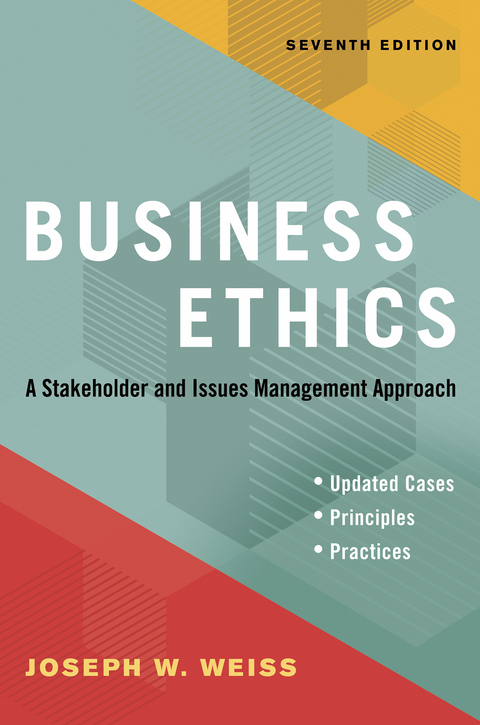
Business Ethics, Seventh Edition (eBook)
648 Seiten
Berrett-Koehler Publishers (Verlag)
978-1-5230-9156-0 (ISBN)
Joseph Weiss's Business Ethics is a pragmatic, hands-on guide for determining right and wrong in the business world. To be socially responsible and ethical, Weiss maintains, businesses must acknowledge the impact their decisions can have on the world beyond their walls. An advantage of the book is the integration of a stakeholder perspective with an issues and crisis management approach so students can look at how a business's actions affect not just share price and profit but the well-being of employees, customers, suppliers, the local community, the larger society, other nations, and the environment.
Weiss includes twenty-three cases that immerse students directly in contemporary ethical dilemmas. Eight new cases in this edition include Facebook's (mis)use of customer data, the impact of COVID-19 on higher education, the opioid epidemic, the rise of Uber, the rapid growth of AI, safety concerns over the Boeing 737, the Wells Fargo false saving accounts scandal, and plastics being dumped into the ocean.
Several chapters feature a unique point/counterpoint exercise that challenges students to argue both sides of a heated ethical issue. This edition has eleven new point/counterpoint exercises, addressing questions like, Should tech giants be broken apart? What is the line between free speech and dangerous disinformation? Has the Me Too movement gone too far? As with previous editions, the seventh edition features a complete set of ancillary materials for instructors: teaching guides, test banks, and PowerPoint presentations.
Chapter 1
Business Ethics, the Changing Environment, and Stakeholder Management
1.1 Business Ethics and the Changing Environment
1.2 What Is Business Ethics? Why Does It Matter?
1.3 Levels of Business Ethics
1.4 Five Myths about Business Ethics
1.5 Why Use Ethical Reasoning in Business?
1.6 Can Business Ethics Be Taught?
1.7 Plan of the Book
Chapter 2
Ethical Principles, Quick Tests, and Decision-Making Guidelines
2.1 Ethical Reasoning and Moral Decision Making
2.2 Ethical Principles and Decision Making
2.3 Four Social Responsibility Roles
2.4 Levels of Ethical Reasoning and Moral Decision Making
2.5 Identifying and Addressing Ethical Dilemmas
2.6 Individual Ethical Decision-Making Styles
2.7 Quick Ethical Tests
2.8 Concluding Comments
Chapter 3
Stakeholder and Issues Management Approaches
3.1 Stakeholder Theory and the Stakeholder Management Approach Defined
3.2 Why Use a Stakeholder Management Approach for Business Ethics?
3.3 How to Execute a Stakeholder Analysis
3.4 Negotiation Methods: Resolving Stakeholder Disputes
3.5 Stakeholder Management Approach: Using Ethical Principles and Reasoning
3.6 Moral Responsibilities of Cross-Functional Area Professionals
3.7 Issues Management: Integrating a Stakeholder Framework
3.8 Managing Crises
Chapter 4
The Corporation and External Stakeholders: Corporate Governance: From the Boardroom to the Marketplace
4.1 Managing Corporate Social Responsibility in the Marketplace
4.2 Managing Corporate Responsibility with External Stakeholders
4.3 Managing and Balancing Corporate Governance, Compliance, and Regulation
4.4 The Role of Law and Regulatory Agencies and Corporate Compliance
4.5 Managing External Issues and Crises: Lessons from the Past (Back to the Future?)
Chapter 5
Corporate Responsibilities, Consumer Stakeholders, and the Environment
5.1 Corporate Responsibility toward Consumer Stakeholders
5.2 Corporate Responsibility in Advertising
5.3 Controversial Issues in Advertising: The Internet, Children,
5.4 Managing Product Safety and Liability Responsibly
5.5 Corporate Responsibility and the Environment
Chapter 6
The Corporation and Internal Stakeholders: Values-Based Moral Leadership, Culture, Strategy, and Self-Regulation
6.1 Leadership and Stakeholder Management
6.2 Organizational Culture, Compliance, and Stakeholder Management
6.3 Leading and Managing Strategy and Structure
6.4 Leading Internal Stakeholder Values in the Organization
6.5 Corporate Self-Regulation and Ethics Programs: Challenges and Issues
Chapter 7
Employee Stakeholders and the Corporation
7.1 Employee Stakeholders in the Changing Workforce
7.2 The Changing Social Contract between Corporations and Employees
7.3 Employee and Employer Rights and Responsibilities
7.4 Discrimination, Equal Employment Opportunity, and Affirmative Action Discrimination
Workplace
7.6 Whistle-Blowing versus Organizational Loyalty
Chapter 8
Business Ethics and Stakeholder Management in the Global Environment
8.1 The Connected Global Economy and Globalization
8.2 Managing and Working in a Different Global World: Professional and Ethical Competencies
8.3 Societal Issues and Globalization: The Dark Side
8.4 Multinational Enterprises as Stakeholders
8.5 Triple Bottom Line, Social Entrepreneurship, and Microfinancing
8.6 MNEs: Stakeholder Values, Guidelines, and Codes for
8.7 Cross-Cultural Ethical Decision Making and Negotiation Methods
| Erscheint lt. Verlag | 23.11.2021 |
|---|---|
| Verlagsort | Oakland |
| Sprache | englisch |
| Themenwelt | Wirtschaft ► Betriebswirtschaft / Management ► Planung / Organisation |
| Wirtschaft ► Betriebswirtschaft / Management ► Unternehmensführung / Management | |
| Schlagworte | Business Decisions • Business Policies • Business practices • Corporate Governance • Discrimination • Ethics in Business • Hiring Practices • managing business ethics • managing business ethics, ethics in business, business policies, business practices, corporate governance, risk management, social responsibility, discrimination, stakeholders, business decisions, stakeholder management, hiring practices • Risk Management • Social Responsibility • Stakeholder Management • Stakeholders |
| ISBN-10 | 1-5230-9156-8 / 1523091568 |
| ISBN-13 | 978-1-5230-9156-0 / 9781523091560 |
| Informationen gemäß Produktsicherheitsverordnung (GPSR) | |
| Haben Sie eine Frage zum Produkt? |
 EPUB (Adobe DRM)
Kopierschutz: Adobe-DRM
Adobe-DRM ist ein Kopierschutz, der das eBook vor Mißbrauch schützen soll. Dabei wird das eBook bereits beim Download auf Ihre persönliche Adobe-ID autorisiert. Lesen können Sie das eBook dann nur auf den Geräten, welche ebenfalls auf Ihre Adobe-ID registriert sind.
Details zum Adobe-DRM
Dateiformat: EPUB (Electronic Publication)
EPUB ist ein offener Standard für eBooks und eignet sich besonders zur Darstellung von Belletristik und Sachbüchern. Der Fließtext wird dynamisch an die Display- und Schriftgröße angepasst. Auch für mobile Lesegeräte ist EPUB daher gut geeignet.
Systemvoraussetzungen:
PC/Mac: Mit einem PC oder Mac können Sie dieses eBook lesen. Sie benötigen eine
eReader: Dieses eBook kann mit (fast) allen eBook-Readern gelesen werden. Mit dem amazon-Kindle ist es aber nicht kompatibel.
Smartphone/Tablet: Egal ob Apple oder Android, dieses eBook können Sie lesen. Sie benötigen eine
Geräteliste und zusätzliche Hinweise
Buying eBooks from abroad
For tax law reasons we can sell eBooks just within Germany and Switzerland. Regrettably we cannot fulfill eBook-orders from other countries.
aus dem Bereich