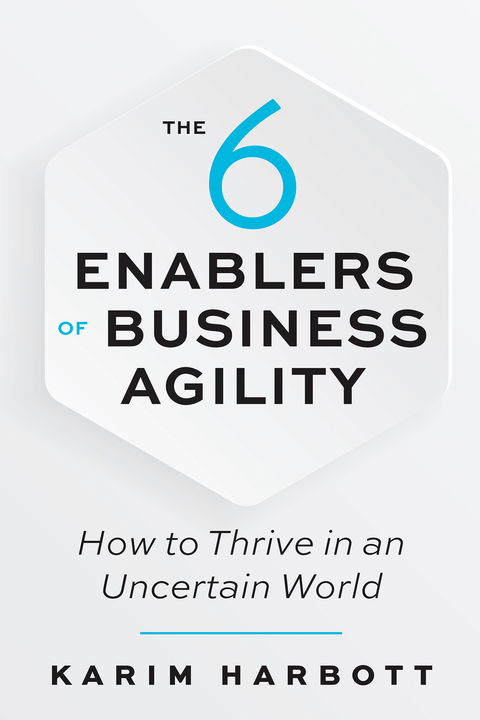
The 6 Enablers of Business Agility (eBook)
296 Seiten
Berrett-Koehler Publishers (Verlag)
978-1-5230-9007-5 (ISBN)
Many managers struggle to install the underlying organizational operating system for business agility. High-performing agile organizations depend on the strength of six key enabling factors: leadership, culture, structure, people, governance, and ways of working. This book explains why these factors are important and how they work together to increase organizational agility. Real-world examples, stories, and tools will help leaders get realistic about the scope of changes needed in their organizations and show them how to get started.
Karim Harbott does not offer a book of recipes. Instead, he focuses on mindset, principles, and general patterns. This book summarizes of the most important factors in increasing organizational agility and why they work, which leaders will need to consider in a so-called agile transformation. Because every organization is different, each will have its own route to agility and high performance. Managers will need to tackle all the areas that are crucial to creating an environment in which any chosen approach can work.
Introduction - About This Book
• Business Agility & The Organizational Operating System
• Why I Wrote This Book
• My Two Key Drivers
• How This Book Works
Chapter 1 – The Changing Business Climate
• Exploring & Exploiting: Two Key Organisational Activities
• The Twentieth-Century Organization – Exploiting with Efficiency
• The Rise of VUCA: The Game Has Changed
• The Modern Organization – Exploring with Agility
Chapter 2 – Introducing Business Agility
• Breaking Out of the Status Quo: Beyond Belief Perseverance
• The Three Waves of Agile: From 17 Software Developers to the Boardroom
• Business Agility: Cautionary Tales from History
• No Sacred Cows: Disrupting Yourself
Chapter 3 – The 6 Enablers of Business Agility
• Why Agility Initiatives Fail: A Narrow Focus
• Introducing The 6 Enablers of Business Agility: Taking A Holistic Approach
• Leadership & Management
• Organisational Culture
• Organisational Structure
• People & Engagement
• Governance & Funding
• Ways of Working
• Pulling It All Together
Chapter 4 - Leadership & Management
• The Birth of Management: The Emerging Imperative
• Early Management: Back to the Pioneers
• Reinventing Management: What Worked Before…
• Twenty-First Century Leadership – Some Emerging Approaches
• Agile Leadership: Three Key Mindset Shifts
Chapter 5 - Organisational Culture
• Why Culture Matters: Lessons from a Failing Car Plant
• Modelling Culture: Making Tangible the Intangible
• Shifting Culture: Changing by Not Changing
• Moving Beyond Words: Creating an Environment for Agility
Chapter 6 - Organisational Structure
• The Importance of Structure: Adopting Electricity
• Principle One: Customer-Centricity
• Principle Two: Small, Cross-Functional Teams
• Principle Three: The Network of Interconnected Teams
• Principle Four: Ambidextrous Organisations
• The Importance of Structure: Fighting Terrorism in Iraq
Chapter 7 - People & Engagement
• The Case for Employee Engagement: Wake Up and Smell the Success
• The Neuroscience of Knowledge Work: Priming the Brain for Thinking
• Managing for Engagement: From Compliance to Creativity
• Reinventing HR: A Twenty-First Century Approach
Chapter 8 - Governance & Funding
• Projects, Budgets & Traditional Governance: Time for a Rethink
• Managing the Portfolio: Striking the Right Balance
• Searching: Casting the Net Wide
• Building & Scaling: Bringing Ideas to Life
Chapter 9 - Ways of Working
• Daily Team Practices: Patterns for Collaboration
• Kaizen: A Mindset of Continuous Improvement
• Measuring Performance: More Value with Less Work
Chapter 10 - Leading the Change
• Why Most Change Fails: Avoiding the Pitfalls
• Seven Principles of Leading Change: Laying the Foundations
• The Business Agility Canvas: Your Transformation on a Page
• Working with the Canvas: Change as the New Normal
Notes
Acknowledgements
Index
About the Author
| Erscheint lt. Verlag | 1.6.2021 |
|---|---|
| Verlagsort | Oakland |
| Sprache | englisch |
| Themenwelt | Wirtschaft ► Betriebswirtschaft / Management ► Projektmanagement |
| Wirtschaft ► Betriebswirtschaft / Management ► Unternehmensführung / Management | |
| Schlagworte | agile coaching • Agile Leadership • agile management • business agility • business agility, project management, agile management, organizational development, organizational agility, leadership, agile leadership, management, agile coaching, scrum masters, business transformation, organizational change • Business Transformation • Leadership • Management • organizational agility • Organizational change • Organizational Development • Project Management • scrum masters |
| ISBN-10 | 1-5230-9007-3 / 1523090073 |
| ISBN-13 | 978-1-5230-9007-5 / 9781523090075 |
| Informationen gemäß Produktsicherheitsverordnung (GPSR) | |
| Haben Sie eine Frage zum Produkt? |
 EPUB (Adobe DRM)
Kopierschutz: Adobe-DRM
Adobe-DRM ist ein Kopierschutz, der das eBook vor Mißbrauch schützen soll. Dabei wird das eBook bereits beim Download auf Ihre persönliche Adobe-ID autorisiert. Lesen können Sie das eBook dann nur auf den Geräten, welche ebenfalls auf Ihre Adobe-ID registriert sind.
Details zum Adobe-DRM
Dateiformat: EPUB (Electronic Publication)
EPUB ist ein offener Standard für eBooks und eignet sich besonders zur Darstellung von Belletristik und Sachbüchern. Der Fließtext wird dynamisch an die Display- und Schriftgröße angepasst. Auch für mobile Lesegeräte ist EPUB daher gut geeignet.
Systemvoraussetzungen:
PC/Mac: Mit einem PC oder Mac können Sie dieses eBook lesen. Sie benötigen eine
eReader: Dieses eBook kann mit (fast) allen eBook-Readern gelesen werden. Mit dem amazon-Kindle ist es aber nicht kompatibel.
Smartphone/Tablet: Egal ob Apple oder Android, dieses eBook können Sie lesen. Sie benötigen eine
Geräteliste und zusätzliche Hinweise
Buying eBooks from abroad
For tax law reasons we can sell eBooks just within Germany and Switzerland. Regrettably we cannot fulfill eBook-orders from other countries.
aus dem Bereich