Chicago's Industrial Decline (eBook)
272 Seiten
Cornell University Press (Verlag)
978-1-5017-5263-6 (ISBN)
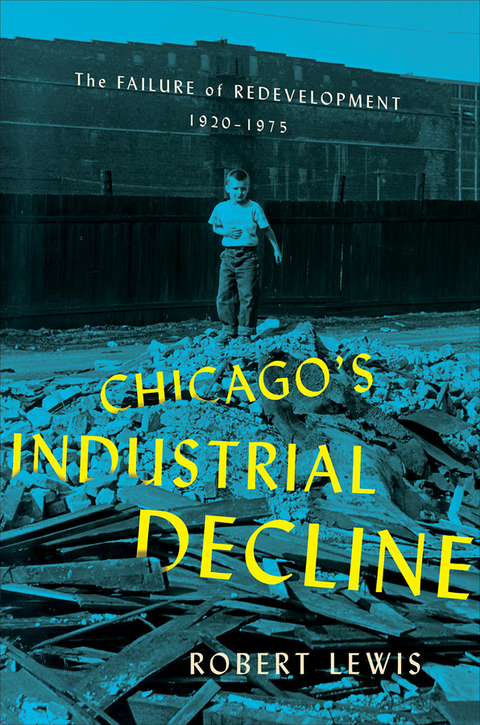
In Chicago's Industrial Decline Robert Lewis charts the city's decline since the 1920s and describes the early development of Chicago's famed (and reviled) growth machine. Beginning in the 1940s and led by local politicians, downtown business interest, financial institutions, and real estate groups, place-dependent organizations in Chicago implemented several industrial renewal initiatives with the dual purpose of stopping factory closings and attracting new firms in order to turn blighted property into modern industrial sites. At the same time, a more powerful coalition sought to adapt the urban fabric to appeal to middle-class consumption and residential living. As Lewis shows, the two aims were never well integrated, and the result was on-going disinvestment and the inexorable decline of Chicago's industrial space.
By the 1950s, Lewis argues, it was evident that the early incarnation of the growth machine had failed to maintain Chicago's economic center in industry. Although larger economic and social forces—specifically, competition for business and for residential development from the suburbs in the Chicagoland region and across the whole United States—played a role in the city's industrial decline, Lewis stresses the deep incoherence of post-WWII economic policy and urban planning that hoped to square the circle by supporting both heavy industry and middle- to upper-class amenities in downtown Chicago.
Robert Lewis is Professor of Geography and Planning at the University of Toronto. He is the author of Chicago Made, Calculating Property Relations, and Manufacturing Montreal.
Introduction: Visions of Chicago
1. Industrial Decline and the Rise of the Suburbs
2. Building the Suburban Factory and Industrial Decline in Postwar Chicago
3. Blight and the Transformation of Industrial Property
4. Industrial Property and Blight in the 1950s
5. Industrial Renewal and Land Clearance
6. Reinventing Industrial Property
7. Industrial Parks as Industrial Renewal
Conclusion: It's All Over Now
| Erscheint lt. Verlag | 15.12.2020 |
|---|---|
| Zusatzinfo | 13 b&w halftones, 1 map |
| Verlagsort | Ithaca |
| Sprache | englisch |
| Maße | 150 x 150 mm |
| Themenwelt | Sachbuch/Ratgeber ► Geschichte / Politik ► Regional- / Landesgeschichte |
| Geisteswissenschaften ► Geschichte ► Regional- / Ländergeschichte | |
| Naturwissenschaften ► Geowissenschaften ► Geografie / Kartografie | |
| Wirtschaft ► Volkswirtschaftslehre | |
| Schlagworte | Urban redevelopment in Chicago, Industrial decline and central-city job loss, Growth coalitions and urban renewa, Industrial property relations and public-private interaction, industrial suburbanization |
| ISBN-10 | 1-5017-5263-4 / 1501752634 |
| ISBN-13 | 978-1-5017-5263-6 / 9781501752636 |
| Informationen gemäß Produktsicherheitsverordnung (GPSR) | |
| Haben Sie eine Frage zum Produkt? |
 EPUB (Adobe DRM)
Kopierschutz: Adobe-DRM
Adobe-DRM ist ein Kopierschutz, der das eBook vor Mißbrauch schützen soll. Dabei wird das eBook bereits beim Download auf Ihre persönliche Adobe-ID autorisiert. Lesen können Sie das eBook dann nur auf den Geräten, welche ebenfalls auf Ihre Adobe-ID registriert sind.
Details zum Adobe-DRM
Dateiformat: EPUB (Electronic Publication)
EPUB ist ein offener Standard für eBooks und eignet sich besonders zur Darstellung von Belletristik und Sachbüchern. Der Fließtext wird dynamisch an die Display- und Schriftgröße angepasst. Auch für mobile Lesegeräte ist EPUB daher gut geeignet.
Systemvoraussetzungen:
PC/Mac: Mit einem PC oder Mac können Sie dieses eBook lesen. Sie benötigen eine
eReader: Dieses eBook kann mit (fast) allen eBook-Readern gelesen werden. Mit dem amazon-Kindle ist es aber nicht kompatibel.
Smartphone/Tablet: Egal ob Apple oder Android, dieses eBook können Sie lesen. Sie benötigen eine
Geräteliste und zusätzliche Hinweise
Buying eBooks from abroad
For tax law reasons we can sell eBooks just within Germany and Switzerland. Regrettably we cannot fulfill eBook-orders from other countries.
aus dem Bereich