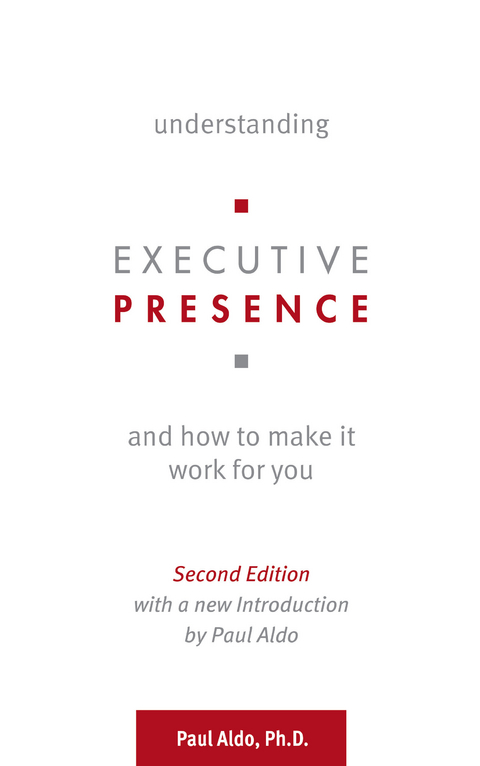
Understanding Executive Presence and How to Make It Work for You (eBook)
165 Seiten
Bookbaby (Verlag)
978-1-0983-2276-2 (ISBN)
Not too many years ago, you could have completed your entire business career without hearing the term "e;executive presence."e; But today it is the term of choice for capturing the ways of speaking and acting characteristic of our most influential leaders. Until now, the rising popularity of-and need for-the executive presence phenomenon has not been accompanied by a common understanding of what, exactly, the term means. Understanding Executive Presence and How to Make It Work for You clears away the confusion by providing a practical definition of executive presence and the information and tools you need to make it work for you. Based on years of observing and coaching leaders-and learning what separates the best from the rest-Dr. Paul Aldo has created a practical guide for understanding exactly what we're looking at when we make judgments about executive presence and how to turn these observations into meaningful development actions. His Executive Presence workshop participants and coaching clients consistently report noticeable gains in their leadership presence and effectiveness from following the simple principles and advice contained in these pages.
Introduction to the
Second Edition
More than five years have passed since our first printing of Understanding Executive Presence. We’ve learned a lot in that time, in some cases through our interaction with workshop participants and coaching clients, in others simply because the world is constantly changing. In this new introduction I’ll comment briefly on how what we’ve learned has changed the way we talk about and teach executive presence.
But first, let’s start by emphasizing something that hasn’t changed: Understanding Executive Presence is about how leaders with the best executive presence show up—how they behave as leaders, day-in and day-out. Consequently, this book focuses on behavior and demystifying what has generally been thought of as intangible—something that has often been referred to as the X factor in leadership and career success.
Now to the changes. Here are some of the more notable changes and things we’ve learned since publishing the first edition of Understanding Executive Presence.
Business Dress. Since drafting the original chapters of this book, nothing has changed more dramatically or faster than rules for grooming and dress. Starting with casual Fridays in the 1990s, business dress has continued its rapid evolution to ever more informality and opportunity for self-expression. From suits and ties for men and hose and closed-toe shoes for women to sport shirts and blouses, slacks, casual layering pieces, and an astonishing variety of shoe choices (for both women and men), everything has changed.
Today, client requests for grooming and dress advice have declined dramatically, reflecting what seems to be a settled new age of home-office telecommuting, “dress for your day,” and less formality in social relations generally. To be clear, there are still rules for grooming and dress, but they are now found much more within organizations than as general codes.
With respect to today’s work environments, my best (and updated) advice is to consciously project the image you want to project and look to your organization for guidance when making decisions about how to dress for work. As a result, I have removed the chapter on grooming and dress from this edition.
Creating Executive Messages. Since I introduced Message Architecture™ in 2004, our workshop participants have found it incredibly helpful with improving message clarity, crispness, and resonance. It is consistently called out by participants as a workshop highlight. However, participants have also shared with us that while the method is simple, it’s not especially easy to learn. It takes discipline, practice, and learning support. Because of this, we’ve continued to refine the way we talk about and teach Message Architecture™. This edition of Understanding Executive Presence provides more explanation and greater assistance with story structure. We’ve found that emphasizing story structure helps participants understand and work with Message Architecture™ more intuitively.
Demographic Changes. Not surprisingly, demographic changes impact expectations for leadership behavior as new generations make their preferences known. One of the most consequential for organizations of all kinds is the growing expectation for more freedom and recognition at work. Unlike previous generations, millennials and the generations following them are demanding to be recognized as far more than cogs in an organizational wheel. They want more collaboration, more feedback, and a much more human touch. We’ve seen this play out over the years in a workshop exercise called Best Leader. Participants are asked to visualize a leader they have observed who was truly remarkable, then identify the behaviors that caused that leader to stand out. The behaviors are then mapped into the Nine Dimensions that define executive presence (see chapters 3 through 5), and a tally is taken to see how many of the Best Leader behaviors fall into each of the three Nine Dimensions categories. Since we started this exercise a decade ago, the About Our Relationships category continues to show an ever-larger percentage of the mapped behaviors when compared to the About Us and About Our Messages categories.
It is also interesting to note that the single biggest challenge facing our executive coaching clients is a deficiency with About Our Relationships behaviors. In other words, their most important leadership issues are with authentically showing sincerity, thoughtfulness, and warmth.
Another important demographic change impacting leadership today is the global workplace. While we know from our work in Asia and Europe that the Nine Dimensions apply to behaviors globally, we also know that paying attention to the nuances of cultural expression is critical for today’s leaders. Slight differences in nonverbals when expressing passion, for example, can cause misinterpretation of the behaviors if cultural expression is not taken into account. This is equally true for the other eight Dimensions.
Gender. Gender parity in organizational leadership continues to be a work in process. Although women are making strides in attaining organizational leadership positions, progress has been painfully slow. And we know it’s not just about helping women adjust to an organizational environment that has traditionally been dominated by men. The organization itself is a big part of the problem.
Several studies have shown, for example, that women respond to opportunities much more conservatively than men. Men will apply for an open position if they meet 60 to 75 percent of the qualifications. Women, on the other hand, typically won’t apply unless they meet 100 percent of them. This obviously limits an organization’s exposure to its pool of female leadership talent and the chance for that talent to rise to the top.
There’s also the question of self-confidence generally. Several studies have shown women to be less self-confident than men in organizational settings—and this matters. Self-confidence is more highly correlated with success than competence. As the example in the last paragraph illustrates, if you lack self-confidence, you limit your professional prospects in two ways: you are less likely to be considered for a new job and you will achieve less organizational exposure and fewer opportunities to advance. An excellent book about this critically important issue is The Confidence Code by Katty Kay and Claire Shipman. I highly recommend it.
A good start for “fixing the organization” would be focusing on what I call tolerance limits in expressing the Nine Dimensions of executive presence. Consider assertive expression, for example (associated with the Passion Dimension). As with all the Nine Dimensions, organizational culture sets upper and lower limits on the acceptability of our behavioral expression. In the case of Passion, it’s about how assertive an executive can be. The challenge for women here, and with all the Nine Dimensions, is that those limits are much narrower than they are for men, making it more difficult to satisfactorily express the leadership behaviors the organization is looking for.
Tolerance Limits in Expressing the Nine Dimensions
It’s a problem of implicit bias created by the different and largely unconscious cultural expectations we have for men and women. To begin correcting this, organizations could explore and educate about unconscious bias and how it works against appreciating and leveraging diversity of all kinds. This is a topic I thoroughly discuss in my upcoming book, Sustaining Your Executive Presence.
Behavior Change. We’ve always known that changing behavior is hard and that it takes small goals, discipline, and persistence to make progress. What we’ve learned from our workshop participants is much more detail about the typical things that get in the way. While this has not changed our starting point of identifying specific behaviors that need to change, it has highlighted the need to integrate emotional self-awareness and habit structures into improvement plans.
At Executive Presence, we are approaching this in several ways. Most immediately, we will offer more self-help resources on our website (ExecutivePresence.com) as well as a new Sustaining Your Executive Presence workshop that builds on the current Understanding Executive Presence foundation workshop. The self-help resources will start rolling out in 2020 and will include resources linked to our Executive Presence Multi-Rater Assessment, video tips, broader use of social media, and more provisions for coaching, both virtual and live.
Virtual Space. As many of us move from simple telecommuting to lives of more virtual work, the way we connect, relate, and influence one another are all being impacted. This includes the way we express the Nine Dimensions of executive presence. Although virtual space doesn’t change the importance of expressing the Nine Dimensions with skill and balance, it does limit the full use of our tools of self-expression. As you will see in the coming chapters, these tools include both body language (eyes, faces, and bodies) and auditory nonverbal expression (inflection, resonance, diction, pace of speech, and the architecture of our messages). But working in virtual space limits our use of these tools. Non-video conference calls,...
| Erscheint lt. Verlag | 4.11.2020 |
|---|---|
| Sprache | englisch |
| Themenwelt | Wirtschaft ► Betriebswirtschaft / Management ► Unternehmensführung / Management |
| ISBN-10 | 1-0983-2276-2 / 1098322762 |
| ISBN-13 | 978-1-0983-2276-2 / 9781098322762 |
| Informationen gemäß Produktsicherheitsverordnung (GPSR) | |
| Haben Sie eine Frage zum Produkt? |
 EPUB (Ohne DRM)
Größe: 2,5 MB
Digital Rights Management: ohne DRM
Dieses eBook enthält kein DRM oder Kopierschutz. Eine Weitergabe an Dritte ist jedoch rechtlich nicht zulässig, weil Sie beim Kauf nur die Rechte an der persönlichen Nutzung erwerben.
Dateiformat: EPUB (Electronic Publication)
EPUB ist ein offener Standard für eBooks und eignet sich besonders zur Darstellung von Belletristik und Sachbüchern. Der Fließtext wird dynamisch an die Display- und Schriftgröße angepasst. Auch für mobile Lesegeräte ist EPUB daher gut geeignet.
Systemvoraussetzungen:
PC/Mac: Mit einem PC oder Mac können Sie dieses eBook lesen. Sie benötigen dafür die kostenlose Software Adobe Digital Editions.
eReader: Dieses eBook kann mit (fast) allen eBook-Readern gelesen werden. Mit dem amazon-Kindle ist es aber nicht kompatibel.
Smartphone/Tablet: Egal ob Apple oder Android, dieses eBook können Sie lesen. Sie benötigen dafür eine kostenlose App.
Geräteliste und zusätzliche Hinweise
Buying eBooks from abroad
For tax law reasons we can sell eBooks just within Germany and Switzerland. Regrettably we cannot fulfill eBook-orders from other countries.
aus dem Bereich