


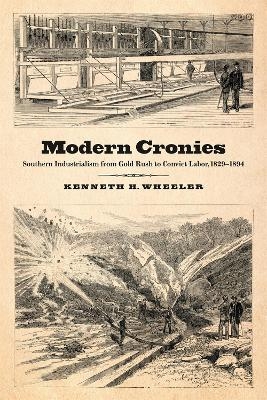
Modern Cronies
Southern Industrialism from Gold Rush to Convict Labor, 1829-1894
Seiten
2021
University of Georgia Press (Verlag)
978-0-8203-5750-8 (ISBN)
University of Georgia Press (Verlag)
978-0-8203-5750-8 (ISBN)
Modern Cronies traces how various industrialists, thrown together by the effects of the southern gold rush, shaped the development of the southeastern United States. Iron makers, attracted by the gold rush, built the most elaborate iron-making operations in the Deep South near this railroad, in Georgia’s Etowah Valley;
Modern Cronies traces how various industrialists, thrown together by the effects of the southern gold rush, shaped the development of the southeastern United States. Existing historical scholarship treats the gold rush as a self-contained blip that—aside from the horrors of Cherokee Removal (admittedly no small thing) and a supply of miners to California in 1849—had no other widespread effects. In fact, the southern gold rush was a significant force in regional and national history.
The pressure brought by the gold rush for Cherokee Removal opened the path of the Western & Atlantic Railroad, the catalyst for the development of both Atlanta and Chattanooga, Tennessee. Iron makers, attracted by the gold rush, built the most elaborate iron-making operations in the Deep South near this railroad, in Georgia’s Etowah Valley; some of these iron makers became the industrial talent in the fledgling postbellum city of Birmingham, Alabama. This book explicates the networks of associations and interconnections across these varied industries in a way that newly interprets the development of the southeastern United States.
Modern Cronies also reconsiders the meaning of Joseph E. Brown, Georgia’s influential Civil War governor, political heavyweight, and wealthy industrialist. Brown was nurtured in the Etowah Valley by people who celebrated mining, industrialization, banking, land speculation, and railroading as a path to a prosperous future. Kenneth H. Wheeler explains Brown’s familial, religious, and social ties to these people; clarifies the origins of Brown’s interest in convict labor; and illustrates how he used knowledge and connections acquired in the gold rush to enrich himself. After the Civil War Brown, aided by his sons, dominated and modeled a vigorous crony capitalism with far-reaching implications.
Modern Cronies traces how various industrialists, thrown together by the effects of the southern gold rush, shaped the development of the southeastern United States. Existing historical scholarship treats the gold rush as a self-contained blip that—aside from the horrors of Cherokee Removal (admittedly no small thing) and a supply of miners to California in 1849—had no other widespread effects. In fact, the southern gold rush was a significant force in regional and national history.
The pressure brought by the gold rush for Cherokee Removal opened the path of the Western & Atlantic Railroad, the catalyst for the development of both Atlanta and Chattanooga, Tennessee. Iron makers, attracted by the gold rush, built the most elaborate iron-making operations in the Deep South near this railroad, in Georgia’s Etowah Valley; some of these iron makers became the industrial talent in the fledgling postbellum city of Birmingham, Alabama. This book explicates the networks of associations and interconnections across these varied industries in a way that newly interprets the development of the southeastern United States.
Modern Cronies also reconsiders the meaning of Joseph E. Brown, Georgia’s influential Civil War governor, political heavyweight, and wealthy industrialist. Brown was nurtured in the Etowah Valley by people who celebrated mining, industrialization, banking, land speculation, and railroading as a path to a prosperous future. Kenneth H. Wheeler explains Brown’s familial, religious, and social ties to these people; clarifies the origins of Brown’s interest in convict labor; and illustrates how he used knowledge and connections acquired in the gold rush to enrich himself. After the Civil War Brown, aided by his sons, dominated and modeled a vigorous crony capitalism with far-reaching implications.
Kenneth H. Wheeler is a professor of history at Reinhardt University and is the former president of the Georgia Association of Historians (2014-2015). He’s the author of Cultivating Regionalism: Higher Education and the Making of the American Midwest (Northern Illinois University Press, 2011).
| Erscheinungsdatum | 12.04.2021 |
|---|---|
| Zusatzinfo | 23 b&w images |
| Verlagsort | Georgia |
| Sprache | englisch |
| Maße | 152 x 229 mm |
| Themenwelt | Geisteswissenschaften ► Geschichte ► Regional- / Ländergeschichte |
| Wirtschaft | |
| ISBN-10 | 0-8203-5750-2 / 0820357502 |
| ISBN-13 | 978-0-8203-5750-8 / 9780820357508 |
| Zustand | Neuware |
| Informationen gemäß Produktsicherheitsverordnung (GPSR) | |
| Haben Sie eine Frage zum Produkt? |
Mehr entdecken
aus dem Bereich


aus dem Bereich
die Geschichte meiner Urgroßmutter
Buch | Hardcover (2025)
C.H.Beck (Verlag)
CHF 32,15
Träume und Macht : eine Biografie
Buch | Hardcover (2025)
C.H.Beck (Verlag)
CHF 61,60


