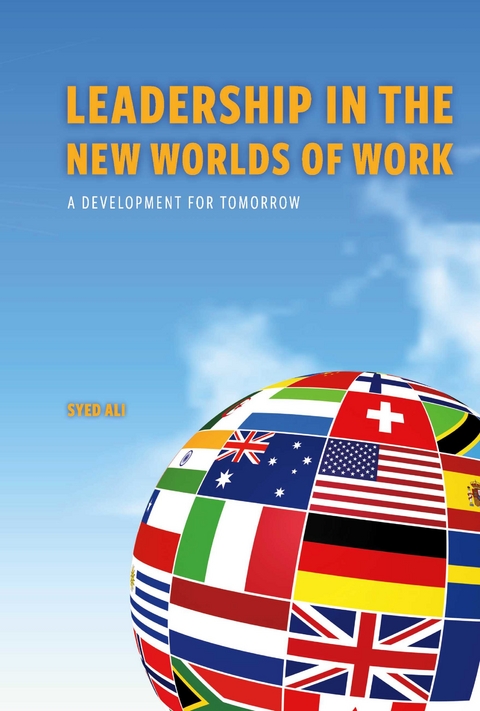
Leadership in The New Worlds of Work (eBook)
210 Seiten
Bookbaby (Verlag)
978-1-0983-2360-8 (ISBN)
The genius of leadership is its humanness. This book has discussed heavily on the human side of leadership such as people involvement, leadership, ethics, honesty, integrity, trust, diversity, and ego. If we don't recognize the importance of human engagement, human communication, and human development, we will not have a business. Humanity is in a period of great upheaval. For people and organizations attempting to thrive in this tumultuous time, old mindsets and approaches no longer work. To create a better future where everyone can flourish, leaders and organizations need to find ways to engage and encourage emotions more fully. Leading and humanity work in partnership. It takes the best parts of us, our diverse backgrounds, our distinct gifts, and it emerges them together to complement each other. To be successful, all organizations will need not only different leaders, but also a whole new style of leadership. Instead of charismatic risk-taking heroes, we should demand our leaders be more real-more humble in the face of uncertainty, more open about challenges (as well as opportunities), and more committed to a clear set of core values that govern how they choose to help us navigate this new uncertain normal.
Chapter 1
New Approach for Leadership: Discussion of What, Why, and How of Leadership?
The transformation from the industrial age to digital age brings us face-to-face with the reality of our interdependence. Success in the future will go to those who help us come to harmony, among ourselves and with the planet, to those who help us to thrive as one global community. According to the president of the World Business Academy Rinaldo Btutoco, “Now more than ever the world business community must face the inescapable conclusion, at the core of the academy’s very existence: Business must be willing to become responsible for the whole global society.”
To meet the challenge in the twenty-first century, we must respond to the trends currently defining social milieu of organizations and communities such as:
New generation: The young people are constantly expecting different thing from work, from the community, and from the leadership than the generation that have preceded them. The digital age intelligent young generation wants to be engaged. They want to be involved in the decisions that affect their structure of coexistence.
Diversity: Organizations and communities are no longer homogenous. These days local or global small town and big corporate are all composed of a wide variety of people with different ethnicity and cultural background speaking many languages and sharing different history. People in today’s workplaces want leadership to be collaborative and just organizations are constantly reinvented: The context of leadership is no longer stable or predictable in twentieth century. In most sectors of business and industry, institutions have crumbled and are being reorganized and redesigned. The new era of institution is becoming more agile and fluid and adapting to the current needs with the help of new leadership practices and a set of strategies of collaborative action to mobilize creative potential and turn in to a positive ripple of confidence, energy, and performance to make positive difference in the institution.
The contours of leadership are also changing rapidly since the early part of twenty-first century. There are number of forces that are influencing the process of leadership that affects the leader’s followers and the organizations and their settings. The three forces are:
Globalization: The integration of economics, societies, and cultures through linked systems of travel, communication, and trade has created a vast opportunities and major challenges for nations and their leaders. International corporations have blurred national boundaries. It is virtually impossible to think of an industry that is not affected by international competition.
Innovation and technology: In all their manifestation—economical air travel, ubiquitous cellular phone, communication satellites, and the expansion of the internet have shrunk geographic distance and, as a result, have exposed vast segment of the globe to new cultures and traditions.1
The political world has changed: The European Union and its monetary currency, the Euro along with China’s stunning trade surplus present serious challenges to American economy and the value of dollar. These developments challenges traditional views of the leaders as being the sole masters of their destinies and in control of their organization’s traditional views of leadership as command and control are much less applicable in today’s leadership situations never have organizations face so many challenges, and never there has been such a need for leaders to formulate new response. Uncertainties and complexities abound2
The only thing truly predictable is unpredictability. As Yogi Barra puts it, “The future isn’t what it used to be.” Gone are the days when leaders relied upon their titles or positions in the organizations for their “power over” their followers. Tomorrow’s leaders are empowered from within themselves and must rely more upon the internal qualities of leadership than their external “cloak of office” The new leader’s new responsibility presents a significant challenge to all those who are currently in power, the challenge to be more accepting of uncertainty, to allow for paradox and to accept true responsibility for the “whole”—the organization, its people, the stakeholders, and the community
Linda Hill, professor of business administration and faculty chair of the High Potential Leadership Program at Harvard University, says about what leaders need to be and do, “Leaders need to adapt a more inclusive, collaborative style [because] today’s complex environment often demands a team approach to problem solving. This requires a leader, who among other things is comfortable sharing power and generous in doing so, is able to see extraordinary potential in ordinary people. Leadership is a collective activity in which different people at different times—depending on their strengths, or ‘nimbleness’—come forward to move the group in the direction it needs to go. [The group] doesn’t have to wait for and then respond to a command from the front. That kind of agility is more likely when a leader conceives her role as creating the opportunity for collective leadership, as opposed to merely setting a direction.”
What is Leadership, Anyway?
There is no concrete definition of leadership. Per the Harvard Business Review, there are more than one thousand definitions for leadership. No single definition stands out from the rest. Each definition of leadership exists in a framework chosen by the authors and each reflects that author’s knowledge and experience. The views expressed here are personal experiences and are based on many years of work and teaching, working with leaders and negotiating with people all over the world in a variety of environments as a system assurance manager.3
The question, of course, is what leadership is and why it is so important? Clearly leadership is an elusive concept, in part because of complex individual roles and personalities of leaders and followers defining leadership is a generational endeavor. While the traits and attributes can be timeless, each generation must filter the meaning through its own experiences and collective anchors.
Such a simple question, and yet it continues to vex popular consultants and lay people alike. I have said before that leadership has no concrete definition so let’s start with what leadership is not. Leadership has nothing to do with seniority or one’s position in the hierarchy of a company. Too many talks about a company’s leadership, referring to the senior executives in the organization. They are just that, senior executives. Leadership doesn’t automatically happen when you reach a certain pay grade.
Leadership has nothing to do with titles. Like the point above, just because you have a C-level title, it doesn’t automatically make you a “leader.” In all my talks, I stress the fact that you don’t need a title to lead. In fact, you can be a leader in your place of worship, your neighborhood, or your family, all without having a title.
Leadership has nothing to do with personal attributes. Say the word “leader” and most people think of a domineering, take-charge, charismatic individual. We often think of icons from history like General Paton or President Lincoln. But leadership isn’t an adjective. We don’t need extroverted, charismatic traits to practice leadership. And those with charisma don’t automatically lead.4
Leadership has been defined in terms of individual traits, behavior, influence over other people, interaction patterns, role relationship, and occupation of an administrative. It is about your position and others’ perception regarding legitimacy of influence. Some representative old definitions are as follows: (“Leadership in organizations” by Gary A Yukl, 1989, published by Prentice Hall.)
- Leadership is “interpersonal influence, exercised in a situation, and directed, through the communication process, toward the attainment of a specified goal or goals” (Leadership and Organization: A Behavioral Science Approach. by Tannenbaum/Weschler/Massarik Published by McGraw Hill, New York, New York (1961)
- Leadership is “a particular type of power relationship characterized by a group member’s perception that another group member has the right to prescribed behavior patterns for the former regarding his activity as a group member”( Leadership Theories and model chapter 4. By F. Janda 1960, 358).
- Leadership is “the initiation and maintenance of structure in expectation and interaction” (Stogdill, R. (1974). Handbook of leadership: A survey of theory and research. New York: The Free Press.)
- Leadership is “the process of influencing the activities of an organized group toward goal achievement” (Rauch, C.F. and Behling, O. (1984) Functionalism: Basis for an Alternate Approach to the Study of Leadership).
What is it that makes some people excel in leadership roles? Leadership theories seek to explain how and why certain people become leaders. Such theories often focus on the characteristics of leaders, but some attempt to identify the behaviors that people can adopt to improve their own leadership abilities in different...
| Erscheint lt. Verlag | 29.9.2020 |
|---|---|
| Sprache | englisch |
| Themenwelt | Wirtschaft ► Betriebswirtschaft / Management ► Unternehmensführung / Management |
| ISBN-10 | 1-0983-2360-2 / 1098323602 |
| ISBN-13 | 978-1-0983-2360-8 / 9781098323608 |
| Informationen gemäß Produktsicherheitsverordnung (GPSR) | |
| Haben Sie eine Frage zum Produkt? |
 EPUB (Ohne DRM)
Größe: 2,2 MB
Digital Rights Management: ohne DRM
Dieses eBook enthält kein DRM oder Kopierschutz. Eine Weitergabe an Dritte ist jedoch rechtlich nicht zulässig, weil Sie beim Kauf nur die Rechte an der persönlichen Nutzung erwerben.
Dateiformat: EPUB (Electronic Publication)
EPUB ist ein offener Standard für eBooks und eignet sich besonders zur Darstellung von Belletristik und Sachbüchern. Der Fließtext wird dynamisch an die Display- und Schriftgröße angepasst. Auch für mobile Lesegeräte ist EPUB daher gut geeignet.
Systemvoraussetzungen:
PC/Mac: Mit einem PC oder Mac können Sie dieses eBook lesen. Sie benötigen dafür die kostenlose Software Adobe Digital Editions.
eReader: Dieses eBook kann mit (fast) allen eBook-Readern gelesen werden. Mit dem amazon-Kindle ist es aber nicht kompatibel.
Smartphone/Tablet: Egal ob Apple oder Android, dieses eBook können Sie lesen. Sie benötigen dafür eine kostenlose App.
Geräteliste und zusätzliche Hinweise
Buying eBooks from abroad
For tax law reasons we can sell eBooks just within Germany and Switzerland. Regrettably we cannot fulfill eBook-orders from other countries.
aus dem Bereich