


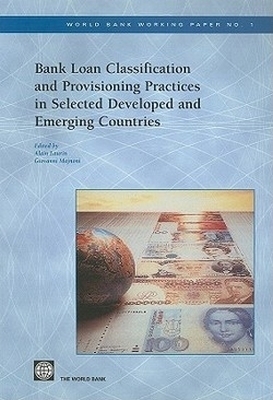
Bank Loan Classification and Provisioning Practices in Selected Developed and Emerging Countries
Seiten
2003
World Bank Publications (Verlag)
978-0-8213-5397-4 (ISBN)
World Bank Publications (Verlag)
978-0-8213-5397-4 (ISBN)
- Titel z.Zt. nicht lieferbar
- Portofrei ab CHF 40
- Auch auf Rechnung
- Artikel merken
This report reviews loan classification and provisioning practices prevailing in the 23 jurisdictions represented in the Basel Core Principles Liaison Group in 2001. It covers classification of individual and multiple loans, treatment of guarantees and collateral, and bank loan review processes.
This report reviews loan classification and provisioning practices prevailing in the 23 jurisdictions represented in the Basel Core Principles Liaison Group at the end of 2001. It covers classification of individual and multiple loans, treatment of guarantees and collateral, bank loan review processes, restructured troubled loans, loan loss provisioning, tax treatment of loan loss provisions, disclosure standards, and external auditors' role. Differences in provisioning and classification approaches have often made a comparison of bank and banking system weaknesses across regulatory regimes difficult, and such differences have made peer pressure and market discipline less effective. Poor classification and provisioning practices have led to solvency ratios that gave a false sense of security, as occurred as financial system failed in the 1990s.
This report reviews loan classification and provisioning practices prevailing in the 23 jurisdictions represented in the Basel Core Principles Liaison Group at the end of 2001. It covers classification of individual and multiple loans, treatment of guarantees and collateral, bank loan review processes, restructured troubled loans, loan loss provisioning, tax treatment of loan loss provisions, disclosure standards, and external auditors' role. Differences in provisioning and classification approaches have often made a comparison of bank and banking system weaknesses across regulatory regimes difficult, and such differences have made peer pressure and market discipline less effective. Poor classification and provisioning practices have led to solvency ratios that gave a false sense of security, as occurred as financial system failed in the 1990s.
| Erscheint lt. Verlag | 31.3.2003 |
|---|---|
| Verlagsort | Washington |
| Sprache | englisch |
| Maße | 175 x 248 mm |
| Gewicht | 150 g |
| Themenwelt | Wirtschaft ► Betriebswirtschaft / Management ► Finanzierung |
| Betriebswirtschaft / Management ► Spezielle Betriebswirtschaftslehre ► Bankbetriebslehre | |
| Wirtschaft ► Volkswirtschaftslehre | |
| ISBN-10 | 0-8213-5397-7 / 0821353977 |
| ISBN-13 | 978-0-8213-5397-4 / 9780821353974 |
| Zustand | Neuware |
| Informationen gemäß Produktsicherheitsverordnung (GPSR) | |
| Haben Sie eine Frage zum Produkt? |
Mehr entdecken
aus dem Bereich



aus dem Bereich
Warum unser Geld stirbt und wie Sie davon profitieren. Der …
Buch | Hardcover (2024)
FinanzBuch Verlag
CHF 41,95
Praxisnahe Einführung mit zahlreichen Fallbeispielen börsennotierter …
Buch | Softcover (2020)
Vahlen (Verlag)
CHF 34,85
denken und handeln wie ein professioneller Trader
Buch | Softcover (2023)
Vahlen, Franz (Verlag)
CHF 51,65


