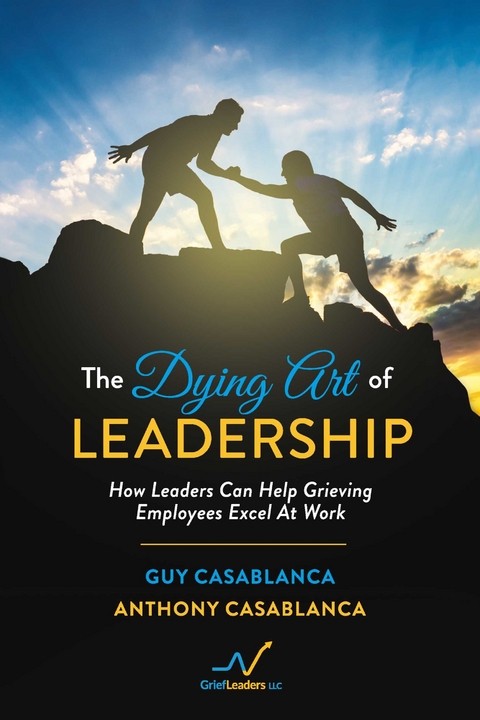
Dying Art of Leadership (eBook)
154 Seiten
Bookbaby (Verlag)
978-1-0983-2118-5 (ISBN)
"e;The Dying Art of Leadership"e; is a must-read for anyone who leads people. Whether a senior leader or a front-line supervisor, you will want to learn the concepts discussed in this book. Everyone suffers tragedies in their lives. Successful leadership requires having the compassion and the skills to help your team through these inevitable situations. This book provides a model that will improve the engagement, morale, and performance of not only grieving employees, but of all the employees you lead. More than just a guide, "e;The Dying Art of Leadership"e; delivers a process that companies and leaders can follow to help emotionally traumatized and grieving employees excel at work.
Chapter 2
The Types of Loss *
Helping leaders understand that not all losses are created equal
(Guy Casablanca)
Like the unpredictability of the ocean, the relatively calm waters on the surface of our lives do not reveal the turbulent undercurrents and riptides that lie beneath. At first glance, loss and grief seem quite simple to recognize and define. But more profound than the superficial definitions we have come to know and recognize, an emotional torrent of rapidly moving currents is shifting and changing, with the potential to become a breaking wave of whitewater and destruction.
Loss is a complex creature. It wears many faces and comes in many forms. The loss of a loved one or treasured friend is an obvious predecessor to grief and bereavement. But loss takes many shapes and is delivered in packages of all sizes. What may seem insignificant to one person may have profound emotional ramifications on another. Therefore, it is crucial to understand the very nature of grief itself.
First and foremost, we must realize that when we celebrate something in life, we celebrate a moment, like a wedding or an anniversary, a graduation or a birthday. It is a fleeting moment, usually just one day long, that represents a culmination of events or an accomplishment in our lives. Although the celebration may be years in the making, take months of planning, and include weeks of swelling anticipation, the celebration itself comes and goes in a matter of hours.
In stark contrast, when we grieve over something, we digress into the sadness of everything we have ever lost in our lifetime. When my father died, I relived the loss of my grandparents all over again. When my mother died, I relived the grief of my father’s death. When the house I grew up in was sold, I relived the loss of my mother again. The same happened when my dog died, when my aunt died, and when my college friend died. Each loss opened the scars of losses from my past, beckoned long-repressed sadness to the surface, and forced me to reflect on an entire lifetime of losses. The event that triggered these feelings was but a moment in time. The feelings themselves were buried for years.
Why is this? Twenty years had elapsed between my father’s death and my mother’s passing. This certainly seems like ample time to have come to terms with one loss before incurring another of equal magnitude. And why did the death of my aunt make me cry over my mom again? I rarely ever saw my aunt; I hadn’t seen her at all in at least eight years. How broken up could I possibly be over a long-distance relative passing? Why did it dig up old emotions and bring past sadness to the surface?
The reason we grieve so deeply is that we never get over our losses; we just get through them. The resiliency of the basic human instinct to survive makes us push forward, even if it means repressing our feelings so we can take care of our obligations, be there for our kids’ sporting events, pay our bills, and get back to work. More often than not, what we consider “dealing well” with adversity and loss is just a masquerade we perform to get on with our daily lives. Under the surface, a swelling current of emotions is whirling around, manifesting itself in our dreams, in our subconscious thoughts, in our subtle actions, and in the way we react when a new loss comes along.
Within a professional organization, virtually every type of loss will need to be addressed at some point. Not every loss is dealt with in the same way, and it is important to quantify the depth and breadth of the situation in order to lead people through it effectively. We will discuss principles of leadership through the grieving process in later chapters. For now, let’s just focus on the situational aspects of the types of loss an organization will inevitably encounter.
Natural, Anticipated, and Expected Losses
Some things are lingering on the horizon of our lives that can be seen from miles away. My mom was first diagnosed with breast cancer in 1991. She, and our family, knew that even though this was a treatable and survivable condition, it meant she would one day have to battle cancer again … and she did. Around 2006, cancer reared its ugly head again, and a new, more difficult battle for her life began. She fought it well. Five years later, she was still treating and battling the grips of metastatic cancer, but we all knew that one day the fight would come to an end. My mother was brazenly honest about her condition, saying that she would eventually decide that the sickness of chemotherapy would not be worth the quality of life she had left, and she would make the choice to stop fighting and accept her fate openly. She faced this reality on June 11, 2010, when she gave in to the deadliness of this relentless disease.
Her death crushed me.
Although it had been coming for years, and regardless of the myriad of signs that death was on the horizon, when the days leading to her death arrived, I wasn’t ready to let go. We had said everything we could ever want to say to each other. We’d had considerable time to prepare, and we took advantage of that time. Our last spoken words to each other, before she was kept sedate in a state of drug-induced “comfort,” were “I love you.” As far as she and our family were concerned, she had beaten cancer because she enjoyed the hell out of her limited time, fought till the end, and went out on her own terms and at a time she felt was appropriate. It was one of the most well-orchestrated end-of-life scenarios I had ever seen and the most graceful ending anyone could ever hope for.
Nonetheless, I was devastated. Her passing was a harsh reminder that I was now parentless. Even though I was forty years old, well established in my career, and had long since been “on my own” in life, the emotional security of her wisdom and support was forever gone. When my wife would call her mom to chat, I would cry. When something good happened in my life that I wanted to share, I would cry. When something troubled me, and I needed to vent, I would cry. When my daughter would say, “I miss Grandma Terry,” I would cry.
Anticipated losses of natural causes, as expected as they are, can also be no less significant than tragic, unexpected circumstances.
There is a quote I love: “All farewells should be sudden.” I mention it because expected; anticipated death is not necessarily to anyone’s advantage. Sometimes the anticipation of the inevitable only causes us to delay experiencing our pent-up emotions. I know I started grieving when I first learned my mom had cancer. For a long time, I repressed the sadness it brought me in an effort to “stay strong” for her. But when “farewell” finally reached my doorstep, I was not ready to say goodbye, and my years of grief over the battle she faced, husbandless, widowed, and alone, came rushing to the top of my mental state when she took her last breath. The success of her battle against cancer was merely a Band-Aid on the reality of the situation, and part of me wishes it had been torn off quickly rather than over several years.
When my mom’s mother died, years later, at the ripe old age of ninety-nine, I shed a tear accompanied by a sentimental smile in honor of the fact that her incredible life journey had ended. But I was now faced with yet another new reality: there were no more generations above me on my family tree. My brother and I would be the next to go.
What happened? It seems like yesterday I was just a wee little branch at the bottom of that tree, and now here I am, the next leaf to fall from the very top. My grandmother’s death was not only expected, inevitable, anticipated, and natural, but it was outright unbelievable that she had outlived almost everyone in the family! And although she woke up every day wondering just why in the hell she was still alive, when she died, I was deeply moved for reasons that were beyond the isolated event of her passing. It changed my perception of my place in life and escorted my own mortality ever closer to my everyday reality.
Do not underestimate the emotional impact of an anticipated, expected, and natural loss. There are other factors to consider that may not be obvious on the surface.
Unnatural, Unanticipated, and Unexpected Losses
When a child, sibling, or a member of the younger generation dies suddenly and unexpectedly, the loss becomes far more complex. Grief of this magnitude can instigate a period of shock that lasts for years, and what some may interpret as “healthy grieving” might actually signify repressed feelings in disguise.
Our psyche does not know how to process a loss that feels unnatural. A parent should never have to bury a child. It breaks the natural order of what we know to be true in this world. We expect older people to die first, not the other way around.
I know this scenario all too well, as my career as a funeral director has ushered into my office those affected by such tragic circumstances many, many times. I often encounter parents who look like they have not quite woken up from a deep sleep, with glazed eyes and expressionless faces, short on words and unable to think clearly, perpetually trapped in a state of confusion and forgetfulness. They...
| Erscheint lt. Verlag | 24.8.2020 |
|---|---|
| Sprache | englisch |
| Themenwelt | Wirtschaft ► Betriebswirtschaft / Management ► Unternehmensführung / Management |
| ISBN-10 | 1-0983-2118-9 / 1098321189 |
| ISBN-13 | 978-1-0983-2118-5 / 9781098321185 |
| Informationen gemäß Produktsicherheitsverordnung (GPSR) | |
| Haben Sie eine Frage zum Produkt? |
 EPUB (Adobe DRM)
Größe: 1,1 MB
Kopierschutz: Adobe-DRM
Adobe-DRM ist ein Kopierschutz, der das eBook vor Mißbrauch schützen soll. Dabei wird das eBook bereits beim Download auf Ihre persönliche Adobe-ID autorisiert. Lesen können Sie das eBook dann nur auf den Geräten, welche ebenfalls auf Ihre Adobe-ID registriert sind.
Details zum Adobe-DRM
Dateiformat: EPUB (Electronic Publication)
EPUB ist ein offener Standard für eBooks und eignet sich besonders zur Darstellung von Belletristik und Sachbüchern. Der Fließtext wird dynamisch an die Display- und Schriftgröße angepasst. Auch für mobile Lesegeräte ist EPUB daher gut geeignet.
Systemvoraussetzungen:
PC/Mac: Mit einem PC oder Mac können Sie dieses eBook lesen. Sie benötigen eine
eReader: Dieses eBook kann mit (fast) allen eBook-Readern gelesen werden. Mit dem amazon-Kindle ist es aber nicht kompatibel.
Smartphone/Tablet: Egal ob Apple oder Android, dieses eBook können Sie lesen. Sie benötigen eine
Geräteliste und zusätzliche Hinweise
Buying eBooks from abroad
For tax law reasons we can sell eBooks just within Germany and Switzerland. Regrettably we cannot fulfill eBook-orders from other countries.
aus dem Bereich