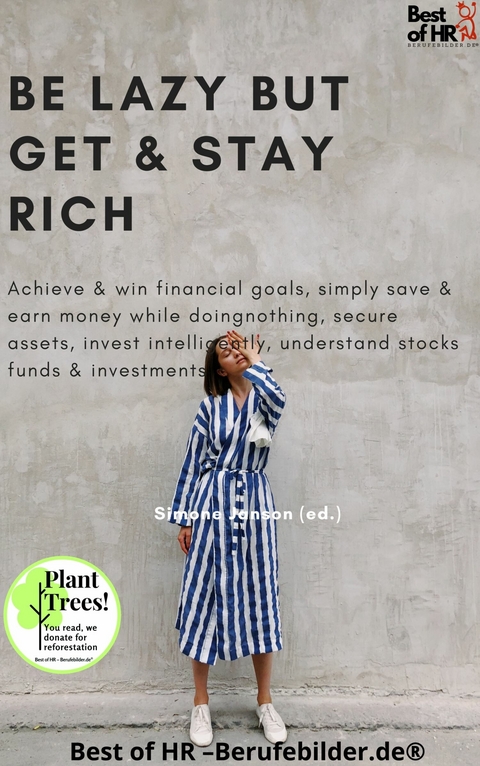
Be Lazy but Get & Stay Rich (eBook)
C, 180 Seiten
Best of HR – Berufebilder.de® (Verlag)
978-3-96596-271-2 (ISBN)
Also in the 8th revised and improved edition, published by a government-funded publisher involved in EU programs and a partner of the Federal Ministry of Education, you receive the concentrated expertise of renowned experts (overview in the book preview), embedded in an integrated knowledge system with premium content and 75% advantage. At the same time, you do good and support sustainable projects.
Because it is the desire of many people to earn money on the side, as if in their sleep. And the dream of a passive income must not remain an illusion. However one should know: In the end you can only become really rich if you make your money work for you. But unfortunately, very few people really know a lot about investing money and there are as many opinions as experts on how to plan your financial affairs correctly; if you don't want to lose track in the jungle of financial products between stock trading with individual securities, ETF and index funds, gold, real estate, etc., you would do well to take a closer look at your own asset planning.
Knowledge that makes a difference: With its 'Information on Demand' concept, the publisher was not only involved in an EU-funded program, but also received several awards. So when you buy the book, you are also doing good: The publisher is financially and personally committed to socially relevant projects such as tree planting campaigns, scholarship foundations, sustainable living, and many other innovative ideas.
The goal of providing you with the best possible content on topics such as career, finance, management, recruiting, or psychology goes far beyond the static nature of traditional books: The interactive book not only imparts expert knowledge but also allows you to ask individual questions and receive personal advice.
In doing so, expertise and technical innovation go hand in hand, as we take the responsibility of delivering well-researched and reliable content, as well as the trust you place in us, very seriously. Therefore, all texts are written by experts in their field. Only for better accessibility of information do we rely on AI-supported research results to a limited extent to make information easier to find, which assists you in your search for knowledge.
You also gain extensive premium services: Each book includes detailed explanations and examples, making it easier for you to successfully use the consultation services, freeky available only to book buyers. Additionally, you can download e-courses, work with workbooks, or engage with an active community. This way, you gain valuable resources that enhance your knowledge, stimulate creativity, and make your personal and professional goals achievable and successes tangible.
That's why, as part of the reader community, you have the unique opportunity to make your journey to personal success even more unforgettable with travel deals of up to 75% off. Because we know that true success is not just a matter of the mind, but is primarily the result of personal impressions and experiences.
Publisher and editor Simone Janson is also a best-selling author, was a columnist for WELT and Wirtschaftswoche, and, according to ZEIT, one of Germany's most bloggers on success - find out more about her on Wikipedia.
Janson began her career as an editor for two magazines published by the German Federal Employment Agency before founding her own magazine and book publishing company, for which over 500 authors write today. In addition, she has worked for almost all major newspapers, written books and appeared several times as an expert on German TV.
Invest successfully in finance: say no, make money
// By Dr. Markus Elsässer
Internal unrest and daily news are bad advice. The fear dominates. The key to making money is easy to find: the word "no".
Most of the money is earned with the word "no"
Whether you buy or sell. The temptations are on the wayside. Bombarded by daily news from the financial world, many investors are repeatedly misled. The sources of the evil lie in two areas. On the one hand, driven by the fear of missing opportunities, investors are constantly itching to jump on trains. On the other hand, investors are constantly tempted to sell and unnecessarily exit from commitments due to the lurking fear of losses. From commitments that would have been worth keeping for the long term. These phenomena can be observed everywhere: an actionism with fatal consequences for the saved. So nothing big can be built up.
The old stock market saying "Back and forth makes the pockets empty" was justified. Most of the income in the broker and exchange industry is still based on transaction fees. That means: the more is bought and sold, the more the industry earns. This is particularly pronounced in the United States. Most employed brokers do not receive a fixed monthly salary there. They only get a percentage of the transaction fees their customers earn. Therefore, with a few exceptions, it makes no sense to ask an investment advisor whether you should sell or buy a particular stock. It's like going to the barber shop and asking if you should have a haircut.
Finance learned from scratch
I am lucky enough to have been friends with fourth generation bankers for two decades. There are two brothers, raised in Paris and Switzerland, who are still fully liable with their private bank, including their private assets. Such business people are rarely found in our time. You have always opted for international quality and independence. After the Second World War, they employed 60, today there are 62 people in the bank. They conduct their banking business with care and a lot of commitment. Not surprisingly, the Lehmann crisis in 2008, to which numerous banks fell victim and in which other institutes only survived with the help of politicians, passed unharmed.
From an early age, they listened with pointed ears to conversations between their father and uncle at home, at the breakfast table, so to speak. This way they got to know what was going badly and well in the banking world. One of the principles that was repeatedly suggested to them was: "Boys, never forget, we make more money, saying - no". This simple sentence has it all and hits the nail on the head. For the investor it is like this: Permanently successful investors and entrepreneurs avoid bad and mediocre business. You focus on one area. There, their expertise and competence grow. And they hold out there too. Stamina with know-how is what makes the difference in the end.
The role of privacy in financial decisions
According to my long-standing observation, the root of bad investment is often in the professional or private environment. People who pursue a profession that is often considered repetitive or boring are particularly at risk. For example, dentists and notaries, to name just two professions, are tied to their practice or office space. After a few years in the job they lack real challenges. The monotony of the daily routine is tired.
Investing money, speculating, offers itself as a flight to another world, so to speak. The thrill of a financial adventure is literally sought out subconsciously. The following scenario can also often be found at home: After many years of family life, family members show little interest in the daily work at the dinner table. There is hardly any praise or recognition left. How beneficial are the calls with the investment advisor or the asset manager? »Yes, he still has understanding, he still appreciates what I do here every day.« And so some successful people, as permanent amateurs, drift off into the financial world. And as a rule, the end result is always the same: in the boom, he buys with full cheeks at high prices. And in a crash, according to 2008 and 2009, he gets very nervous and eventually climbs to market lows. He feels like a beaten dog, unfairly and badly treated.
Have emotions under control
Anyone who ventures onto the slippery trading floor should give up their emotions in the cloakroom together with their coat. Boredom, a thirst for adventure, frustration at work, a vacuum in domestic life - none of this should have any influence on investing and investing. Such deficits should be balanced with other interests: perhaps activating a hobby, playing a sport, learning a musical instrument, getting socially involved in the non-profit sector. From my own experience, I can assure you that my performance on the stock exchange has improved again since I started taking violin lessons at the age of 55. No matter what you choose: For God's sake, just leave your capital alone.
It's not just about the many unnecessary expenses. Constantly investing on every exciting-looking opportunity has far worse consequences. Before you know it, you are fully invested over time. The stock portfolio is overflowing with speculations and commitments that have gone wrong. Most of the time you don't really know why you bought one or the other stock at all. The typical picture of such a depot: nothing about strategic consideration, more like a shelf full of bitten apples. A picture of misery. No trace of wealth accumulation or expansion.
Confidence helps to identify opportunities
Everyone can achieve infinite successes in business and on the stock exchange. It only requires one thing: the knowledge and confidence that you will be offered excellent opportunities in life. But only a few! I see it this way: The art lies in the calm, patiently waiting, looking at the sea and looking for the really big tanker. And then one day when he shows up. He drives past you very close to your eyes. Many investors miss this wonderful moment. Or they just don't see the big tanker. They think a cloud darkens the picture. And in the second step you have to grab and strike. With capital in your pockets, you now have to get on board.
These are irretrievable moments for which the investor must be prepared. But if you do not systematically maintain discipline and constantly invest in mediocrity, you cannot "strike" at the crucial moment as an investor. It's always the same. At the crucial moment - when the best assets, land, shares and company shares are practically given away in the mega crisis - hardly any investors have liquidity to buy. It is an ancient observation on the stock market: At times of extreme swings, both in the hyperboom of boiling price quotes and in the deepest sell-off crash, the irrationality of mass hysteria lasts much, much longer than you think possible. These are the moments when great fortunes are made.
It is the investors who keep saying "no" for a long time - over the years - who make it big. So again, please: do not engage in occupational therapy with your money, but only take exceptional opportunities! Who cares: Warren Buffett is also convinced of this approach. He doesn't use my picture of the "big tanker". He believes that every person receives a "twelve card" for the journey through life at birth. If you are on the ball, you can score twelve times in life. Buffett and I are optimists by nature and from experience. But as a friend of mine said a long time ago: "The houses on the best properties on Park Avenue in New York are all built by optimists." He is right.
When investing: Always think in percent
Young people in training and at the start of their careers are particularly important to me. It is not easy for them to find the way to invest and invest. They are not taught it at school. But there is a very simple recommendation: Do not think in euros, but in percent.
I keep hearing the argument: »I don't have enough money. It's not worth it for me. For the few euros that come around… ”Well, I know what I'm talking about. I myself was in the same situation as a young person. But I tried it and learned that it is worth investing money on the stock exchange. Here is an example: On 8. December 1971 I bought my first stock. I was 15 years old and my savings were 200 Deutsche Mark (DM). It was a time when there was no smartphone or internet. I wanted to make more of my money. So I studied the stock market prices in the newspaper and did my research as best I could.
I decided on a mechanical engineering share, the GuteHoffnungshütte share (called: GHH, later part of the MAN Group), which seemed promising to me. I had to issue the purchase order from the payphone during the school break. The share was listed at DM 143,50. Because of the high minimum basic fee, all the fun cost me DM 150,36. As such, I had only expected 1,5 percent expenses for purchases and sales. I had not thought of the minimum basic fee of DM 7. What started out hopefully initially turned out to be a low blow. Because the GHH share had to increase by at least DM 14, so that I would reach the PlusMinusNullLinie. I was really depressed. I had prepared myself so well and had calculated incorrectly. But I was lucky. Within only four months, on the 11. April 1972, I was able to sell the GHH share at the DM 179 price. After deducting the expenses, DM 172,05 remained. I had won DM 21,69. A very small amount (Euro 11,06) that most should have shrugged. "So, was it worth it ...?"
Don't let others irritate you
But I looked at it very differently because I had achieved a remarkable success. A profit of 14,42 percent in just four months! I didn't mind the small amount of money. It was the interest...
| Erscheint lt. Verlag | 17.11.2025 |
|---|---|
| Verlagsort | Düsseldorf |
| Sprache | englisch |
| Themenwelt | Wirtschaft ► Betriebswirtschaft / Management ► Unternehmensführung / Management |
| Wirtschaft ► Volkswirtschaftslehre | |
| Schlagworte | Asset accumulation • Asset planning • Banks • becoming a millionaire • Bond • Bonds • Building society contract • Building society savings • business • Capital • Company • Corporate • Currency strategy • dividend • Dividend Yield • Economic crisis • Entrepreneur • Equity • Equity funds • Equity ratio • Equity strategy • Finance • financial consulting • Financial Education • Financial investment • Financial Market • Financial Planning • Financial products • Financial Sector • Financial service providers • Financing • Funds • getting rich • health insurance • Investing • Investment • Investment funds • Investor • liquidity • Make more of your money • Management • market participants • open-ended real estate funds • percent • Personnel Management • Product • Products • Profit • Real Estate • saving • Securities • Share prices • Stock exchange • Stock exchange prices • Stock market crash • Success • yield |
| ISBN-10 | 3-96596-271-X / 396596271X |
| ISBN-13 | 978-3-96596-271-2 / 9783965962712 |
| Informationen gemäß Produktsicherheitsverordnung (GPSR) | |
| Haben Sie eine Frage zum Produkt? |
 EPUB (Ohne DRM)
Größe: 270 KB
Digital Rights Management: ohne DRM
Dieses eBook enthält kein DRM oder Kopierschutz. Eine Weitergabe an Dritte ist jedoch rechtlich nicht zulässig, weil Sie beim Kauf nur die Rechte an der persönlichen Nutzung erwerben.
Dateiformat: EPUB (Electronic Publication)
EPUB ist ein offener Standard für eBooks und eignet sich besonders zur Darstellung von Belletristik und Sachbüchern. Der Fließtext wird dynamisch an die Display- und Schriftgröße angepasst. Auch für mobile Lesegeräte ist EPUB daher gut geeignet.
Systemvoraussetzungen:
PC/Mac: Mit einem PC oder Mac können Sie dieses eBook lesen. Sie benötigen dafür die kostenlose Software Adobe Digital Editions.
eReader: Dieses eBook kann mit (fast) allen eBook-Readern gelesen werden. Mit dem amazon-Kindle ist es aber nicht kompatibel.
Smartphone/Tablet: Egal ob Apple oder Android, dieses eBook können Sie lesen. Sie benötigen dafür eine kostenlose App.
Geräteliste und zusätzliche Hinweise
Buying eBooks from abroad
For tax law reasons we can sell eBooks just within Germany and Switzerland. Regrettably we cannot fulfill eBook-orders from other countries.
aus dem Bereich