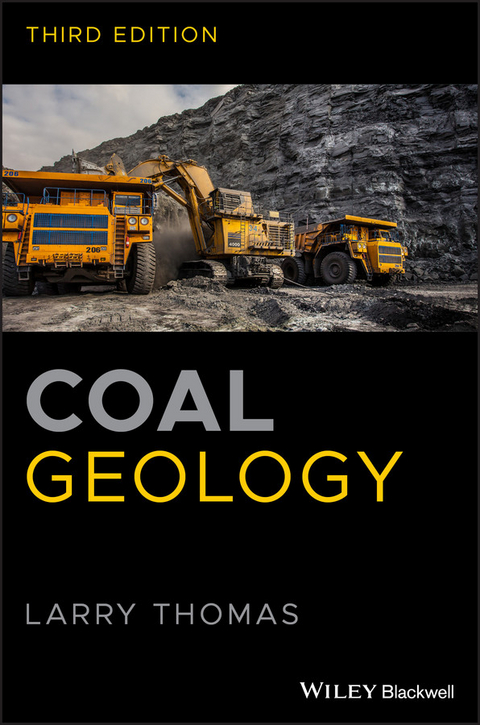
Coal Geology (eBook)
John Wiley & Sons (Verlag)
978-1-119-42426-0 (ISBN)
A global exploration of coal geology, from production and use to chemical properties and coal petrology
Coal Geology, 3rd Edition, offers a revised and updated edition of this popular book which provides a comprehensive overview of the field of coal geology including coal geophysics, hydrogeology and mining. Also covered in this volume are fully revised coverage of resource and reserve definitions, equipment and recording techniques together with the use of coal as an alternative energy source as well as environmental implications.
This third edition provides a textbook ideally suited to anyone studying, researching or working in the field of coal geology, geotechnical engineering and environmental science.
- Fills the gap between academic aspects of coal geology and the practical role of geology in the coal industry
- Examines sedimentological and stratigraphical geology, together with mining, geophysics, hydrogeology, environmental issues and coal marketing
- Defines global coal resource classifications and methods of calculation
- Addresses the alternative uses of coal as a source of energy
- Covers a global approach to coal producers and consumers
LARRY THOMAS graduated from the University of Wales with a Ph.D in coalfield sedimentology, and has since been associated with the geology, exploration and mining of coal for over 50 years, and has produced a number of technical papers, maps and reports on coal deposits worldwide. He is a director of Dargo Associates Ltd., an international coal consultancy, involved in assessment of coal resources and coal utilisation in many parts of the world for both mining operations, fuel for electricity generation and for project financing.
A global exploration of coal geology, from production and use to chemical properties and coal petrology Coal Geology, 3rd Edition, offers a revised and updated edition of this popular book which provides a comprehensive overview of the field of coal geology including coal geophysics, hydrogeology and mining. Also covered in this volume are fully revised coverage of resource and reserve definitions, equipment and recording techniques together with the use of coal as an alternative energy source as well as environmental implications. This third edition provides a textbook ideally suited to anyone studying, researching or working in the field of coal geology, geotechnical engineering and environmental science. Fills the gap between academic aspects of coal geology and the practical role of geology in the coal industry Examines sedimentological and stratigraphical geology, together with mining, geophysics, hydrogeology, environmental issues and coal marketing Defines global coal resource classifications and methods of calculation Addresses the alternative uses of coal as a source of energy Covers a global approach to coal producers and consumers
LARRY THOMAS graduated from the University of Wales with a Ph.D in coalfield sedimentology, and has since been associated with the geology, exploration and mining of coal for over 50 years, and has produced a number of technical papers, maps and reports on coal deposits worldwide. He is a director of Dargo Associates Ltd., an international coal consultancy, involved in assessment of coal resources and coal utilisation in many parts of the world for both mining operations, fuel for electricity generation and for project financing.
Preface
1. Preview
2. Origin of Coal
3. Age and Occurrence of Coal
4. Coal as a Substance
5. Coal Sampling and Analysis
6. Coal Exploration and Data Collection
7. Coal Resources and Reserves
8. Geophysics of Coal
9. Hydrogeology of Coal
10. Geology and Coal Mining.
11. Coal as an Alternative Energy Source
12. Coal Use and the Environment
13. Coal Marketing
Bibliography
Appendices
Glossary
Index
2
Origin of Coal
2.1 Introduction
Sedimentary sequences containing coal or peat beds are found throughout the world and range in age from middle Palaeozoic to Recent.
Coals are the result of the accumulation of vegetable debris in a specialised environment of deposition. Such accumulations have been affected by synsedimentary and post‐sedimentary influences to produce coals of differing rank and differing degrees of structural complexity, the two being closely interlinked. The plant types that make up coals have evolved over geological time, providing a variety of lithotypes in coals of differing ages.
Remarkable similarities exist in coal‐bearing sequences, due for the greater part to the particular sedimentary associations required to generate and preserve coals. Sequences of vastly different ages from areas geographically separate have a similar lithological framework and can react in similar fashions structurally.
It is a fact, however, that the origin of coal has been studied for over a century and that no one model has been identified that can predict the occurrence, development, and type of coal. A variety of models exist that attempt to identify the environment of deposition, but no single one can adequately give a satisfactory explanation for the cyclic nature of coal sequences, the lateral continuity of coal beds, and the physical and chemical characteristics of coals. However, the advent of sequence stratigraphy has recognised the pattern of geological events leading to the different phases of deposition and erosion within coal‐bearing sequences.
2.2 Sedimentation of Coal and Coal‐Bearing Sequences
During the last 90 years, interest has grown rapidly in the study of sedimentological processes, particularly those characteristic of fluviatile and deltaic environments. It is these, in particular, that have been closely identified with coal‐bearing sequences.
It is important to give consideration both to the recognition of the principal environments of deposition and to the recent changes in emphasis regarding those physical processes required, in order to produce coals of economic value. In addition, the understanding of the shape, morphology, and quality of coal seams is of fundamental significance for the future planning and mining of coals. Although the genesis of coal has been the subject of numerous studies, models that are used to determine the occurrence, distribution, and quality of coal are often still too imprecise to allow such accurate predictions.
2.2.1 Depositional Models
The recognition of depositional models to explain the origin of coal‐bearing sequences and their relationship to surrounding sediments has been achieved by a comparison of the environments under which modern peats are formed and ancient sequences containing coals.
Cecil et al. (1993) suggested that the current models often concentrate on the physical description of the sediments associated with coal rather than concentrating on the geological factors that control the genesis of coal beds. They also suggest that models that combine sedimentation and tectonics with eustasy and chemical change have not yet been fully developed. Such integrated models would give an improved explanation of physical and chemical processes of sedimentation. It should be noted that the use of sequence stratigraphy in facies modelling is based on physical processes and does not take into account chemical stratigraphy. This will prove a deficiency when predicting the occurrence and character of coal beds.
The traditional depositional model used by numerous workers was based on the ‘cyclothem’, a series of lithotypes occurring in repeated ‘cycles’. Weller (1930) and Wanless and Weller (1932) remarked on the similarity of stratigraphic sections associated with every coal bed; i.e. marine sediments consisted of black sheety shale with large concretions, limestone with marine fossils and shale with ironstone nodules and bands, whereas continental sequences comprised sandstone lying unconformably on lower beds, sandy shale, limestone without marine fossils, rootlet bed or seatearth, and then coal. Although all of the members of each cyclothem vary in thickness and lithology from place to place, the character of some beds is remarkably similar at localities great distances apart. Their studies showed that the entire Pennsylvanian (upper Carboniferous) system in the Eastern Interior and northern Appalachian Basins and the Lower Pennsylvanian strata in the northern part of the Western Interior Basin consist of similar successions of cyclothems. Individual cyclothems are persistent, and correlation of cyclothems at widely separated localities is possible. This concept has been modified to a model that relates lateral and vertical sequential changes to depositional settings that have been recognised in modern fluvial, deltaic, and coastal barrier systems. Further studies on the traditional model are based on work carried out in the USA by Horne (1979), Horne et al. (1978, 1979), Ferm (1979), Ferm et al. (1979), Ferm and Staub (1984), and Staub and Cohen (1979). The sequences, or lithofacies, are characterised by the sedimentary features listed in Table 2.1. Other workers include Thornton (1979) and Jones and Hutton (1984) on coal sequences in Australia, Galloway and Hobday (1996), and Guion et al. (1995) and George (2014) in the UK. More recent studies have compared such established depositional models with modern coastal plain sedimentation, e.g. in equatorial South‐East Asia, and have concentrated in particular on modern tropical peat deposits (Cecil et al. 1993; Clymo 1987; Gastaldo et al. 1993; McCabe and Parrish 1992). Studies by Hobday (1987), Diessel (1992), Lawrence (1992), Jerzykiewicz (1992), Dreesen et al. (1995), Cohen and Spackman (1972, 1980), Flint et al. (1995), and McCabe (1984, 1987, 1991) have all further developed the model for coal deposits of differing ages, using the traditional model but relating it to modern sedimentary processes. Galloway and Hobday (1996), in their textbook, give a detailed analysis of coal‐bearing environments with worldwide examples.
Table 2.1 Sedimentary features used to identify depositional environments.
Source: From Horne et al. (1979).
| Recognition characteristics | Fluvial and upper delta plaina | Transitional lower delta plaina | Lower delta plaina | Back‐barriera | Barriera |
| I Coarsening upwards |
| A Shale and siltstone sequences | 2–3 | 2 | 1 | 2–1 | 3–2 |
| (i) >50 ft | 4 | 3–4 | 2–1 | 2–1 | 3–2 |
| (ii) 5–25 ft | 2–3 | 2–1 | 2–1 | 2–1 | 3–2 |
| B Sandstone sequences | 3–4 | 3–2 | 2–1 | 2 | 2–1 |
| (i) >50 ft | 4 | 4 | 2–1 | 3 | 2–1 |
| (ii) 5–25 ft | 3 | 3–2 | 2–1 | 2 | 2 |
| II Channel deposits |
| A Fine‐grained abandoned fill | 3 | 2–3 | 1–2 | 2 | 3–2 |
| (i) Clay and silt | 3 | 2–3 | 1–2 | 2 | 3–2 |
| (ii)Organic debris | 3 | 2–3 | 1–2 | 2–3 | 3 |
| B Active sandstone fill | 1 | 2 | 2–3 | 2–3 | 2 |
| (i)Fine grained | 2 | 2 | 2–3 | 2–3 | 2 |
| (ii)Medium‐ and coarse‐grained | 1 | 2–3 | 3 | 3 | 2–3 |
| (iii)Pebble lags | 1 | 1 | 2 | 2–3 | 3–2 |
| Erscheint lt. Verlag | 13.7.2020 |
|---|---|
| Sprache | englisch |
| Themenwelt | Naturwissenschaften ► Geowissenschaften ► Geologie |
| Naturwissenschaften ► Physik / Astronomie | |
| Technik ► Elektrotechnik / Energietechnik | |
| Wirtschaft | |
| Schlagworte | coal • coal consultancy • coal deposits • coalfield • coal geology • coal mines • coal petrology • coal usage • coal variations • direct fuel • earth sciences • Energie • Energy • Environmental Geology • Gasification • Geologe • Geologie u. Geophysik • Geology • Geology & Geophysics • Geowissenschaften • global coal • Kohle • Kohlenlagerstätte • Methane gas • Sedimentology |
| ISBN-10 | 1-119-42426-7 / 1119424267 |
| ISBN-13 | 978-1-119-42426-0 / 9781119424260 |
| Informationen gemäß Produktsicherheitsverordnung (GPSR) | |
| Haben Sie eine Frage zum Produkt? |
 EPUB (Adobe DRM)
Kopierschutz: Adobe-DRM
Adobe-DRM ist ein Kopierschutz, der das eBook vor Mißbrauch schützen soll. Dabei wird das eBook bereits beim Download auf Ihre persönliche Adobe-ID autorisiert. Lesen können Sie das eBook dann nur auf den Geräten, welche ebenfalls auf Ihre Adobe-ID registriert sind.
Details zum Adobe-DRM
Dateiformat: EPUB (Electronic Publication)
EPUB ist ein offener Standard für eBooks und eignet sich besonders zur Darstellung von Belletristik und Sachbüchern. Der Fließtext wird dynamisch an die Display- und Schriftgröße angepasst. Auch für mobile Lesegeräte ist EPUB daher gut geeignet.
Systemvoraussetzungen:
PC/Mac: Mit einem PC oder Mac können Sie dieses eBook lesen. Sie benötigen eine
eReader: Dieses eBook kann mit (fast) allen eBook-Readern gelesen werden. Mit dem amazon-Kindle ist es aber nicht kompatibel.
Smartphone/Tablet: Egal ob Apple oder Android, dieses eBook können Sie lesen. Sie benötigen eine
Geräteliste und zusätzliche Hinweise
Buying eBooks from abroad
For tax law reasons we can sell eBooks just within Germany and Switzerland. Regrettably we cannot fulfill eBook-orders from other countries.
aus dem Bereich