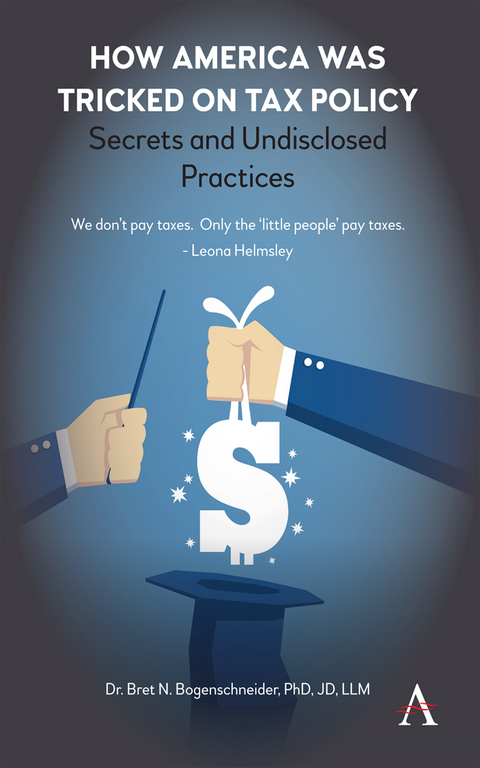
How America was Tricked on Tax Policy (eBook)
How America was Tricked on Tax Policy explains how regular citizens were “tricked” by the outdated view of economists that much heavier taxation of labor rather than capital is economically justifiable. The truth is that workers pay their taxes while the rich pay very little. Based on reputable sources of information, including publications of the Organization for Economic Cooperation and Development (OECD), official statistics data, and the publications in high-ranked journals, the book paves the way for a new policy-making process aimed to achieve more sustainable taxation and to increase the wellbeing of citizens as the main goal of any modern state policy. The book compellingly argues how tax policy could be improved by incorporating science and scientific methods.
How America was Tricked on Tax Policy explains how regular citizens were “tricked” by the outdated view of economists that much heavier taxation of labor rather than capital is economically justifiable. The truth is that workers pay their taxes while the rich pay very little. Based on reputable sources of information, including the publications of the Organization for Economic Cooperation and Development (OECD), official statistics data, and the publications in high-ranked journals, the book paves the way for a new policy making process aimed to achieve more sustainable taxation and to increase the wellbeing of citizens as the main goal of any modern state policy.
Dealing with critically important and underexplored topics in tax policy, the book challenges an enshrined dogma that is rarely challenged at the level of policy. In doing so, this book envisions policy changes that could be highly impactful in a new political administration. This book proposes that governments should look for not just corporate income tax rate reduction when announcing their tax reforms but should equally focus on the reduction of the overall tax burden on labor. The negative impact and high social cost of wage taxation is exemplified by the key areas of tax policy that are relevant for every wealthy state, such as taking due care of public health, investing in education and wellbeing of children, and supporting small business for the overall benefit to society.
The book provides sound arguments that “labor” should essentially be treated as “human capital” and be given the same tax treatment as that of classically understood “capital”. This understanding is extremely relevant nowadays as we are facing the issues of digitalization, in general, and “robotization,” where a new type of labor, i.e., nonhuman labor, is entering the workforce. The book’s fresh novelty comes from its new approach to tax policy while addressing the issues relevant to the “digital” era such as taxation of artificial intelligence or “robots” that are currently partially substituting the human workforce. The book compellingly argues how tax policy could be improved by incorporating science and scientific methods.
lt;p>Bret Bogenschneider holds multiple tax and law degrees including a Juris Doctor, LLM in taxation, and PhD in international business taxation. He is an assistant professor at Indiana University East, specializing in taxation.
Introduction: The Classic Deceptions in Tax Policy; CHAPTER 1 Tax Policy in the Oval Office; CHAPTER 2 The Abandonment of Scientific Methods in Tax Research; CHAPTER 3 How the Business Tax System Favors Large Corporations over Small Businesses; CHAPTER 4 The Limits of Moral Philosophy in Formulating Tax Policy; CHAPTER 5 Wage Taxes Do Have Social Costs; Conclusion: Postmodern Tax Policy, or Why the “Little People” Matter to Tax Policy; Index.
| Erscheint lt. Verlag | 30.6.2020 |
|---|---|
| Verlagsort | London |
| Sprache | englisch |
| Maße | 140 x 140 mm |
| Gewicht | 454 g |
| Themenwelt | Wirtschaft |
| ISBN-13 | 9781785274299 / 9781785274299 |
| Informationen gemäß Produktsicherheitsverordnung (GPSR) | |
| Haben Sie eine Frage zum Produkt? |
 EPUB (Adobe DRM)
Kopierschutz: Adobe-DRM
Adobe-DRM ist ein Kopierschutz, der das eBook vor Mißbrauch schützen soll. Dabei wird das eBook bereits beim Download auf Ihre persönliche Adobe-ID autorisiert. Lesen können Sie das eBook dann nur auf den Geräten, welche ebenfalls auf Ihre Adobe-ID registriert sind.
Details zum Adobe-DRM
Dateiformat: EPUB (Electronic Publication)
EPUB ist ein offener Standard für eBooks und eignet sich besonders zur Darstellung von Belletristik und Sachbüchern. Der Fließtext wird dynamisch an die Display- und Schriftgröße angepasst. Auch für mobile Lesegeräte ist EPUB daher gut geeignet.
Systemvoraussetzungen:
PC/Mac: Mit einem PC oder Mac können Sie dieses eBook lesen. Sie benötigen eine
eReader: Dieses eBook kann mit (fast) allen eBook-Readern gelesen werden. Mit dem amazon-Kindle ist es aber nicht kompatibel.
Smartphone/Tablet: Egal ob Apple oder Android, dieses eBook können Sie lesen. Sie benötigen eine
Geräteliste und zusätzliche Hinweise
Buying eBooks from abroad
For tax law reasons we can sell eBooks just within Germany and Switzerland. Regrettably we cannot fulfill eBook-orders from other countries.
aus dem Bereich