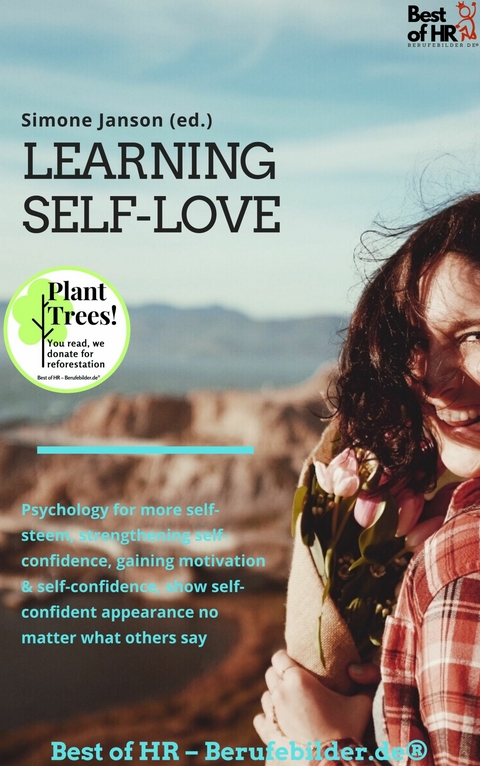
Learning Self-Love (eBook)
C, 180 Seiten
Best of HR – Berufebilder.de® (Verlag)
978-3-96596-217-0 (ISBN)
Also in the 8th revised and improved edition, published by a government-funded publisher involved in EU programs and a partner of the Federal Ministry of Education, you receive the concentrated expertise of renowned experts (overview in the book preview), embedded in an integrated knowledge system with premium content and 75% advantage. At the same time, you do good and support sustainable projects.
Because self-love is so easy to say and is especially in challenging times incredibly difficult. Often and quickly the so important self-care, i.e. taking care of your own well-being, is confused with egoism, while in our society self-sacrifice is demanded. For this reason, and because of negative experiences that often reach far back into childhood, many people find it so incredibly difficult to give themselves the urgently needed self-love. But only those who love and accept themselves can give enough to others.
Knowledge that makes a difference: With its 'Information on Demand' concept, the publisher was not only involved in an EU-funded program, but also received several awards. So when you buy the book, you are also doing good: The publisher is financially and personally committed to socially relevant projects such as tree planting campaigns, scholarship foundations, sustainable living, and many other innovative ideas.
The goal of providing you with the best possible content on topics such as career, finance, management, recruiting, or psychology goes far beyond the static nature of traditional books: The interactive book not only imparts expert knowledge but also allows you to ask individual questions and receive personal advice.
In doing so, expertise and technical innovation go hand in hand, as we take the responsibility of delivering well-researched and reliable content, as well as the trust you place in us, very seriously. Therefore, all texts are written by experts in their field. Only for better accessibility of information do we rely on AI-supported research results to a limited extent to make information easier to find, which assists you in your search for knowledge.
You also gain extensive premium services: Each book includes detailed explanations and examples, making it easier for you to successfully use the consultation services, freeky available only to book buyers. Additionally, you can download e-courses, work with workbooks, or engage with an active community. This way, you gain valuable resources that enhance your knowledge, stimulate creativity, and make your personal and professional goals achievable and successes tangible.
That's why, as part of the reader community, you have the unique opportunity to make your journey to personal success even more unforgettable with travel deals of up to 75% off. Because we know that true success is not just a matter of the mind, but is primarily the result of personal impressions and experiences.
Publisher and editor Simone Janson is also a best-selling author, was a columnist for WELT and Wirtschaftswoche, and, according to ZEIT, one of Germany's most bloggers on success - find out more about her on Wikipedia.
Janson began her career as an editor for two magazines published by the German Federal Employment Agency before founding her own magazine and book publishing company, for which over 500 authors write today. In addition, she has worked for almost all major newspapers, written books and appeared several times as an expert on German TV.
Identity Personality Roles on the Net: Who am I and where am I?
// By Simone Janson
Everyone is a multiple personality. At least as far as the effect on his environment is concerned. Depending on who we communicate with, we take on different roles.
Everyone has different roles
A man, for example, will usually behave differently with buddies over beer in the evening than with his wife - and his appearance in everyday work and with his boss is something completely different. For some, this change of roles may be more pronounced than for others, but it is comparatively normal that the same person corresponds in social dealings with other, different roles - and not only since the invention of the Internet. What is new, however, is the number of options that are available to us through the Internet. We can move anonymously and adopt a foreign identity with a different gender or age. We can appear under a pseudonym in chats or forums, buy funny avatars and make up our opinions without makeup - or do the opposite.
And even if we appear on the net under our real name, we often adapt our behavior to the respective network - for example, Xing is particularly serious, Facebook is cool and Twitter is funny. This game with a variety of different identities unsettles many people who do not know how to deal with it. Does someone use Twitter for private or professional purposes? And can professional friendship inquiries be made on Facebook or is it perceived as too private? New communication rules are necessary because the boundaries between private and public identity are becoming increasingly blurred.
Authentic or idiotic?
Many internet users are idiots! At least if you go by the Greek origin meaning of the word. Because in ancient Greece idiot was a person who does not separate private from public. And that's exactly what many people do when they present themselves on the Internet. Because as the study “Facebook Profiles Reflect Actual Personality, Not Self-Idealization” by the Johannes Gutenberg University Mainz shows, most people in social networks want to be as self-sufficient as possible and to express their own personality.
In cooperation with German and American colleagues, the Mainz psychologists examined a total of 236 German (studiVZ / meinVZ) and US (Facebook) user profiles. Questionnaires were used to ascertain the actual personality traits of the profile owners as well as their idealized self-images (ie the ideas of how they would like to be). The so-called Big Five were recorded as personality traits: extraversion, tolerance, conscientiousness, neuroticism and openness to experience. Subsequently, external assessors saw the user profiles and gave their impression of personality. The external judgments were then compared with the actual personality and self-ideal of the profile owner. It turns out that the spontaneous impressions of the external assessors match the actual properties of the profile owners and are not falsified by their self-idealization. The results contradict the widespread opinion that online profiles are only used to create an ideal of yourself, an idealized virtual identity, so to speak.
Too much openness creates fear
This openness scares many people. Because, according to the popular opinion, it may be nice and good to give yourself as you are in private life. However, too much openness has lost nothing in public and even in professional and professional surroundings. In a way it looks idiotic. Or not?
In October 2010, Uwe Knaus, blog manager from Daimler, received a memorable application for a social media internship: “I am addicted to social media… yes, I hereby officially confess. Nothing can sweeten my day more than the golden ringing of a new message on Facebook and a hoped-for retweet ... Yes, it is ... I get repeated reports of harassment because I follow people on the street. And worst of all:… My friend now only speaks to me with @Schatzi… Only the structured use of social media can help me now. I'm counting on your support. ”
The sender was the Regensburg graduate Natascha Müller, who caused heated discussions among HR professionals and social media experts. Because Knaus had published the application, initially anonymously, on his private blog - not without giving his own impression: “At first I thought: That is not possible! Someone made a joke, or someone else submitted a fake application. Let us assume that the cover letter is not a fake. Then it is fun, open, honest, funny, outstanding and the applicant will be remembered. But it doesn't suit Daimler - or does it? If the lady had applied to an agency with that, she would probably have been able to start tomorrow. Thoughts about thoughts. At least one thing has been achieved: I am dealing with your application intensively for an unusually long time. ” And that was exactly the success of Müller's application: With her cheeky, unconventional nature, she not only got the blog manager of a global automotive group to think, but also received great, mostly approving attention via Twitter. So openness and authenticity as the strategy of success of our time?
Not every openness is well received
The matter is much more complicated and complex. Because not every form of openness is well received. The management consultant Olaf Hinz even warns against overdoing it with authenticity: “What is needed is a coherent appearance or a coherent staging. And staging in particular also has an eye on the role models / expectations of employees, colleagues or the public. Because whoever comes personally and authentically, is quickly perceived by their professional environment as 'too close' and 'too private'. I think it takes a professional demeanor that 'balancing' between authenticity and the role is neither adapted nor too private: a coherent staging. ”
Political scientist Eva Horn, who used to work in the state parliament of Baden-Württemberg, has mastered this staging perfectly on her preferred social media channel, Twitter: with her green hair, the rather random snapshot and the cheeky saying “I often stay long up, drink a lot and be ashamed of all of us ”, they take their profile more as a private and therefore particularly authentic channel. Nevertheless, she also thinks carefully about what she tweets and what not, because she knows very well who is reading everything - and what misunderstandings the interlocking and private and public can lead to:
“With self-portrayal in social networks it is like everywhere else: some do it more than others, it is simply part of it. However, I would never tweet any crap to get more followers. That would be dishonest. What you write must fit you. I keep very private things like my love life to myself. But people can know that I am an identified missanthrope and sometimes drink a little more. Spontaneous expressions of feeling too, even if this sometimes causes irritation: Once I tweeted 'accidentally started crying' - many people thought that I had to be totally bad because I make it public. These are just short snapshots. There are a lot of people who don't understand the irony and cynicism with whom Twitter topics are carried to extremes in 140 characters. That has to suit you. Through Twitter I have already got a lot of professional contacts and job offers and I also tweet officially for the Greens - they have already noticed that I can formulate well. In the official account of a party or a company, however, private statements have lost nothing, you have to strictly separate them, otherwise it looks unprofessional! ”
Unintentionally famous - and now?
Anyone who attended the Rheinkultur Festival in Bonn on July 02nd, 2011 had a good chance of becoming famous. Not because he was suddenly discovered as a musician. But the WDR took a photo and enlarged it so that you could zoom in and see every face, and published it as the “largest German festival panorama” with 25.000 people. But that wasn't the worst. The WDR called at http: /rheinkulturpanorama.de/ to mark themselves or friends and acquaintances in the photo - optionally with or without Facebook, where people can be tagged in photos for a long time and thus assign contacts. This is precisely why the WDR thought the campaign was a successful gimmick - but bloggers and lawyers saw it somewhat differently.
"These concepts are not permissible in terms of German law," notes Thomas Stadler, specialist lawyer for IT law in his Internet Law blog. And John F. Nebel, staff member of the Heinrich Böll Foundation, writes: “The scope for the individual is getting smaller, the freedom to act unobserved is shrinking, and in the back of the mind, thinking is slowly developing that takes this into account.” the WDR users the opportunity to have their faces pixelated. All they have to do is send in a screenshot of the section on which they can be seen, provide their telephone number and prove that they are the same person, for example with a driver's license photo. In order to become anonymous again, you have to disclose further data!
A picture says more than 1000 words
Granted, many people don't care if anyone knows that you were at the Rhein-Kultur-Festival on July 02nd, 2011. But some don't either. But they have to live with the fact that after entering their name in the search engine, you may find exactly that picture when entering their name. But tagging and marking photos is just the beginning: software can now automatically recognize people in photos and assign them to a previously entered name. This is not really new: image processing programs such as Picasa, iPhoto or Photoshop Elements already have this function. What is new, however, is that you can no longer use them offline for yourself and your own photo...
| Erscheint lt. Verlag | 17.11.2025 |
|---|---|
| Verlagsort | Düsseldorf |
| Sprache | englisch |
| Themenwelt | Wirtschaft ► Betriebswirtschaft / Management ► Unternehmensführung / Management |
| Wirtschaft ► Volkswirtschaftslehre | |
| Schlagworte | Abitur • Activity • Banks • business • Company • competitiveness • Consultant • Corporate • credit • economic • education financing • Employee • employees • employment agency • Examination • Further Education • Lifelong Learning • Loan • Management Consultancy • Manager • Master • MBA • offer • organization • Organizational Development • Personnel Development • Personnel Management • Provider • Qualification • Questioning technique • Retraining • Sales • school • Seminar • Strategy • Subsidies • Success • Taxes • training place • Universities • vocational |
| ISBN-10 | 3-96596-217-5 / 3965962175 |
| ISBN-13 | 978-3-96596-217-0 / 9783965962170 |
| Informationen gemäß Produktsicherheitsverordnung (GPSR) | |
| Haben Sie eine Frage zum Produkt? |
 EPUB (Ohne DRM)
Größe: 233 KB
Digital Rights Management: ohne DRM
Dieses eBook enthält kein DRM oder Kopierschutz. Eine Weitergabe an Dritte ist jedoch rechtlich nicht zulässig, weil Sie beim Kauf nur die Rechte an der persönlichen Nutzung erwerben.
Dateiformat: EPUB (Electronic Publication)
EPUB ist ein offener Standard für eBooks und eignet sich besonders zur Darstellung von Belletristik und Sachbüchern. Der Fließtext wird dynamisch an die Display- und Schriftgröße angepasst. Auch für mobile Lesegeräte ist EPUB daher gut geeignet.
Systemvoraussetzungen:
PC/Mac: Mit einem PC oder Mac können Sie dieses eBook lesen. Sie benötigen dafür die kostenlose Software Adobe Digital Editions.
eReader: Dieses eBook kann mit (fast) allen eBook-Readern gelesen werden. Mit dem amazon-Kindle ist es aber nicht kompatibel.
Smartphone/Tablet: Egal ob Apple oder Android, dieses eBook können Sie lesen. Sie benötigen dafür eine kostenlose App.
Geräteliste und zusätzliche Hinweise
Buying eBooks from abroad
For tax law reasons we can sell eBooks just within Germany and Switzerland. Regrettably we cannot fulfill eBook-orders from other countries.
aus dem Bereich