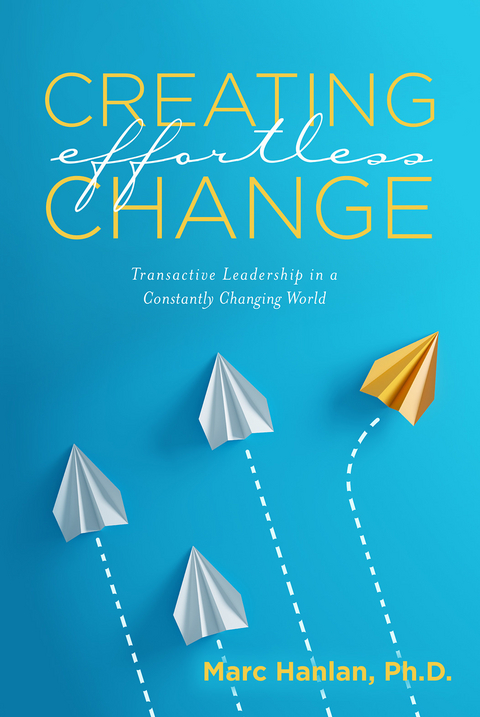
Creating Effortless Change (eBook)
176 Seiten
Bookbaby (Verlag)
978-1-0983-0501-7 (ISBN)
Creating Effortless Change looks at leading change by offering a fundamental shift in the perspective of leadership. By redefining leadership and offering a new perspective for leaders, the author shows how extraordinary Change Leaders make the impossible become routine, the uncontrollable become manageable, and resistance become alignment. What leadership does is important. How leadership is, is even more important. This book explores how leadership is. You probably don't need this book if you:- Get all of the cooperation you need to get things done- Simply tell people to do something, and they do it- Have no difficult situations with people- Have no conflict in the workplace or your personal life- Can leave people alone and they get all their work done- Believe there is nothing else to learn about leadership- Don't want to read but will wait for the audiobook- Don't like to read and don't want toYou probably can use this book if you:- Find that things don't work out as you would like them to- Believe that leading has challenges- Don't understand why people don't agree with the 'right' way to do things- Wonder how others get so much done with so little time- Know that there must be better ways to lead change- Wonder why change is so hard- Are curious about the future of leadership and changeFrom the Foreword by Claude Cloutier, Ph.D., CEO of XtremeEDA:"e;This is a leading-edge book on changethe author is a change visionary whose Culture chapter on its own is pricelessoffering a vision of where change and change leadership are going, with the theory, tools, techniquesexperience, and wisdom ready to be adapted to your specific context and change initiative...this book shows how change should be effortless and fun."e;
CHAPTER TWO: THE NATURE OF CHANGE
Change is inevitable – except from a vending machine.
Chapter Two: The Nature of Change
What is Change?
The Challenge of Change
Change from What to What? The Role of Different, Seen,
Value-Added Performance
What is Old about Change
What is New about Change
The Four Basic ‘Whats’ of Change
The (Invisible) Fifth Basic ‘What’ of Change
Why Does Change Take So Much Work?
The Language of ‘What’ Changes
Summary: The Nature of Change
Before we proceed into the nature of Leading Change in a Changing World, it is helpful to review some of the background of ‘change’ in the organization. What is change? Why should anyone worry about it? What are the basic ways that ‘change’ is affected in the organization?
First…
What is Change?
The dictionary definition is, The act or instance of making or becoming different (noun), or make or become different; transform; move from one to another (verb).6 This simple definition belies the impact that change has on our lives and within ourselves. Our bodies are in a constant state of change; we are always becoming different. Our relationships are constantly changing; the ‘us’ is always becoming different. Our environment is constantly changing; the ‘context’ is always becoming different.
PARC: A Story
The Palo Alto Research Center (PARC) is an example of great research and idea-creation that Xerox was unable to commercialize. Built in the 1970s to address opportunities in copy science and to expand the Xerox product line, PARC invented and developed key technologies that became instrumental to the computer industry of the 1980s7 including the laser printer, graphical user interface (GUI), ethernet, full object-oriented programming, and much more. While some of the technologies were (in)famously copied by Xerox’s ultimate competition8, the majority were developed into full products by other companies who had hired PARC employees. Xerox developed several computer products including the Xerox Star in 1981, that incorporated many of the leading-edge technologies that were ultimately copied and expanded upon by competitors such as Apple Computer, Microsoft, and 3Com. Much has been written about Xerox’s lost opportunities but the fundamental question remains: how did Xerox have the insight to create and fund PARC and still let some of the greatest computer technologies in a generation be commercialized by others?9
As will be seen throughout this book, ‘change’ is not just about other people, other companies, and other problems. It is not always about the internal impact of external events such as increased competition, market acceptance, or customer relationships. ‘Change’ is more commonly and more invisibly about each person, each company, and each culture.
Change is inevitable. Adapting to change is the challenge. Riding the waves of change is the opportunity. Creating the waves of opportunity is the excitement.
The Challenge of Change
The only people who like change are wet babies.
Change by itself is neutral; it can either create major benefits (e.g., winning the lottery), or it can create major problems and headaches (e.g., winning the lottery). The challenge of change is the impact it has on our lives and within ourselves. This distinction is critical to the nature of change and change leadership. Change without impact may be transparent and invisible to those whose lives are not changed. Conversely, change with significant impact may be overwhelming to those whose lives are changed. The greater the impact, the greater the need to deal with change.
Change often has significantly different impacts throughout an organization. To the Information Technology group trying to update software across many departments, different computer systems, the impact of software upgrades may be considerable, demanding additional time, resources, and commitment. To the Accounting worker using the updated software, the impact might be minimal, perhaps changing a few tasks here and there. To the Maintenance worker who does not interface directly with the software, the impact may be completely transparent. Throughout the organization, the mechanics of the change may be the same, while the impact of that change may vary dramatically.
The challenge of change is its impact. The impact may vary significantly across the Key Stakeholders in and out of the organization.
Change from What to What?
Differently Seen Value-Added Performance
Figure 2-1: Basic Organizational Imperative
The purpose of any organization is to provide “different, seen, value-added performance” of services or products to survive as a viable entity. Whether business, community, social, government or other types of group, the gathering of people exists to provide something together that an individual cannot provide. Together, they produce more than they can, apart.
But ‘more’ is not necessarily greater. Amazon wrote off $170M in unsold Fire phones in 201410, Blackberry wrote off almost $1B in unsold phones in 201311, and other technology companies have had to do the same in rapid-paced markets. Osborne Computer had thousands of outdated but not replaced computers that presaged their bankruptcy12. Enron had more liabilities in shareholders’ legal action than they had in assets13. Many executives have increased profits and cash-flow by reducing sales.
Rather than focusing on producing ‘more,’ it is helpful to focus on the key metrics of success in any organization: Differently Seen Value-Added Performance product and/or service of the organization (i.e., its output).
A different product or service is something that is different from any other organization. This does not have to be a major difference, just sufficiently different to be perceived as such (see next paragraph). This difference may be in the “form, fit, or function” of a product, or the “application, use, fit, or circumstance” of a service.
A seen product or service is one that the ultimate receiver is aware of prior to procurement or use. If the person using the product or service is not aware of its existence, it will not be used (if another person is aware and forwards it, the end-user becomes aware). With respect, “if you build it, he will come”14 is not based upon organizational reality.
The product or service needs to provide added value and performance to the end-user in order to be useful and sustaining. The end-user receives a benefit from the use or application of the organization’s output. It’s important to note that this benefit may be tangible or intangible to the end-user.
For the organization to survive, it must be providing differently seen value-added performance products or services to the receiver. While it is easy to imagine the ‘receiver’ being a conventional customer, this concept applies to all Key Stakeholders of the organization, including Customer-, Employee-, Owner- and Key Stakeholder-Value, as well:
Customers are defined as anyone who directly ‘receives the products or services’ of the organization. Customer-Value may be reflected in sales, market share, customer relationship management, and even co-opetition (competition and cooperation concurrently).
In most supplier-customer relationships, the vendor desires to be the “desired supplier” or the “supplier of choice.” However, the need for “differently seen value-added performance” products and services apply to the customer as well as the original (supplier) organization. When the supplying organization can offer differently seen value-added performance output in a way that enables the customer to offer differently seen value-added performance products and services, this supplier-customer relationship transforms into a new level of interaction and interdependence. In this type of relationship, traditional metrics of price defer to new metrics of total cost and traditional performance metrics of ‘service level agreements’ (SLAs) defer to different metrics of trust and mutual performance.
When the company’s Different, Seen, Value-added Performance enables the customers’ Different, Seen, Value-added Performance, a critical relationship is...
| Erscheint lt. Verlag | 24.2.2020 |
|---|---|
| Sprache | englisch |
| Themenwelt | Wirtschaft ► Betriebswirtschaft / Management ► Unternehmensführung / Management |
| ISBN-10 | 1-0983-0501-9 / 1098305019 |
| ISBN-13 | 978-1-0983-0501-7 / 9781098305017 |
| Informationen gemäß Produktsicherheitsverordnung (GPSR) | |
| Haben Sie eine Frage zum Produkt? |
 EPUB (Ohne DRM)
Größe: 7,7 MB
Digital Rights Management: ohne DRM
Dieses eBook enthält kein DRM oder Kopierschutz. Eine Weitergabe an Dritte ist jedoch rechtlich nicht zulässig, weil Sie beim Kauf nur die Rechte an der persönlichen Nutzung erwerben.
Dateiformat: EPUB (Electronic Publication)
EPUB ist ein offener Standard für eBooks und eignet sich besonders zur Darstellung von Belletristik und Sachbüchern. Der Fließtext wird dynamisch an die Display- und Schriftgröße angepasst. Auch für mobile Lesegeräte ist EPUB daher gut geeignet.
Systemvoraussetzungen:
PC/Mac: Mit einem PC oder Mac können Sie dieses eBook lesen. Sie benötigen dafür die kostenlose Software Adobe Digital Editions.
eReader: Dieses eBook kann mit (fast) allen eBook-Readern gelesen werden. Mit dem amazon-Kindle ist es aber nicht kompatibel.
Smartphone/Tablet: Egal ob Apple oder Android, dieses eBook können Sie lesen. Sie benötigen dafür eine kostenlose App.
Geräteliste und zusätzliche Hinweise
Buying eBooks from abroad
For tax law reasons we can sell eBooks just within Germany and Switzerland. Regrettably we cannot fulfill eBook-orders from other countries.
aus dem Bereich