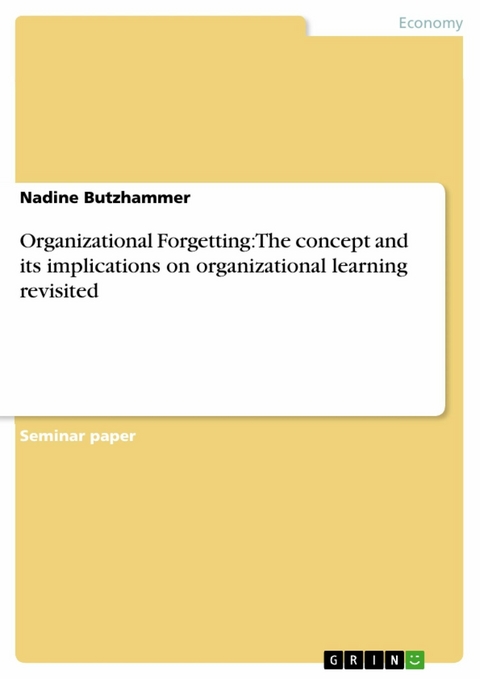
Organizational Forgetting: The concept and its implications on organizational learning revisited (eBook)
In the intricate relationship between learning and forgetting, there is a surprising synergy at play. Forgetting, often seen as the antagonist of learning, actually serves as a catalyst for it. It is a process that liberates cognitive capacities, making room for the absorption of new knowledge.
This dynamic relationship is highlighted by Blaschke and Schoeneborn (2006), who argue that a higher organizational forgetting rate results in increased knowledge levels. To illustrate this, consider a bakery that has been forming pretzels using the same method for years. When the bakery owner introduces a more efficient technique, it's essential to eliminate the old knowledge. The deeply ingrained routine becomes a barrier to learning the new method. Only by allowing the old knowledge to fade into the background can the staff adapt to the better approach. Failure to forget hinders the organization's progress.
| Erscheint lt. Verlag | 15.4.2020 |
|---|---|
| Verlagsort | München |
| Sprache | englisch |
| Themenwelt | Wirtschaft ► Betriebswirtschaft / Management ► Unternehmensführung / Management |
| Schlagworte | autopoietic systems • Constructivism • Forgetting • Framing • Organizational Learning |
| ISBN-10 | 3-346-14765-7 / 3346147657 |
| ISBN-13 | 978-3-346-14765-3 / 9783346147653 |
| Informationen gemäß Produktsicherheitsverordnung (GPSR) | |
| Haben Sie eine Frage zum Produkt? |
 PDF (Ohne DRM)
Digital Rights Management: ohne DRM
Dieses eBook enthält kein DRM oder Kopierschutz. Eine Weitergabe an Dritte ist jedoch rechtlich nicht zulässig, weil Sie beim Kauf nur die Rechte an der persönlichen Nutzung erwerben.
Dateiformat: PDF (Portable Document Format)
Mit einem festen Seitenlayout eignet sich die PDF besonders für Fachbücher mit Spalten, Tabellen und Abbildungen. Eine PDF kann auf fast allen Geräten angezeigt werden, ist aber für kleine Displays (Smartphone, eReader) nur eingeschränkt geeignet.
Systemvoraussetzungen:
PC/Mac: Mit einem PC oder Mac können Sie dieses eBook lesen. Sie benötigen dafür einen PDF-Viewer - z.B. den Adobe Reader oder Adobe Digital Editions.
eReader: Dieses eBook kann mit (fast) allen eBook-Readern gelesen werden. Mit dem amazon-Kindle ist es aber nicht kompatibel.
Smartphone/Tablet: Egal ob Apple oder Android, dieses eBook können Sie lesen. Sie benötigen dafür einen PDF-Viewer - z.B. die kostenlose Adobe Digital Editions-App.
Buying eBooks from abroad
For tax law reasons we can sell eBooks just within Germany and Switzerland. Regrettably we cannot fulfill eBook-orders from other countries.
aus dem Bereich