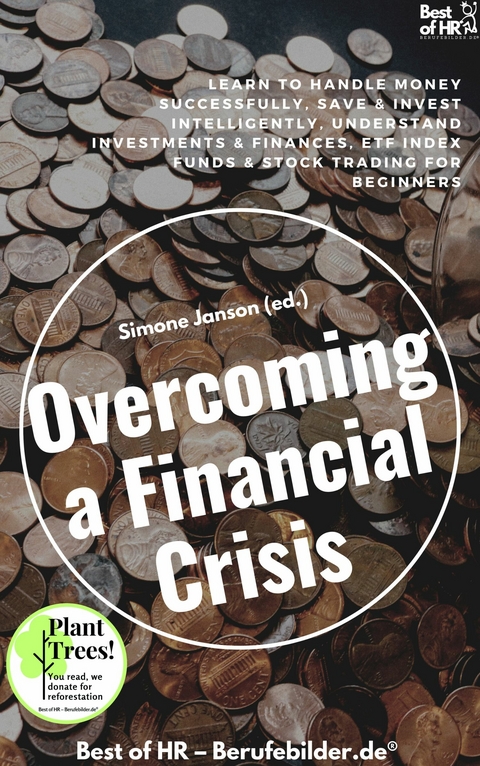
Overcoming a Financial Crisis (eBook)
C, 180 Seiten
Best of HR – Berufebilder.de® (Verlag)
978-3-96596-215-6 (ISBN)
Also in the 8th revised and improved edition, published by a government-funded publisher involved in EU programs and a partner of the Federal Ministry of Education, you receive the concentrated expertise of renowned experts (overview in the book preview), embedded in an integrated knowledge system with premium content and 75% advantage. At the same time, you do good and support sustainable projects.
Because financial crises can be very frightening: In addition to the normal everyday worries, in crisis situations there is also the worry of what will become of the saved money and whether we will be able to put money aside at all. But the good news is: On the one hand, we can save a lot of money in everyday life with the right financial planning, on the other hand, everyone should urgently deal with the topic of investments and shares, after all, savings and thus the retirement provisions that are important for pensions are only destroyed by inflation.
Knowledge that makes a difference: With its 'Information on Demand' concept, the publisher was not only involved in an EU-funded program, but also received several awards. So when you buy the book, you are also doing good: The publisher is financially and personally committed to socially relevant projects such as tree planting campaigns, scholarship foundations, sustainable living, and many other innovative ideas.
The goal of providing you with the best possible content on topics such as career, finance, management, recruiting, or psychology goes far beyond the static nature of traditional books: The interactive book not only imparts expert knowledge but also allows you to ask individual questions and receive personal advice.
In doing so, expertise and technical innovation go hand in hand, as we take the responsibility of delivering well-researched and reliable content, as well as the trust you place in us, very seriously. Therefore, all texts are written by experts in their field. Only for better accessibility of information do we rely on AI-supported research results to a limited extent to make information easier to find, which assists you in your search for knowledge.
You also gain extensive premium services: Each book includes detailed explanations and examples, making it easier for you to successfully use the consultation services, freeky available only to book buyers. Additionally, you can download e-courses, work with workbooks, or engage with an active community. This way, you gain valuable resources that enhance your knowledge, stimulate creativity, and make your personal and professional goals achievable and successes tangible.
That's why, as part of the reader community, you have the unique opportunity to make your journey to personal success even more unforgettable with travel deals of up to 75% off. Because we know that true success is not just a matter of the mind, but is primarily the result of personal impressions and experiences.
Publisher and editor Simone Janson is also a best-selling author, was a columnist for WELT and Wirtschaftswoche, and, according to ZEIT, one of Germany's most bloggers on success - find out more about her on Wikipedia.
Janson began her career as an editor for two magazines published by the German Federal Employment Agency before founding her own magazine and book publishing company, for which over 500 authors write today. In addition, she has worked for almost all major newspapers, written books and appeared several times as an expert on German TV.
3 risky forms of investment: watch out for money loss!
// By Judith Engst, Rolf Morrien
There are many scandals when it comes to investments. Therefore: You should definitely say “No” to transactions that are too risky. An overview.
Investments that you better stay away from
With your money, you are a welcome victim for all kinds of questionable advisors and intermediaries who persuade you to make an allegedly lucrative investment and earn a lot of money from commissions and fees. Since investment scandals were anything but rare in the past, you should first get an overview of those investments that are out of the question.
Because a decided “No!” In the right place sometimes saves you from high losses. Stock exchange legend Warren Buffett got to the point when asked what the most important investment rules are: »Rule No. 1: Don't lose money! Rule No. 2: Never forget rule 1! «
1. Eco investments in wind power, solar parks, geothermal projects and combined heat and power plants
"Earning money with a clear conscience" is how many providers advertise their investments. In other words: You want to put your money in wind power or solar parks - or alternatively in geothermal projects and combined heat and power plants. Why in the past, especially with »EcoInvestments«, did so many projects fail and have wasted billions in Germany alone?
On the one hand, some doers were specialists in the area of ecology, but failed in the area of economy. Not every good idea produces good returns. On the other hand, some fraudsters (unfortunately successful) have relied on investors and savers not to do the exact calculation if the motto is "Eco-investments - earning money with a clear conscience". Who wants to be considered a bean counter when it comes to a good thing? This trick switched off common sense when investing.
Four types of investments are common:
- OTC bonds: As an investor, you lend money to the operator with the purchase and receive a piece of paper (or an electronic document). This money is then - allegedly or actually - put into a wind power, solar or geothermal project. But be careful: You cannot really judge whether the promised interest will be paid on time and in full. You rely on the information provided by the provider. In contrast to exchange-traded paper, there are no publication requirements here and, moreover, mostly no ratings (i.e. no assessment by agencies that take a close look at payment power). Since there are no daily quotes on the stock exchange for over-the-counter bonds, you might notice with a long delay if the business model does not work as promised. And there is something else that speaks against any kind of over-the-counter paper (including shares and dividend-right certificates): you cannot get rid of them if you want to sell. Because as a buyer practically only the provider comes into consideration, and he will insist on the agreed term. However, it is doubtful whether it is still fluid enough to pay back the borrowed money. Often enough it turns out during the term: Unfortunately, the supposedly profitable business model Wind Power, Solar & Co. has only produced losses and therefore there is no longer enough money to repay the bonds.
- Over-the-counter participation certificates: Participation certificates are a balance between equity and debt - or you could also say: between shares and bonds. That means that as an investor, you are moving a little more into the position of an owner. However, this is particularly noticeable in the risk that you as a buyer of such participation certificates will be burdened. Because often the annual distributions depend on the profit of the company. If the profits are low, the distributions are also low, if they fail to appear completely, then the distributions will also fail. Otherwise, the same applies to this form of investment as to over-the-counter bonds. In addition, your protection as a creditor of such a provider in the event of its insolvency is even worse than the protection for bond holders. Perhaps you still remember the Prokon debacle? Exactly: It was about participation rights worth more than one billion euros, which the wind turbine financier Prokon bankrupted in 2014 with its bankruptcy. The former holders of profit participation certificates now have to wait several years until at least some of the losses are offset. The insolvency administrator repays partial amounts from sales proceeds of the former property at irregular intervals. By the way, Prokon has been »refurbished« and is now going back to investing as a cooperative.
- Closed funds or silent partnerships: With this form of investment, you become an entrepreneur, more precisely a shareholder. If the fund has enough money, no further shares are sold, hence the term "closed". However, in most cases, as a partner, you have no say in the management of the company. They should only participate in the profits. But you do bear the full entrepreneurial risk. As with over-the-counter bonds and profit participation certificates, it is not that easy to part with your company share, especially not before the end of the term. Another big minus point: The "FondsMacher" and the sales outlets collect high fees, which can well be in the double-digit percentage range of the investment amount. So only a part of your money is actually invested in the project. And then only this part can generate profits. This makes many promise of returns completely unrealistic right from the start. So here too the advice is: stay away!
- Direct purchase of solar modules, combined heat and power plants, etc.: Here you are not buying paper, but (supposedly) existing real assets. For example, a certain number of square meters of solar modules on the roof of a production hall. Or an entire cogeneration plant. You will then primarily make your profits from the sale of electricity or district heating that is produced with it. Or from leasing the systems in question to the operator, for example. But we also strongly advise against this. Such participation models have also existed in the past - often with catastrophic consequences for investors. For example, at the Nuremberg company GFE, which sold “vegetable oil cogeneration plants” to private investors with great success in 2010 - for 40 euros each. These systems should be leased for 000 euros per month. The lease should benefit investors directly. The public prosecutor intervened at the end of the year. Because the company had sold nothing but hot air. The advertised cogeneration plants did not even exist. A clear case of investment fraud: more than 1000 investors were cheated by 1400 million euros.
The problem with such offers: You cannot check any of what the providers tell you: you do not know how profitable an advertised business model really is. You do not know the risks - the indication that total losses are possible nowadays has to be given for practically every investment offer and is therefore meaningless. You do not even know the scenarios that the provider used in his forecast calculations - for example, the feed-in tariff for green electricity, which incidentally has fallen rapidly in recent years. And with “real” goods, you don't know how many of them actually exist and which ones are assigned to you. Therefore, you should avoid such investments!
2. Forest and wood
Mind you, this is not about a piece of forest inherited from grandfather. Keep it calm if you enjoy it. Because it can (at least) cover your winter firewood needs, and you may like to work outside from time to time in the great outdoors with a chainsaw and ax or wood splitter.
The situation is different with investment offers from the forestry and agricultural sectors. Whether teak investments in Brazil, tea tree plantations in Australia, sandalwood plantations in India or maple, cherry or robinia forests in Switzerland: (again) OTC bonds, silent participations or profit participation certificates are sold. Some providers also sell you the individual logs or certain areas directly.
The same concerns apply here as with the above-mentioned eco-investments: the whole thing is extremely opaque. You neither know how profitable the business model is, nor do you know the risks. Prices fluctuate extremely strongly in forestry and agriculture, and that is just one risk among many. Because pest infestation, droughts, storms or floods can quickly destroy a plantation completely. Then the money invested is gone. In addition, there are a lot of black sheep in this area of financial investments, who first collect the investors' money, accept generous commissions and then go underground when the project turns out to be unprofitable at best and fraudulent at worst. And honestly: How do you want to prove to Brazilian dishes without the help of the provider that the teak plantation bought for a lot of money really belongs to you? Don't get involved!
3. Closed and open real estate funds as well as housing associations
It sounds plausible at first: If you can't buy an entire property right away, you buy a property investment. This is made possible by the so-called closed real estate funds, open real estate funds and housing associations.
Closed real estate funds
Let us first come to the closed real estate funds. They each finance a single real estate project, for example a high-rise building with umpteen residential units or a business park. There is a good reason why these funds are described as "closed": investors can only purchase shares during the so-called subscription phase. When the money necessary for the realization has been collected, the fund is closed and no further shares...
| Erscheint lt. Verlag | 17.11.2025 |
|---|---|
| Verlagsort | Düsseldorf |
| Sprache | englisch |
| Themenwelt | Sachbuch/Ratgeber ► Beruf / Finanzen / Recht / Wirtschaft ► Geld / Bank / Börse |
| Wirtschaft ► Betriebswirtschaft / Management ► Unternehmensführung / Management | |
| Wirtschaft ► Volkswirtschaftslehre | |
| Schlagworte | Asset accumulation • Bank • Banks • Become a millionaire • Bond • Bonds • building savings • Building society contract • business • Business Management • Capital • Capital investment • Company • Corporate • credit • Currency strategy • Economic crisis • Entrepreneurs • Equity • Finance • Financial consultant • financial consulting • Financial Education • Financial investment • Financial Market • Financial Planning • Financial Sector • Financial Service Provider • Financing • Funds • getting rich • Gold Price • government bonds • Investing • Investment • Investment funds • Investor • Make more of your money • Manager • market participants • open real estate funds • percent • Personnel Management • Portfolio • Product • Products • Profit • Real Estate • Sales • saving • Securities • Share prices • Stock exchange • Stock market crash • Stock strategy • Success • yield |
| ISBN-10 | 3-96596-215-9 / 3965962159 |
| ISBN-13 | 978-3-96596-215-6 / 9783965962156 |
| Informationen gemäß Produktsicherheitsverordnung (GPSR) | |
| Haben Sie eine Frage zum Produkt? |
 EPUB (Ohne DRM)
Größe: 256 KB
Digital Rights Management: ohne DRM
Dieses eBook enthält kein DRM oder Kopierschutz. Eine Weitergabe an Dritte ist jedoch rechtlich nicht zulässig, weil Sie beim Kauf nur die Rechte an der persönlichen Nutzung erwerben.
Dateiformat: EPUB (Electronic Publication)
EPUB ist ein offener Standard für eBooks und eignet sich besonders zur Darstellung von Belletristik und Sachbüchern. Der Fließtext wird dynamisch an die Display- und Schriftgröße angepasst. Auch für mobile Lesegeräte ist EPUB daher gut geeignet.
Systemvoraussetzungen:
PC/Mac: Mit einem PC oder Mac können Sie dieses eBook lesen. Sie benötigen dafür die kostenlose Software Adobe Digital Editions.
eReader: Dieses eBook kann mit (fast) allen eBook-Readern gelesen werden. Mit dem amazon-Kindle ist es aber nicht kompatibel.
Smartphone/Tablet: Egal ob Apple oder Android, dieses eBook können Sie lesen. Sie benötigen dafür eine kostenlose App.
Geräteliste und zusätzliche Hinweise
Buying eBooks from abroad
For tax law reasons we can sell eBooks just within Germany and Switzerland. Regrettably we cannot fulfill eBook-orders from other countries.
aus dem Bereich