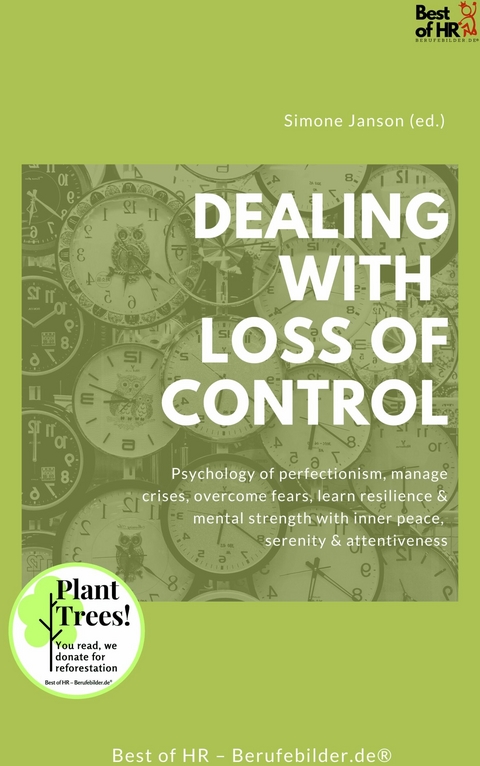
Dealing with Loss of Control (eBook)
C, 180 Seiten
Best of HR – Berufebilder.de® (Verlag)
978-3-96596-207-1 (ISBN)
Also in the 8th revised and improved edition, published by a government-funded publisher involved in EU programs and a partner of the Federal Ministry of Education, you receive the concentrated expertise of renowned experts (overview in the book preview), embedded in an integrated knowledge system with premium content and 75% advantage. At the same time, you do good and support sustainable projects.
Because the credo of our society is to have your life under control and to be able to control your own success. Especially in social media the image of a perfect world is often presented. In this world the loss of control is the ultimate narcissistic insult. And yet this is exactly what happens every day in both major and minor crises. It is then crucial to have enough resilience and flexibility to deal with such a new situation quickly and correctly. This applies to personal changes as well as to global crises. How do you evaluate such situations as objectively and without fear? And how can one learn from these situations, what can be done better for the future?
Knowledge that makes a difference: With its 'Information on Demand' concept, the publisher was not only involved in an EU-funded program, but also received several awards. So when you buy the book, you are also doing good: The publisher is financially and personally committed to socially relevant projects such as tree planting campaigns, scholarship foundations, sustainable living, and many other innovative ideas.
The goal of providing you with the best possible content on topics such as career, finance, management, recruiting, or psychology goes far beyond the static nature of traditional books: The interactive book not only imparts expert knowledge but also allows you to ask individual questions and receive personal advice.
In doing so, expertise and technical innovation go hand in hand, as we take the responsibility of delivering well-researched and reliable content, as well as the trust you place in us, very seriously. Therefore, all texts are written by experts in their field. Only for better accessibility of information do we rely on AI-supported research results to a limited extent to make information easier to find, which assists you in your search for knowledge.
You also gain extensive premium services: Each book includes detailed explanations and examples, making it easier for you to successfully use the consultation services, freeky available only to book buyers. Additionally, you can download e-courses, work with workbooks, or engage with an active community. This way, you gain valuable resources that enhance your knowledge, stimulate creativity, and make your personal and professional goals achievable and successes tangible.
That's why, as part of the reader community, you have the unique opportunity to make your journey to personal success even more unforgettable with travel deals of up to 75% off. Because we know that true success is not just a matter of the mind, but is primarily the result of personal impressions and experiences.
Publisher and editor Simone Janson is also a best-selling author, was a columnist for WELT and Wirtschaftswoche, and, according to ZEIT, one of Germany's most bloggers on success - find out more about her on Wikipedia.
Janson began her career as an editor for two magazines published by the German Federal Employment Agency before founding her own magazine and book publishing company, for which over 500 authors write today. In addition, she has worked for almost all major newspapers, written books and appeared several times as an expert on German TV.
Learning to deal with criticism: For better error culture in companies
// By Simone Janson
How do we deal with mistakes and criticism? What happens if we catch ourselves in the event of a mistake or are caught by colleagues or, even worse, the boss? All this allows conclusions about the culture of mistakes in companies and our society. Practical tips in dealing with criticism.
To err is human
To err is human ... This word is easy to say, because who likes to admit that he made a mistake? Nobody really. And yet, big and small mistakes happen to each of us every day.
Maybe you already have a confidential one eMail sent to the wrong person or presented poorly researched information at a meeting? And haven't you occasionally misunderstood a colleague's statements and reacted inappropriately?
Reaction is everything
Errors and misjudgments are the order of the day for people; Psychologists estimate that every person makes two to five mistakes every hour.
Reasons for this are, for example, overload, use of wrong material or a product that has not been tested sufficiently. This is Murphy's law: what can go wrong also goes wrong. Or to put it casually: Shit happens.
Fruitless avoidance strategies
It follows: Even if you spend all your time perfectionistly to exclude every conceivable mistake from the outset - you will never succeed. You will make smaller and smaller mistakes. The only decisive factor for your professional progress is whether you are ready to accept criticism and learn from your mistakes. Or whether you'd rather complain about your mistakes and hate yourself for it. The decision is yours.
How we deal with mistakes always depends on the way we are criticized: If your colleague or boss becomes insolent or generalizes individual mistakes, for example by saying: "You stupid cow, you always do everything wrong!" You reject the factuality: “I know that I made a mistake. Still, you don't have to insult me. ” Please do not react abusive or offended: This does not shed light on your willingness to deal constructively with errors. However, if you criticize your faux pas in detail and make constructive suggestions for improvement, you probably only want to help. So stay friendly: “Thank you for trying so hard. I will implement it accordingly. ” If you disagree, you can justify this factually: “Thank you for your criticism. I see it differently for the following reasons ... ”
Don't make life unnecessarily difficult
Perfectionists often make life unnecessarily difficult when dealing with absenteeism. Like Paul. He is a freelance software programmer. Unfortunately, he has had some private problems lately. And so it happens that during the final test of a new software, totally tired, he misses some errors.
The customer for whom this software was specially designed has a system crash due to the errors; However, since he has always been satisfied with Paul's work, he shows goodwill: Paul can correct the mistakes within a week. For Paul, however, the event is a shock - how could that have happened? Under no circumstances should this happen to him again. The software must be absolutely flawless by the date. Next time he wants to avoid every mistake.
Impossible work orders: how to deal with them
If you get a job that you think will lead to mistakes, because, for example, it will be impossible to do the work in the allotted time: Point this out in good time diplomatically and with factual arguments!
Ask your supervisor what they think so they don't react angrily. And show that there can be a better solution: “My experience shows me that if we do it as planned, we have to fear certain consequences. I would therefore suggest another way. What do you think?"
Homemade print
Paul not only wants to deliver the software in the coming week, but also install it himself to show that it works absolutely flawlessly. In addition to revising the program, he therefore researches some important facts and creates a manual for operating his program. He really wants to make a good impression and works day and night for it.
Unfortunately, the software does not run correctly. Paul is under a lot of pressure, making some crucial mistakes and paralyzing the customer's entire computer system. He had not factored in some peculiarities in the foreign system. Nobody is interested in his carefully prepared manual - the customer withdraws the order from Paul. Paul's perfectionist avoidance strategy has led to failure.
The absolute worst case scenario
But why all the stress? For many perfectionists, a mistake is a personal worst-case scenario: it shows them that they are far from being as perfect as they thought and deeply unsettles them in their need to keep things under control. In addition, many perfectionists tend to adopt an all-or-nothing attitude that leads them to turn a small mistake into a disaster.
For many perfectionists it is also worth striving to be absolutely flawless, because for them a single small mistake means that they are doing their job completely badly. "I always do everything wrong," they then complain, feeling sorry for themselves. In order not to get into this situation at all, they want to avoid mistakes at all costs, for example by preparing themselves meticulously for a situation, to be prepared for any eventuality.
You can't anticipate mistakes
Of course, it is important to be as careful as possible so that mistakes do not happen. But nobody can anticipate what will happen in a particular situation: If you prepare a presentation, for example, you cannot know the questions of your audience beforehand, but also have to improvise during the lecture.
Nevertheless, many perfectionists with the desire not to make a mistake put themselves under pressure and often overshoot the target - like Paul. The more you try to do something absolutely right, the more stress you build up and therefore cannot react properly at the crucial moment. Because stress has a negative impact on clear thinking and concentration - you will find out exactly how this happens. This mechanism creates errors. You probably also know some situations from your own day-to-day work in which you wanted to do everything as well as possible. And then something went wrong - precisely because you were too stressed at the crucial moment!
Are you a complete failure?
Paul now considers himself a complete failure and decides to give up self-employment and to look for a quiet office job without any responsibility. But even if his behavior could appear as if he would see his mistakes and draw the consequences - the opposite is the case:
He is overreacting. By generalizing his mistake, Paul makes himself immune to criticism; if he is a failure anyway, it is absolutely impossible to improve something and he doesn’t even have to make an effort to do better with a new job. So instead of analyzing exactly what went wrong and what might change next time, he gives up. With this mixture of black-and-white thinking, catastrophism and convenience, he blocks the possibility of using the insights he has gained for the future.
Admitting mistakes in such an exaggerated way by accusing yourself of total failure has only a limited positive effect on others. Sometimes the “tear gland number” pulls. However, it is not enough if you complain about your mistake in a plastic and epic breadth, you also have to show that you are overworked, but despite all adversities, you are willing to do superhuman things. Many a boss then feels like a slave driver and exploiter and will forgive you out of bad conscience and pity. However, other bosses will stamp you with such behavior as an unlikely weakling - especially if it happens more often and you complain loudly every time, but always accuse yourself of the same mistakes. Then show that you haven't learned anything. Better: handle errors constructively!
Constructive instead of destructive
For these reasons, avoiding mistakes at all costs is not the best strategy. It makes more sense to deal with mistakes constructively and to learn from them for the future. "If it were that easy ..." you might moan. Right! It is not easy because you first have to be aware of your mistakes and analyze exactly what went wrong. Depending on how serious the error weighs and what the consequences are, this process can be difficult and painful. Because you will ask yourself again and again what could have been done better and whether a different situation would have resulted from a different decision.
But these thoughts are by no means unnecessary or even a waste of time. Because if you think about what could have gone differently, you will get new ideas for solving a problem or recognize what you should look for in the next decision to avoid this error. But be careful: don't sink into deep brooding! It is much more important that after an in-depth analysis you also put your findings into practice.
Your inner attitude
How you deal with difficulties also depends on your inner attitude. This is especially true if you make mistakes in your work. Because now you have two options: you can almost get angry about your mistakes or you can try to see your mistakes positively and learn from them what you can do better next time.
And even if, with a certain tendency towards catastrophic thinking, you might initially assume that a mistake is the worst thing that can ever happen to you, you can always gain something positive from mistakes. Because what are mistakes other than experiences and what are experiences other than the sum of the stupidities that are used again when necessary - to keep up with the cabaret artist Dieter Hildebrandt?
Dealing...
| Erscheint lt. Verlag | 17.11.2025 |
|---|---|
| Verlagsort | Düsseldorf |
| Sprache | englisch |
| Themenwelt | Wirtschaft ► Betriebswirtschaft / Management ► Unternehmensführung / Management |
| Wirtschaft ► Volkswirtschaftslehre | |
| Schlagworte | Activity • applicant • Bank • becoming a millionaire • becoming rich • business • Career • career ladder • Career Planning • colleague • Communicating • Communication • Company • competence • Corporate Culture • costs • Decision • Decision-making scope • difficult situations • Employee Leadership • employees • employer • Entrepreneur • Entrepreneurial • Everyday work • Executive • executives • Factor • Idea Generation • Idea Management • Ideas • Innovation • Innovative Power • Leadership • Management • Management Techniques • Manager • managing director • Minimalism • Motivation • Not wasting time • organization • Perfectionism • Performance • prioritising • Product • Project • Project Management • self-efficacy • self-management • Selfmotivation • Service • setting priorities • Simplify your life • Small Business • strategic • Strategy • Success • Success factor • Successful • Task • time thieves • time traps • winning • Work |
| ISBN-10 | 3-96596-207-8 / 3965962078 |
| ISBN-13 | 978-3-96596-207-1 / 9783965962071 |
| Informationen gemäß Produktsicherheitsverordnung (GPSR) | |
| Haben Sie eine Frage zum Produkt? |
 EPUB (Ohne DRM)
Größe: 203 KB
Digital Rights Management: ohne DRM
Dieses eBook enthält kein DRM oder Kopierschutz. Eine Weitergabe an Dritte ist jedoch rechtlich nicht zulässig, weil Sie beim Kauf nur die Rechte an der persönlichen Nutzung erwerben.
Dateiformat: EPUB (Electronic Publication)
EPUB ist ein offener Standard für eBooks und eignet sich besonders zur Darstellung von Belletristik und Sachbüchern. Der Fließtext wird dynamisch an die Display- und Schriftgröße angepasst. Auch für mobile Lesegeräte ist EPUB daher gut geeignet.
Systemvoraussetzungen:
PC/Mac: Mit einem PC oder Mac können Sie dieses eBook lesen. Sie benötigen dafür die kostenlose Software Adobe Digital Editions.
eReader: Dieses eBook kann mit (fast) allen eBook-Readern gelesen werden. Mit dem amazon-Kindle ist es aber nicht kompatibel.
Smartphone/Tablet: Egal ob Apple oder Android, dieses eBook können Sie lesen. Sie benötigen dafür eine kostenlose App.
Geräteliste und zusätzliche Hinweise
Buying eBooks from abroad
For tax law reasons we can sell eBooks just within Germany and Switzerland. Regrettably we cannot fulfill eBook-orders from other countries.
aus dem Bereich