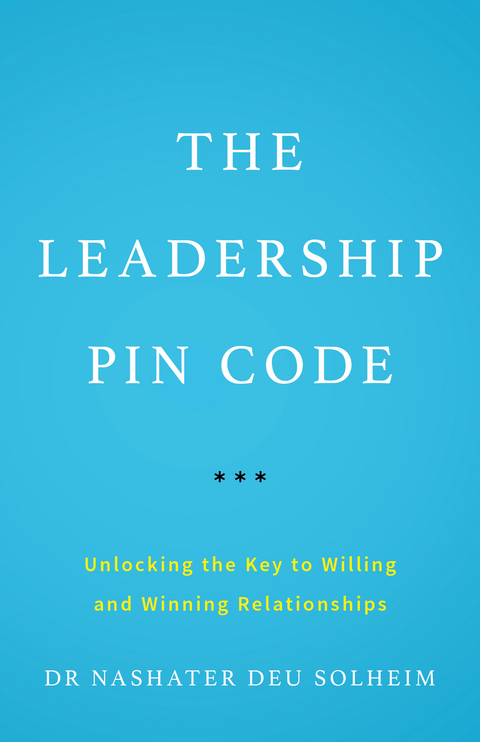
Leadership PIN Code (eBook)
200 Seiten
Lioncrest Publishing (Verlag)
978-1-5445-0717-0 (ISBN)
As a seasoned business leader, do you wonder why you sometimes get the traction you want with people, while other times it feels like you're spinning your wheels? It's not luck. You must be able to persuade and influence those you lead to get results in a positive way. Finding the win-win in every interaction is critical to achieving this, as your team and stakeholders must willingly go in the direction you're asking them to go. It's the integration of these skills-persuasion, influence, and negotiation-that allows leaders to gain traction and develop high-performing, fully engaged teams. In The Leadership PIN Code, Dr Nashater Deu Solheim shares a unique and proven framework for creating the impact and influence you need in your daily work. You'll learn how to use three simple keys to get what you need from every interaction-while also maintaining positive relationships. If you want to be a leader who inspires trust, easily navigates conflict, and creates value every day, The Leadership PIN Code is for you.
Chapter 1
1. The Dysfunctional Beliefs of Leaders
‘I’m leaving.’
Pierre said those words to Bill, his leader, over the phone one day after several failed attempts to schedule an appointment with him. Bill’s first response was, ‘OK, well, I need to make some plans.’ Pierre explained he’d been headhunted by a new company. Bill said, ‘I’m shocked. I wasn’t expecting it.’ Silently Pierre wondered how Bill could be shocked since he’d never taken the time to get to know Pierre and probably had no idea what motivated him. It wasn’t just with Pierre. Bill had a reputation for his cold and detached leadership style—when he was told by department members about personal matters that might impact work, he was awkward, uncomfortable and dismissive. They simply stopped sharing.
Throughout the time they’d worked together, it wasn’t just that Bill was impossible to reach, but that whenever he was physically in the room, he wasn’t really present. He would enter into a room unprepared or unfocused, repeat conversations they’d already had, and ask questions that had already been answered, clearly not recalling that they’d moved on from them. Bill sometimes remained texting on the phone whilst meeting with team members—and on an unforgettable occasion he even kept his feet on the table, soles pointing towards Pierre whilst he stood in Bill’s office and began conducting a spontaneous performance review of a project. A colleague later shared the reflection that Bill clearly felt at ease with Pierre—Pierre, on the other hand, reflected it felt like disrespect.
Bill probably believed he was a good leader. He ended the conversation with Pierre by saying that he was unhappy with Pierre’s decision and that he did value him even though he might not have shown it. Pierre said he’d been given a great opportunity that he couldn’t refuse. Because that’s what they tell you to say, to not burn bridges. If Bill would have been open to constructive feedback on his style, Pierre might have shared it, asked for an exit interview or confided in a senior, but he knew, however, it was pointless. Bill was entitled.
People Don’t Leave Jobs, They Leave Leaders
Leaders cannot simply expect respectful regard based on their position or title. Everything they say and do happens under the microscope of employees and stakeholders, who may be quick to point out flaws and inconsistencies. Words and actions have more weight and authority than the title, so the challenge is in being more careful, adaptive and filtered whilst still having integrity and authenticity.
Leadership literature is full of strong rhetoric stating that people don’t leave their jobs, rather they leave their leaders and the toxic cultures these difficult leaders create. When good people leave without warning, leaders must ask themselves, ‘Did I not know? What could I have done differently? What difference would it have made if I’d known earlier? Where are my blind spots?’
When leaders are surprised by their employees’ aspirations, it’s simply a sign they don’t know them—and they’re not really doing their job as a leader. Take, for instance, the standard departure letter, which is, ‘Dear Leader, I’ve been given an amazing opportunity I can’t possibly ignore. I’ve had a great time at this job.’ Consider what the letter doesn’t say. The smart albeit unhappy employee will have given at least some thought to the content and rather than write, ‘You’ve been a great leader, and I can’t imagine ever finding somebody like you again,’ to a poor leader, they leave blank silences in relation to the leader’s skills or their relationship together. The message is in the absence, not the presence of words.
In the case with Bill, there was a clear gap between intention and impact. His shock and dismay at Pierre’s news show that he didn’t feel his intentions had been well understood. His style of leadership was to let team members get on with their jobs and not get in the way, which at one level is what is needed, particularly at senior leadership levels. But he only had half the equation. Leadership is not about being absent until required. It’s about being present and directive and ‘seeing’ your employees. When employees say they wish the leader was more visible, what they are really saying is that they want to be valued, heard, recognised and understood. Being physically present in itself is of little consequence.
All leaders fall somewhere on the continuum between the fully engaged or fully entitled leader. Where the needle falls on the continuum reveals the beliefs you hold about yourself as a leader. By becoming aware of your beliefs, and confronting and managing them, you’re able to move along the continuum towards engaged leader. PIN and ABC enable you to move the needle, but first, you have to understand your starting point.
Eight Common Dysfunctional Beliefs of Leaders
Leaders don’t get the engagement they want or need often as a result of their own beliefs they have about themselves as a leader. We all have blind spots that keep us from being our best selves.
Far too many leaders believe they’re doing everything right. They are most often mistakenly confident about their leadership skills, their power and how they are perceived by their teams. A dysfunctional belief is a firmly held belief (that in an extreme form is a delusion) and is usually resistant to change—that belief often creates a mindset that in turn, creates the blind spot. Many people have firmly fixed beliefs about their leadership and are resistant to getting into a learning mode or modifying their beliefs. At the extreme end of the spectrum, they will counter feedback and advice on their difficult leadership style with aggressive defensiveness or point out the proposer’s faults in an attempt to shift the blame and pain.
As you read the various types of dysfunctional beliefs held by some leaders, I ask you not only to nod your head when you recognise these in a leader you’ve had or your own colleagues but also honestly acknowledge the twinge of recognition in your own leadership beliefs. Use the descriptions below to first benchmark where you are on the leadership continuum. No one is a perfect leader and self-awareness is the first step to changing the way you lead.
1. ‘I’ve studied leadership, so I’m a good leader.’
Some leaders believe that having read a book or two, gone through a leadership program, or attended countless conferences or seminars automatically makes them an effective leader. As one senior leader proudly shared with her team, ‘I’ve been on the best Leadership Program with Professor X.’ Sadly, that association had not translated into effective leadership as she suffocated her organisation with stifling micromanagement to become more like her. And yet, just because they can talk about what effective leadership is or cite a few known authors, doesn’t mean they know how to lead. However much they have ‘done’ doesn’t mean they’ve trained and put into action the ‘learned’ strategies or behaviours. Knowledge in and of itself does not make an effective leader.
This principle is true for all of us. Think about trying to change your eating habits. You may have read a lot about healthy eating, you know what’s good for you, you may have followed a program or even hired a nutritionist, but have you actually transferred what you know into what you do, or the habits you’ve formed? Have you restocked your cupboards with different food? Have you stopped buying snacks that you know aren’t healthy? When you go to a restaurant, do you resist ordering food that you normally would and make a healthier choice?
As psychologists are quick to point out—and employees with poor leaders will point out, too—having good insight isn’t enough to make a behaviour change. Talking the talk about leadership doesn’t translate to being consciously motivated to walk the walk in their actual leadership, nor address your style and impact.
Engaged leaders will be concerned to apply and test their new learning and seek feedback along the way from objective sources to ensure they are on track or seek advice or coaching if they feel stuck.
Dig Deeper: The Impact of Micromanagement
An organisation that gets used to micromanagement or relentless criticism is easily recognised through employees who show learned helplessness. This notion refers to the idea that if you’re taught to be dependant on others—in this case being told how to solve things, or how to do your job the leader’s way or no way—you learn to become helpless, i.e., learning to rely on others to solve your issues. Quite the opposite of empowerment and people development.
We see people who accept and passively remain in negative situations all the time. Think of a person who remains with an abusive partner, or the employee who tolerates being undervalued despite having the skills necessary for a promotion. The principle of behavioural theory at play here is often learned helplessness.
Based on his studies of learned helplessness,1 Martin Seligman argued that the passivity or unwillingness to act is often accompanied by feelings of chronic failure, sadness and low self-esteem, claiming those feelings are...
| Erscheint lt. Verlag | 3.3.2020 |
|---|---|
| Sprache | englisch |
| Themenwelt | Wirtschaft ► Betriebswirtschaft / Management ► Unternehmensführung / Management |
| ISBN-10 | 1-5445-0717-8 / 1544507178 |
| ISBN-13 | 978-1-5445-0717-0 / 9781544507170 |
| Informationen gemäß Produktsicherheitsverordnung (GPSR) | |
| Haben Sie eine Frage zum Produkt? |
 EPUB (Ohne DRM)
Größe: 1,9 MB
Digital Rights Management: ohne DRM
Dieses eBook enthält kein DRM oder Kopierschutz. Eine Weitergabe an Dritte ist jedoch rechtlich nicht zulässig, weil Sie beim Kauf nur die Rechte an der persönlichen Nutzung erwerben.
Dateiformat: EPUB (Electronic Publication)
EPUB ist ein offener Standard für eBooks und eignet sich besonders zur Darstellung von Belletristik und Sachbüchern. Der Fließtext wird dynamisch an die Display- und Schriftgröße angepasst. Auch für mobile Lesegeräte ist EPUB daher gut geeignet.
Systemvoraussetzungen:
PC/Mac: Mit einem PC oder Mac können Sie dieses eBook lesen. Sie benötigen dafür die kostenlose Software Adobe Digital Editions.
eReader: Dieses eBook kann mit (fast) allen eBook-Readern gelesen werden. Mit dem amazon-Kindle ist es aber nicht kompatibel.
Smartphone/Tablet: Egal ob Apple oder Android, dieses eBook können Sie lesen. Sie benötigen dafür eine kostenlose App.
Geräteliste und zusätzliche Hinweise
Buying eBooks from abroad
For tax law reasons we can sell eBooks just within Germany and Switzerland. Regrettably we cannot fulfill eBook-orders from other countries.
aus dem Bereich